
What Markets Listen for in a Central Bank Meeting
Markets react less to the rate decision than to the surprise, the projections and the press conference. What to watch in a central bank meeting and why.
At a central bank meeting, markets react less to the expected rate decision than to anything that changes the expected path: a surprise move, new projections or the tone of the press conference. When the Fed cut by half a point in September 2024, gold hit a record, then eased as the chair signaled no rush to cut further.
What gets watched
The decision versus expectations. Futures markets price the likely move in advance; only the surprise moves prices.
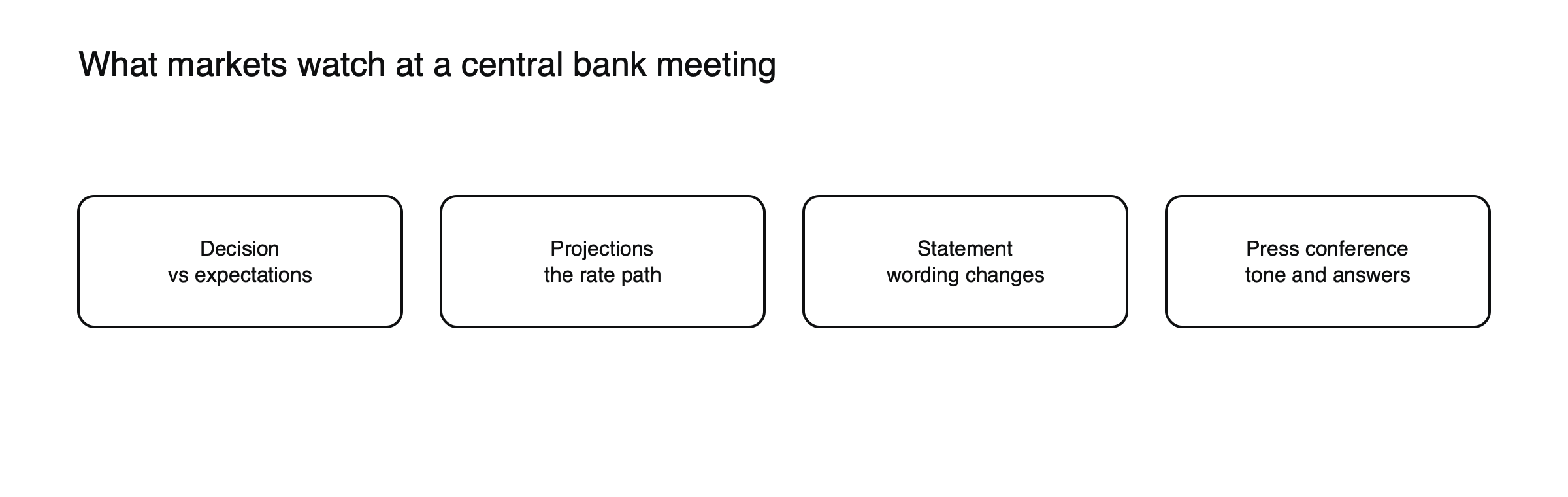
Figure: The decision is usually priced in; the other three often move markets more.
Projections. The Fed publishes officials’ rate projections, the “dot plot,” four times a year. A shift in the expected path can matter more than the day’s move.
The statement. Small wording changes signal what officials worry about.
The press conference. The chair’s answers often set the market’s direction for the following hours.
Pricing before the meeting, illustrated
Suppose futures markets price an 80% chance of a quarter-point cut. (Illustrative scenario.) If the central bank cuts by a quarter point, prices may barely move, because the outcome was expected. If it holds rates, short-term yields jump, the currency strengthens and shares fall. If it cuts by half a point, the reverse happens. The reaction depends on the gap between the decision and what was priced, which is why traders check market expectations before every meeting.
How different markets react
- Bonds: short-term yields move most with rate expectations.
- Currencies: a more hawkish tone than expected usually lifts the currency.
- Stocks and crypto: react to the implied path for rates and growth. See why crypto has started reacting to US economic data.
- Gold: sensitive to real yields and the dollar.
Memorable meetings
Some meetings have shaped markets for years. In 2013, the Fed chair’s comments about slowing bond purchases sparked the taper tantrum, lifting the 10-year Treasury yield from about 2% to about 3% within months. In January 2015, the Swiss National Bank unexpectedly removed its cap on the franc, causing one of the largest currency moves in modern history. On July 31, 2024, the Bank of Japan raised rates to 0.25% and signaled less bond buying, contributing to the yen surge and global sell-off days later. See what the 2013 taper tantrum was.
Why first reactions reverse
Markets often move one way on the statement and another during the press conference. Waiting for the full message reduces the risk of reacting to half the story.
For what policy shifts mean, see what happens to currencies when a central bank pivots and how stocks have behaved in past rate-cutting cycles.
Beyond the Fed
The European Central Bank, Bank of England, Bank of Japan and other central banks hold their own meetings, each with its own format. The ECB holds press conferences after every decision, the Bank of England publishes its vote split, showing how many members wanted a different outcome, and the Bank of Japan’s decisions can move the yen and global bond markets sharply. Currency traders watch the relative stance of central banks, because differences in expected rates drive exchange rates. See ECB vs Fed.
Minutes and speeches
Markets also react to the minutes of meetings, released weeks later, and to speeches by officials between meetings. Minutes can reveal how divided policymakers were; speeches can signal shifts before the next decision. Traders often watch the central bank’s calendar of speakers as closely as the meeting dates.
Trading around meetings
Spreads can widen and prices can gap around decisions, especially in currencies and index CFDs. Many traders reduce position size beforehand, avoid placing stops too close to current prices and wait for the press conference before acting. Leverage magnifies the risk of a sharp, two-way move. See how to read an economic calendar.
The dot plot, illustrated
Suppose the Fed holds rates steady, as expected, but its officials’ projections now show two cuts next year instead of three. (Illustrative scenario.) Markets that had priced three cuts adjust: the 2-year Treasury yield rises, the dollar strengthens and growth shares dip, even though the day’s decision was exactly as expected. The projections changed the expected path, and the path is what markets price. See stocks, bonds and commodities across the rate cycle.
Forward guidance
Central banks often signal their likely future moves, a practice known as forward guidance. Phrases committing to keep rates high for some time, or hinting that cuts may come soon, can move markets as much as decisions. Changes in guidance between meetings, through speeches or interviews, are watched closely for this reason.
Hawkish and dovish
A hawkish message leans toward higher rates or a longer period of tight policy to fight inflation; a dovish message leans toward cuts to support growth. Markets judge tone relative to expectations: a central bank can raise rates and still sound dovish if it signals the end of hikes.
Common misreadings
- Reacting to the decision without checking what was priced.
- Trading the statement before the press conference.
A meeting-day checklist
- What do futures markets price for the decision?
- Are new projections due?
- What changed in the statement wording?
- How did the chair answer questions about future moves?
The 2022 hiking pace
In 2022, the Federal Reserve raised rates from near zero to above 4% within a year, including several three-quarter-point increases, its largest moves in decades. Each meeting became a major market event, with traders debating whether the next move would be a half or three-quarter point. The rapid pace contributed to falls in both shares and bonds that year. See what 2022 taught investors about diversification.
Emergency meetings
Central banks occasionally act between scheduled meetings when markets are in crisis. In March 2020, the Fed cut rates in emergency moves as the pandemic hit markets. Unscheduled moves are rare and usually signal serious stress, so they can trigger large market reactions in both directions.
The communication toolkit
Central banks use several channels: the decision statement, the press conference, economic projections, meeting minutes, monetary policy reports and speeches. Each can shift expectations. Because markets react so strongly to surprises, most central banks try to prepare investors gradually, signaling changes well in advance so that decisions themselves rarely shock.
Currencies on meeting day, illustrated
Suppose EUR/USD trades at 1.1000 before a Fed decision. (Illustrative scenario.) If the Fed signals fewer cuts than expected, US yields rise relative to European yields and the pair may fall to 1.0920 within an hour, a move of about 0.7%. If the Fed sounds more dovish than expected, the pair may rise by a similar amount. Traders with leveraged positions can see large gains or losses in minutes. See what moves EUR/USD.
When central banks diverge
When one central bank is cutting while another is holding or hiking, the gap in expected interest rates tends to drive their currency pair. Markets watch the relative path of policy, not just each meeting in isolation.
Meetings and crypto
Crypto trades through central bank meetings without pause, and its reaction to the press conference can be large, especially when leverage is high. In 2022, bitcoin often swung sharply during Fed press conferences as the chair’s comments shifted rate expectations. Crypto traders now watch meeting dates as closely as traders in currencies or bonds. See what moves bitcoin’s price.
After the meeting
The full market response can take days to settle, as investors digest the message, analysts publish interpretations and officials give follow-up speeches. A sharp first reaction is not always the final one, which is why some traders prefer to act only after the dust has fully settled and trading spreads have normalized.
Frequently asked questions
Why do markets sometimes rise on a hawkish decision?
If the decision was less hawkish than feared, or if the guidance points to cuts later, markets can rally despite higher rates.
How often does the Fed meet?
Eight times a year, with projections published at four of those meetings.
This article is educational content and does not constitute financial, investment, legal or tax advice. Digital assets are volatile and you may lose the amount you invest.
Sources
- Gold rises to record after Fed makes first rate cut since 2020 (half-point cut; pullback after Powell signaled no rush) — BNN Bloomberg, September 2024
- Big macro week: FOMC minutes, PPI and CPI (bitcoin’s reaction to FOMC press conferences) — K33 Research, October 2022
- No taper tantrum this time? (10-year yield from about 2% in May 2013 to about 3% in December) — FRED Blog, St. Louis Fed
- What is the yen carry trade? (BoJ raised rates to 0.25% and announced less bond buying) — GKToday