
Why Bitcoin’s Four-Year Cycle Is So Debated
Bitcoin halvings occur about every four years, but the price-cycle story is disputed. The sample is small and macro, liquidity and demand also matter.
Bitcoin’s four-year cycle is debated because one real mechanism and one much broader market story are often treated as the same thing. The protocol cuts the block subsidy every 210,000 blocks, roughly every four years. The claim that Bitcoin prices must follow a repeatable four-year boom-and-bust cycle is much harder to prove.
The four-year part comes from Bitcoin’s issuance schedule
Bitcoin miners receive newly created bitcoin as part of the block reward.
The protocol began with a 50 BTC block subsidy. The subsidy is cut in half every 210,000 blocks, which works out to roughly four years at Bitcoin’s target block interval.
The historical halvings reduced the subsidy:
| Halving | Approximate date | Subsidy after halving |
|---|---|---|
| First | November 2012 | 25 BTC |
| Second | July 2016 | 12.5 BTC |
| Third | May 2020 | 6.25 BTC |
| Fourth | April 2024 | 3.125 BTC |
The mechanism is not a market superstition. It is part of Bitcoin’s consensus rules.
What is disputed is how much that predictable supply change explains the price behavior that follows.
The supply argument is intuitive
A halving reduces the number of new bitcoin miners can create per block.
If demand stays constant while the flow of new supply falls, the price could face upward pressure. That is the basic scarcity argument behind the four-year-cycle narrative.
But “new issuance falls” is not the same as “available supply is cut in half.”
Existing holders can sell. Miners can change how much inventory they retain. Exchange balances can move. Derivatives can create large synthetic exposures. ETFs and institutional vehicles can alter demand. Long-term holders can suddenly become active.
The halving changes one flow in a much larger market.
The sample size is tiny
As of October 2026, Bitcoin has experienced only four halvings.
That is a painfully small sample for declaring a stable market law.
Worse, each halving happened in a different macro environment.
The 2012 event occurred when Bitcoin was still a small niche market. The 2016 cycle unfolded before the large institutional market structure that exists today. The 2020 halving arrived during extraordinary pandemic-era monetary and fiscal policy. The 2024 event occurred after spot Bitcoin ETFs had changed US market access.
If price rises after each episode, separating the halving effect from everything else is difficult.
Four observations do not give researchers the luxury of holding the rest of the world constant.
Research does not show one clean price response
A 2024 Finance Research Letters paper studying the 2012, 2016 and 2020 halvings found evidence that complicates the popular story.
The authors describe two competing effects:
- a supply effect, where lower issuance could support price; and
- a security effect, where lower miner revenue can pressure mining economics and network activity.
Their empirical results found slightly negative short-run price reactions around the studied halvings, along with lower miner revenue and changes in fees and volatility.
That does not prove halvings are bearish. It shows why a simple “halving happens, price rises” claim is too strong.
A separate 2026 study found that expectations around halving events can affect financial-market behavior and that the effects vary across regimes. Again, the evidence looks conditional rather than mechanical.
The cycle can become partly self-referential
Once enough market participants believe in a four-year pattern, the belief itself can influence behavior.
Investors may accumulate before a halving because they expect others to do the same. Miners may hedge future revenue. Analysts may publish cycle models. Funds may time launches or marketing around the event.
That creates an expectations loop.
A price move caused partly by anticipation can later be cited as evidence that the original cycle is structurally inevitable.
Markets do this often. A calendar event starts with an economic mechanism and gradually attracts positioning that magnifies the event.
Global liquidity can look like a Bitcoin cycle
Bitcoin has historically been sensitive to broad financial conditions.
Low real yields, abundant liquidity and strong risk appetite can support speculative and long-duration assets. Tightening conditions can do the opposite.
That creates a serious identification problem.
The 2020–2021 Bitcoin rally followed a halving, but it also occurred during extraordinary global liquidity, fiscal transfers, strong retail participation and a broad boom in technology and speculative assets.
The 2022 decline followed the maturation of that halving cycle, but it also coincided with aggressive monetary tightening and a sharp rise in global yields.
A four-year chart can hide a conventional macro cycle underneath it.
Market structure has changed after every halving
Bitcoin in 2012 and Bitcoin in 2026 are not the same market.
Liquidity is deeper. Derivatives are larger. Custody is more institutional. Listed investment products provide access to investors who may never touch a wallet. Regulatory treatment has developed across major jurisdictions.
The block subsidy follows the same rule. The market receiving that supply shock keeps changing.
That means even a genuine effect can weaken, strengthen or change timing as the size and composition of demand evolve.
Miners matter, but less in the simplistic way people assume
Halvings directly hit miner revenue from the subsidy.
A miner receiving 6.25 BTC per block before the 2024 halving received 3.125 BTC afterward, before considering transaction fees. If the bitcoin price and fees do not compensate, weaker miners face pressure.
That can affect:
- equipment economics;
- energy-cost sensitivity;
- miner selling;
- hash-rate growth;
- consolidation among miners.
Those are real transmission channels.
But miner economics are not the same as the entire Bitcoin market. A large asset can absorb lower miner issuance without producing a predictable price path.
The more useful distinction is protocol cycle versus price cycle
The protocol cycle is real and measurable. The subsidy falls every 210,000 blocks.
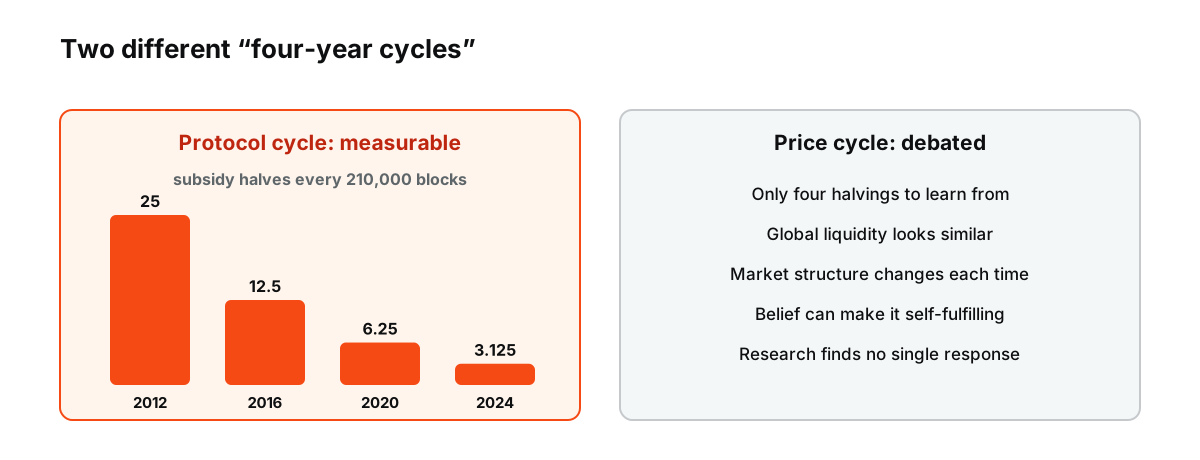
Figure: The protocol cycle is a rule; the price cycle is a debate. Subsidy figures from the halving schedule.
The price cycle is an empirical claim. It may be influenced by the protocol cycle, but it also reflects liquidity, leverage, adoption, regulation, market structure and investor expectations.
Conflating the two creates false certainty.
The halving gives Bitcoin a recurring supply event. It does not give traders a clock that guarantees when a bull market starts, how high it runs or when it ends.
That is why the four-year cycle remains useful to study and dangerous to treat as a law.
Sources
- Block Chain Reference — Bitcoin Developer Documentation
- Some Stylized Facts About Bitcoin Halving — Finance Research Letters, 2024
- An Empirical Examination of Bitcoin’s Halving Effects — Journal of Risk and Financial Management, May 2024
- The Impact of Bitcoin Halving Expectations on Financial Markets — Heliyon, September 2026