
How to Deposit Funds Into Your OTCN Account
Log in, choose a payment method in your own name, enter the amount, confirm and check your balance: how to deposit funds into OTCN, with timing and checks.
To deposit funds into your OTCN account, log in to your client area, choose a payment method in your own name, enter the amount and currency, confirm and check the balance updates. Deposits pass anti-money laundering checks, and the method usually decides where withdrawals of that money go later, so choose it carefully.
[PRODUCT FACTS SHEET — Open decision 3: every OTCN-specific step, screen name, fee, limit and time in this article is a placeholder marked PFS and must be confirmed before publishing.]
Before you start
Complete identity verification; deposits from accounts in third parties’ names are usually refused. [PFS: available methods, currencies, minimum deposit.]
Payment methods compared
| Method | Typical speed | Points to check |
|---|---|---|
| Debit or credit card | Often minutes | Card must be in your name; some banks block trading payments |
| Bank transfer | One or more business days | Include any reference exactly as shown |
| Electronic wallet | Often fast | Wallet must be verified in your name |
(General industry patterns; availability varies.) [PFS: methods OTCN accepts, by country.]
Making a deposit
Open the deposit page
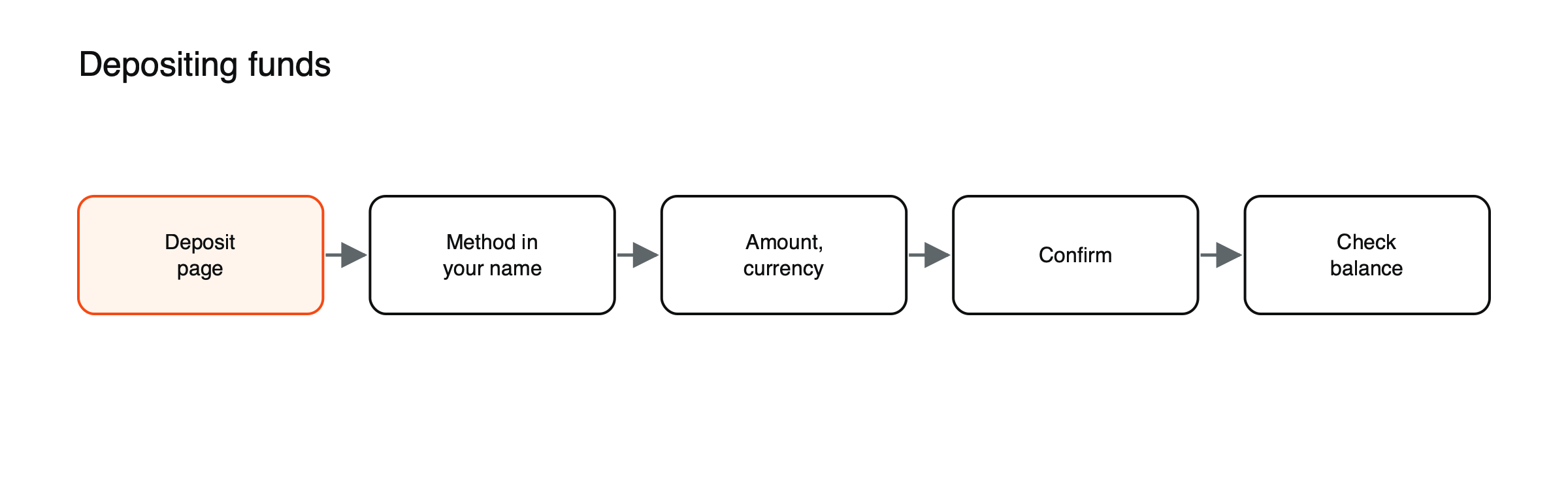
Figure: Making a deposit.
[PFS: menu path in the OTCN client area.]
Choose a method in your name
Card, bank transfer or other methods offered. [PFS: list.]
Enter amount and currency
Depositing in your account’s base currency avoids conversion costs. [PFS: conversion fees, if any.]
Confirm and keep the reference
Save the confirmation for your records.
Check the balance
Funds become available once the provider confirms payment and internal checks are complete.
Currency conversion, illustrated
Suppose your account is in US dollars and you deposit €1,000 by card. (Illustrative scenario.) If the conversion rate applied is 1.0700 and the market rate is 1.0850, you receive $1,070 instead of $1,085, a cost of $15, or about 1.4%, before you place a trade. Depositing in the account’s base currency, or choosing an account currency that matches your bank account, avoids this cost. [PFS: OTCN account currencies and conversion fees.]
Processing times
Card payments are often fast; bank transfers can take one or more business days. [PFS: times by method.]
Why funds might be delayed
Deposits can be delayed when a bank transfer is sent without the correct reference, when a card payment needs extra authorization from the card issuer, when the name on the payment does not match the account, or when larger deposits trigger checks on the source of funds. Keeping the confirmation and reference helps support trace a payment quickly. [PFS: how OTCN clients report a missing deposit.]
Source of funds checks
Anti-money-laundering rules require firms to understand where clients’ money comes from, especially for larger or unusual deposits. Clients may be asked for documents such as bank statements or payslips. These checks are standard across regulated firms and are not an accusation of wrongdoing.
Common mistakes
Using someone else’s card or account, sending a transfer without the required reference, and depositing more than you can afford to lose. See how to withdraw funds from OTCN and how to open an OTCN account.
How much to deposit
The right amount depends on what you can afford to lose, not on the minimum required to open an account or the size of trades you would like to make. Leveraged products can lose money quickly, and depositing more than planned to recover losses is a common mistake. Setting a monthly deposit limit for yourself helps keep trading within your means. See how to size a CFD position using risk per trade.
Bonuses and offers
In many regulated markets, such as the EU, the UK and Australia, providers may not offer bonuses or similar incentives to retail clients to deposit or trade, because regulators found they encouraged excessive risk-taking. Offers of large deposit bonuses can be a sign that a firm is not following these rules. See what ESMA’s 2018 CFD rules changed.
Card disputes and chargebacks
Deposits are payments for a trading account, not for goods. Raising a card dispute after losing money on trades usually fails and can lead to the account being restricted. If there is a genuine problem with a deposit, contact support first. [PFS: OTCN policy on disputed payments.]
Keep records
Save confirmations of every deposit and withdrawal. They help resolve queries, reconcile your account statement and prepare tax records where required. See how to read your OTCN account statement.
Funding and margin, illustrated
Suppose you deposit $1,000 and open a position in a major currency pair worth $15,000, requiring margin of $500 at 30:1. (Illustrative scenario.) Your free margin is $500. A 5% move against you would cost $750, leaving equity of $250, half the required margin, and triggering a close-out under the 50% rule that applies in several regulated markets. Depositing more does not change the risk of the position; it only changes how much of the account is exposed. Sizing positions from the deposit, rather than topping up to keep them open, keeps risk under control. [PFS: OTCN margin requirements and close-out level.]
Which currency to fund in
If your bank account is in euros, a euro-denominated trading account may avoid repeated conversions on deposits and withdrawals, even if you trade dollar-priced markets. [PFS: OTCN account currencies.]
Deposit security
Make deposits only through the official client area, never to bank details sent by email or messaging apps. Fraudsters sometimes send fake payment instructions that look genuine.
Common misreadings
- Believing a larger deposit makes trades safer.
- Assuming any payment method in any name will be accepted.
What happens after you click deposit
Behind the scenes, the payment provider authorizes the payment, the firm receives confirmation, internal checks match the payment to your verified details and the funds are credited to your trading account. For card payments, this can take minutes; for bank transfers, the funds must arrive before they can be credited. Larger or unusual deposits may be held briefly for review. [PFS: OTCN deposit processing steps.]
A first deposit, illustrated
Suppose a new client plans to trade with $2,000 but is still learning. (Illustrative approach.) Depositing $500 first, trading small positions and adding funds only after a month of following a written plan limits the cost of early mistakes. The account can grow later; losses from rushing cannot be undone.
A deposit checklist
- Is the payment method in my name?
- Does the currency match my account?
- Have I included any required reference?
- Is this money I can afford to lose?
- Have I saved the confirmation?
Getting a bank transfer right
Bank transfers need accurate details: the beneficiary name, account number or IBAN, the bank’s identifier and, often, a payment reference that links the transfer to your trading account. A missing or wrong reference is one of the most common reasons transfers cannot be matched quickly. Copy details directly from the client area rather than typing them, and check them before sending. [PFS: OTCN bank transfer details and reference format.]
When a card is declined
Some card issuers decline payments to trading or investment firms, or limit amounts. If a card payment fails, check with your bank before retrying several times, which can trigger fraud alerts.
Deposits from another country
International transfers may pass through intermediary banks, which can deduct fees and add time. Sending in the account currency and checking your bank’s charges helps avoid smaller-than-expected deposits.
Conversion costs both ways, illustrated
Suppose a trader whose bank account is in a different currency funds a dollar account through a bank that converts at a rate 2% worse than the market. (Illustrative scenario.) A deposit equivalent to $1,000 at the market rate arrives as about $980. If the trader later withdraws $980 at another 2% cost, the bank account receives the equivalent of about $960, a loss of about 4% from conversions alone, before any trading. Checking conversion costs on both deposits and withdrawals, and choosing methods that minimize them, can matter as much as trading costs for smaller accounts.
Deposit limits
Firms may set minimum and maximum deposit amounts per transaction or per day, depending on the method. [PFS: OTCN deposit limits by method.]
If a deposit is returned
Payments that cannot be matched to an account or fail checks are usually returned to the sender, sometimes minus bank charges.
Deposits and responsible trading
If you find yourself depositing more often than planned, especially after losses, take a short break and carefully review your trading plan. Many providers offer tools such as deposit limits or temporary account suspensions to help clients stay firmly in control. [PFS: OTCN responsible trading tools.]
Frequently asked questions
Can I deposit from a friend’s or family member’s card?
No. Payments must come from methods in the account holder’s own name.
Why is my deposit not showing?
Bank transfers can take one or more business days, and some payments are held for checks. Keep the reference and contact support if it does not arrive within the expected time.
[RISK WARNING — Open decision 2: approved CFD and leverage risk warning to be inserted here before publishing.]
This article is educational content and does not constitute financial, investment, legal or tax advice. Digital assets are volatile and you may lose the amount you invest.