
How to Withdraw Funds From OTCN
Check free funds, request a withdrawal to the method you deposited with, confirm it and track it: how to withdraw from OTCN and why money returns to its source.
To withdraw funds from OTCN, check your free funds after margin for open positions, request a withdrawal in your client area to the method you deposited with, confirm it with your security checks and track it until it arrives. Under anti-money laundering rules, deposits generally return to their source first.
[PRODUCT FACTS SHEET — Open decision 3: every OTCN-specific step, screen name, fee, limit and time in this article is a placeholder marked PFS and must be confirmed before publishing.]
Before you start
Make sure your account is verified and that withdrawing will not leave open positions short of margin. See equity, free margin and margin level explained.
Free margin, illustrated
Suppose your account equity is $5,000 and your open positions require $3,000 of margin. (Illustrative scenario.) Your free margin is $2,000. Withdrawing the full $2,000 would leave no buffer, so any adverse price move could push the margin level down toward a margin call or automatic close-out. Withdrawing $1,000 instead leaves room for normal fluctuations. Checking the effect of a withdrawal on margin before requesting it avoids an unpleasant surprise. [PFS: OTCN margin call and close-out levels.]
Requesting a withdrawal
Open the withdrawal page
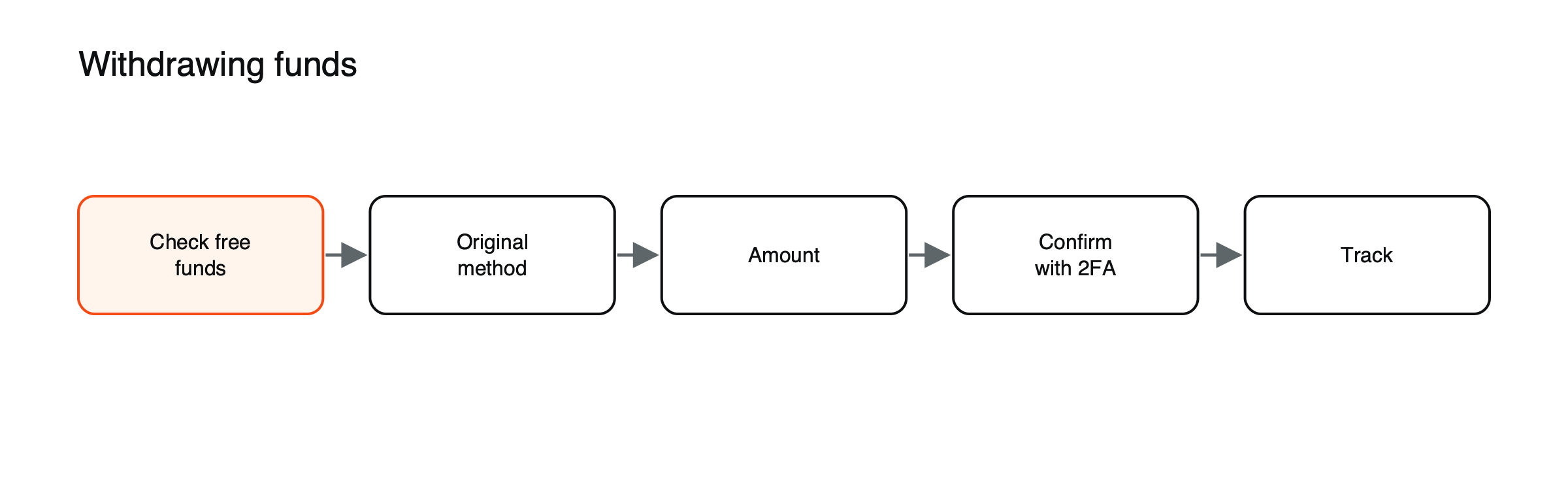
Figure: Requesting a withdrawal.
[PFS: menu path.]
Choose the destination
Usually the method used to deposit. [PFS: rules for profits and alternative methods.]
Enter the amount
[PFS: minimums and fees, if any.]
Confirm securely
Two-factor authentication protects this step. See how to set up two-factor authentication on OTCN.
Track the status
[PFS: processing and arrival times.]
Why withdrawals go back to the source
Returning funds to the original payment method helps prevent fraud and money laundering and ensures money reaches the verified account holder.
Deposits back first, then profits
Many firms return withdrawals to cards up to the amount deposited by card, then send any profits above that amount by bank transfer to an account in the client’s name. This keeps money moving through verified channels. [PFS: OTCN rules for profits and alternative withdrawal methods.]
The stages of a withdrawal
A withdrawal usually passes through several stages: the request, internal review and approval, payment by the firm and receipt by the bank or card issuer. Delays can occur at any stage, and the final step depends on the receiving bank, card network or payment provider. Tracking the status in the client area shows where a request stands. [PFS: OTCN status labels and typical times per stage.]
Common reasons for delays
- Identity or address documents that have expired
- Withdrawal details that do not match the account holder
- Recent changes to contact or bank details, which may trigger a security hold
- Weekends and bank holidays
- Additional checks on large or unusual requests
Common mistakes
Withdrawing while positions are open and leaving too little margin, and expecting money to go to a method in another person’s name. See how to deposit funds into your OTCN account and how to open an OTCN account.
Watch out for withdrawal scams
A common fraud asks victims to pay a fee, tax or “unlocking charge” before they can withdraw money from a trading account, often from an unregulated or fake platform. Legitimate firms deduct any applicable fees from the withdrawal itself and do not ask for new payments to release funds. Requests like these are a strong sign of a scam. See how to contact OTCN support safely and spot impersonators.
Withdrawals and taxes
Trading profits may be taxable depending on where you live, whether or not you withdraw them. Keeping statements and withdrawal records makes it easier to report gains and losses. Tax rules vary widely, so check local guidance or a tax adviser. See how to read your OTCN account statement.
Security when withdrawing
Two-factor authentication on withdrawals, alerts when a request is made and holds after changes to bank details all protect clients if someone gains access to their account. [PFS: OTCN withdrawal security measures.]
Fees and conversion, illustrated
Suppose you withdraw $1,000 from a dollar account to a bank account in euros. (Illustrative scenario.) If your bank converts at a rate 1.5% worse than the market and charges a $10 incoming fee, you receive the euro equivalent of about $975. Some of these costs come from the receiving bank rather than the broker. Checking both sides, and withdrawing in the currency of your bank account where possible, keeps costs down. [PFS: OTCN withdrawal fees and supported currencies.]
Planning withdrawals
Some traders withdraw a share of profits regularly, for example monthly, to separate gains from trading capital and avoid the temptation to increase position sizes after a good run. Others keep a fixed amount in the account and withdraw anything above it. A plan decided in advance tends to work better than ad hoc decisions after wins or losses.
Dormant accounts
If an account has been unused for a long time, documents may need updating before a withdrawal can be processed, and some providers charge inactivity fees. [PFS: OTCN inactivity rules.]
Common misreadings
- Assuming withdrawals are instant once requested.
- Believing a fee must be paid upfront to release funds.
Weekends and holidays, illustrated
Suppose a trader requests a bank withdrawal late on a Friday before a public holiday on Monday. (Illustrative scenario.) The request may not be reviewed until Tuesday, payment may be sent on Tuesday or Wednesday and the receiving bank may take another day to credit it. What looks like a five-day delay is mostly weekends, holidays and banking cut-off times. Requesting withdrawals early in the week avoids much of this waiting. [PFS: OTCN processing days and cut-off times.]
A withdrawal checklist
- Is my free margin enough to leave open positions safe?
- Are my documents and details up to date?
- Is the destination a verified method in my name?
- Have I checked fees and currency conversion?
- Do I have my two-factor device ready?
Partial and full withdrawals
Withdrawing everything usually requires closing all positions first, because open trades need margin. Partial withdrawals leave the account active. If you plan to stop trading, closing positions in an orderly way before requesting a full withdrawal avoids forced closures at poor prices.
Crypto withdrawals
If a provider allows withdrawals to crypto wallets, addresses must be entered exactly, because blockchain transfers cannot be reversed. Sending to the wrong network or a mistyped address can mean losing funds permanently. Many providers require new addresses to be whitelisted in advance. [PFS: whether OTCN offers crypto withdrawals.] See crypto wallet basics.
Why reviews happen
Regulated firms must check withdrawals for signs of fraud and money laundering. A review may be triggered by a large amount, a withdrawal shortly after a deposit with little trading, recent changes to account details or a request to a new destination. Reviews protect clients as well as the firm, because they also stop criminals who have taken over accounts from moving money out.
Asking about a delay
If a withdrawal takes longer than the stated time, contact support through official channels with the request reference, amount, date and destination. Check your email and client area for requests for documents, which are a common cause of delays.
Withdrawals and open positions, illustrated
Suppose a trader has $8,000 of equity, $4,000 of used margin and wants to withdraw $3,000. (Illustrative scenario.) After the withdrawal, equity falls to $5,000 and the margin level drops from 200% to 125%. A further loss of $3,000 on open positions would bring equity down to $2,000, half the used margin, the close-out level in several regulated markets. Before the withdrawal, the same loss would have left the margin level at 125%. Withdrawing less, or reducing positions first, keeps a larger safety buffer. See equity, free margin and margin level explained.
Keeping records
Save confirmations of each withdrawal along with the corresponding statement. They help when checking that funds arrived, resolving disputes and preparing tax returns.
Communication from the firm
Firms usually notify clients by email or in the client area when a withdrawal is approved, sent or held for checks. Read these messages in the client area, because fraudsters imitate them. If a message asks you to click a link to confirm a withdrawal you did not request, report it to support.
Frequently asked questions
Why can’t I withdraw to a different bank account?
Withdrawals normally go to verified methods in your own name; adding a new method may require verification first.
Can I withdraw while trades are open?
Usually yes, up to your free margin, but leaving too little margin increases the risk of positions being closed.
[RISK WARNING — Open decision 2: approved CFD and leverage risk warning to be inserted here before publishing.]
This article is educational content and does not constitute financial, investment, legal or tax advice. Digital assets are volatile and you may lose the amount you invest.