
How Client Money Segregation Protects Traders
Client money segregation keeps customer funds separate from a broker's own money so they can be returned if it fails. How it works and what MF Global showed.

Client money segregation means a regulated broker keeps customers’ money separate from its own and cannot use it for its business. If the broker fails, segregated money should go back to clients, not to the firm’s creditors. It only works if followed: when MF Global failed in 2011, about $1.6 billion of customer funds were missing.
How it works
- Client money is held in designated accounts, often at banks, labeled as client money.
- In the UK, it is held on a statutory trust under the FCA’s client money rules.
- Firms reconcile client balances regularly and report to regulators.
- If the firm fails, client money is pooled and returned to clients in proportion to their entitlements.
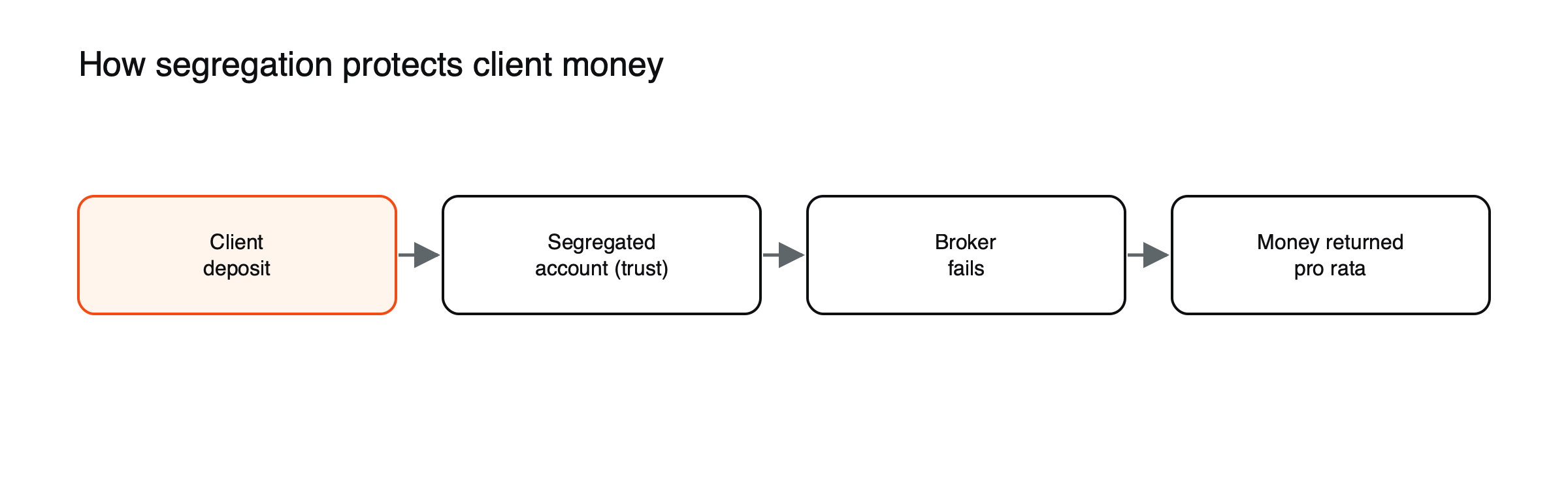
Figure: Segregation keeps client money out of the broker’s estate, if the rules are followed.
Reconciliation, the daily check
Segregation depends on records. Firms must keep accurate records of how much each client is owed and check, often every business day, that the money held in client accounts matches those records. If there is a shortfall, the firm must top it up from its own funds. These reconciliations are the main safeguard against errors or misuse going unnoticed. In the UK, client money must be ring-fenced in trust accounts at regulated banks.
Segregation in a failure, illustrated
Suppose a broker holding $50 million of client money in segregated accounts fails, owing its own creditors $80 million. (Illustrative scenario.) Because the client money is held separately, it does not go to the firm’s creditors; an administrator returns it to clients, after deducting the costs of distribution where the rules allow. If records show $50 million owed and $50 million held, clients should be made whole, though the process can take months. If only $45 million is found, clients share the shortfall in proportion to their claims, and may then turn to a compensation scheme.
What segregation does not cover
- Trading losses: segregation protects your balance from the broker’s failure, not from market losses.
- Shortfalls: if a broker has broken the rules, recovering missing money can take years.
- Unregulated firms: offshore or unlicensed providers may not segregate at all.
Compensation schemes
Many jurisdictions run compensation schemes that step in when a regulated firm fails and cannot return client money. In the UK, the Financial Services Compensation Scheme can pay up to £85,000 per eligible person per investment firm for shortfalls; a higher limit applies to bank deposits. Schemes elsewhere have different limits and eligibility rules, and they do not cover losses from trading or investment performance. Knowing which scheme, if any, applies to your account is part of choosing a provider.
Where client money sits
Client money held by a broker is usually deposited at one or more banks. If one of those banks fails, client money held there can be at risk, which is why firms spread client money across banks and why regulators require due diligence on banks used. The bank’s own deposit protection may apply differently to client money accounts than to personal deposits.
The MF Global lesson
MF Global filed for bankruptcy on October 31, 2011. Investigators found customer funds had been transferred to cover the firm’s own overdrafts and collateral calls during a liquidity crisis. About $1.6 billion was missing; most US futures customers eventually recovered their funds, but some overseas accounts waited much longer.
What traders can check:
- Which legal entity holds your money and which regulator supervises it.
- Whether the firm states that client money is segregated, and with which banks.
- Whether a compensation scheme applies, and its limits.
See what crypto custody is, what happened when FTX collapsed and why best execution matters for traders.
Crypto platforms
Crypto platforms have not always been subject to the same client money rules. The collapse of FTX in 2022 showed what can happen when customer assets are mixed with a firm’s own funds: billions in customer deposits were missing. New rules in several jurisdictions now require crypto custodians and stablecoin issuers to segregate client assets, but protection still varies widely. See what the GENIUS Act means for stablecoin users.
Questions to ask a provider
- Is client money held in segregated accounts, and at which banks?
- How often are client money reconciliations performed?
- Which regulator supervises the entity holding my money?
- Does a compensation scheme apply, and what are its limits?
- Is any of my money used as margin or collateral by the firm, and on what terms?
Money and assets
Rules distinguish between client money, such as cash balances, and client assets, such as shares or bonds held on a client’s behalf. Client assets are usually held in custody, registered in a way that identifies them as belonging to clients. Both should be kept separate from the firm’s own property, but the rules and the recovery process differ. CFD balances are client money, because a CFD is a contract with the provider rather than ownership of an underlying asset.
Earlier failures
MF Global was not the first test. When the futures broker Refco collapsed in 2005 and Lehman Brothers’ European arm failed in 2008, disputes over client money and assets took years to resolve, partly because records were incomplete. Each case led regulators to tighten rules on record-keeping, reconciliations and the speed of returning client money.
How regulators check
Regulators require firms to report on client money arrangements, and auditors often review client money compliance each year. Breaches can lead to fines and, in serious cases, restrictions on holding client money.
Common misreadings
- Assuming segregation guarantees full and fast repayment.
- Believing all brokers must segregate client money in every country.
Professional clients and title transfer
In some jurisdictions, professional clients can agree to title transfer arrangements, under which money passed to a firm becomes the firm’s property, usually as collateral. Such money is not segregated and would rank alongside other creditors if the firm failed. Retail clients are generally protected from these arrangements, which is one reason classification as a retail or professional client matters. See leverage limits by country.
Negative balance protection
In many regulated markets, retail CFD clients benefit from negative balance protection, meaning they cannot lose more than the money in their account. This works alongside segregation: segregation protects the balance from the provider’s failure, while negative balance protection limits how far trading losses can go. See what negative balance protection is.
Client money in a bank failure, illustrated
Suppose a broker holds $30 million of client money spread equally across three banks, and one of them fails. (Illustrative scenario.) The $10 million at the failed bank may be at risk, depending on the bank’s resolution and any deposit protection that applies to client money accounts. The other $20 million remains safe. Spreading client money across several banks limits the damage from any single bank failure, which is why regulators expect firms to diversify and review the banks they use.
Client money and interest
Firms may earn interest on client money held at banks. Whether any of that interest is passed on to clients depends on the firm’s terms, which should be disclosed. Interest arrangements do not change the segregation of the money itself.
Rules differ by country
Client money rules vary between jurisdictions in detail, from how often reconciliations happen to which banks can be used. Checking the rules that apply to your account matters more than general assurances.
Why it matters for traders
For most traders, segregation will never be tested, because most regulated brokers do not fail. But when failures happen, segregation, accurate records and compensation schemes make the difference between recovering most of one’s money and joining a long queue of creditors. Choosing a provider with clear disclosures about client money arrangements is a simple step that can matter greatly in the rare cases where things go wrong. Questions about segregation, compensation and the regulator take minutes to ask before opening an account, and a provider’s willingness to answer them is a signal of how it treats clients.
Frequently asked questions
Does segregation protect me from losing money on trades?
No. It protects your balance from the provider’s failure, not from market losses.
How long does it take to get money back after a broker fails?
It varies. Where records are good, months; where there are shortfalls or disputes, it can take years.
This article is educational content and does not constitute financial, investment, legal or tax advice. Digital assets are volatile and you may lose the amount you invest.
Sources
- The MF Global Bankruptcy, Missing Customer Funds, and Proposals for Reform (October 31, 2011; about $1.6 billion missing; segregation rules; funds wired to meet overdrafts and collateral calls) — Congressional Research Service
- The “hindsight” principle and clients of insolvent UK brokers (CASS client money held on statutory trust; pro rata distribution) — Harvard Law School Forum on Corporate Governance, 2013
- MF Global customer funds and segregation (segregation as a legal boundary, not a liquidity guarantee) — BTW Media
- FSCS and how your money is protected (investment firms covered up to £85,000 per eligible person; segregated client accounts; £120,000 applies to deposit takers) — InvestEngine Help Centre
- How does FSCS protection cover investments? (client money ring-fenced in trust accounts; daily internal client money reconciliation; up to £85,000 per firm) — Financial Interest