
What the GENIUS Act Means for Stablecoin Users
The GENIUS Act, signed in July 2025, requires US payment stablecoins to hold one-to-one reserves, report monthly and pay no interest. What changes for users.
The GENIUS Act, signed on July 18, 2025, is the first US federal law for payment stablecoins. Licensed issuers must back each token one-to-one with cash, deposits or short-term Treasuries, report reserves monthly and give holders priority over reserves if they fail. Paying interest is banned. It takes effect by January 18, 2027 at the latest.
What the law requires of issuers
- Reserves: one-to-one backing in high-quality liquid assets, held separately from the issuer’s own funds.
- Disclosure: monthly reports on reserve composition, examined by an independent accounting firm; annual audited financial statements for the largest issuers.
- Licensing: issuers must be bank subsidiaries, federally chartered nonbanks overseen by the Office of the Comptroller of the Currency or, below $10 billion in issuance, approved state-licensed firms.
- No yield: issuers cannot pay holders interest for simply holding the coin.
The market it regulates
Stablecoins grew rapidly in the years around the law’s passage. Total stablecoin market capitalization reached a record of about $323 billion in May 2026 before easing to about $318 billion in early August 2026, by one widely used measure; more conservative estimates put the figure lower. A small number of dollar-backed coins account for most of the market. The size of the market, and its growing role in payments and trading, is what drew regulators’ attention.
Reserves in practice, illustrated
Suppose a licensed issuer has $10 billion of stablecoins outstanding. (Illustrative figures.) It must hold at least $10 billion in eligible reserves, such as cash, bank deposits and short-term Treasury bills, kept separate from its own funds. If holders redeem $2 billion in a day, the issuer pays them from reserves at par, reducing both its tokens and its reserves to $8 billion. If the issuer fails, holders have a priority claim on the reserves ahead of other creditors. The design aims to make each token as safe as the assets behind it.
What it means for users
More protection in a failure. Reserves are excluded from an issuer’s bankruptcy estate, and holders have a priority claim on them.
Clearer redemption. Licensed issuers must honor redemptions at par.
No interest from issuers. Yield on stablecoins, where offered, must come from other products and carries other risks. See what yield-bearing stablecoins are.
Who supervises
Depending on the issuer, oversight falls to federal bank regulators, the Office of the Comptroller of the Currency for federally qualified nonbank issuers, or state regulators for smaller issuers below $10 billion in outstanding coins that meet federal standards. Larger issuers above $50 billion must publish annual audited financial statements.
Timeline
Signed July 18, 2025; regulators drafting rules through 2026; effective on the earlier of January 18, 2027 or 120 days after final rules; a full three-year grace period runs to July 2028.
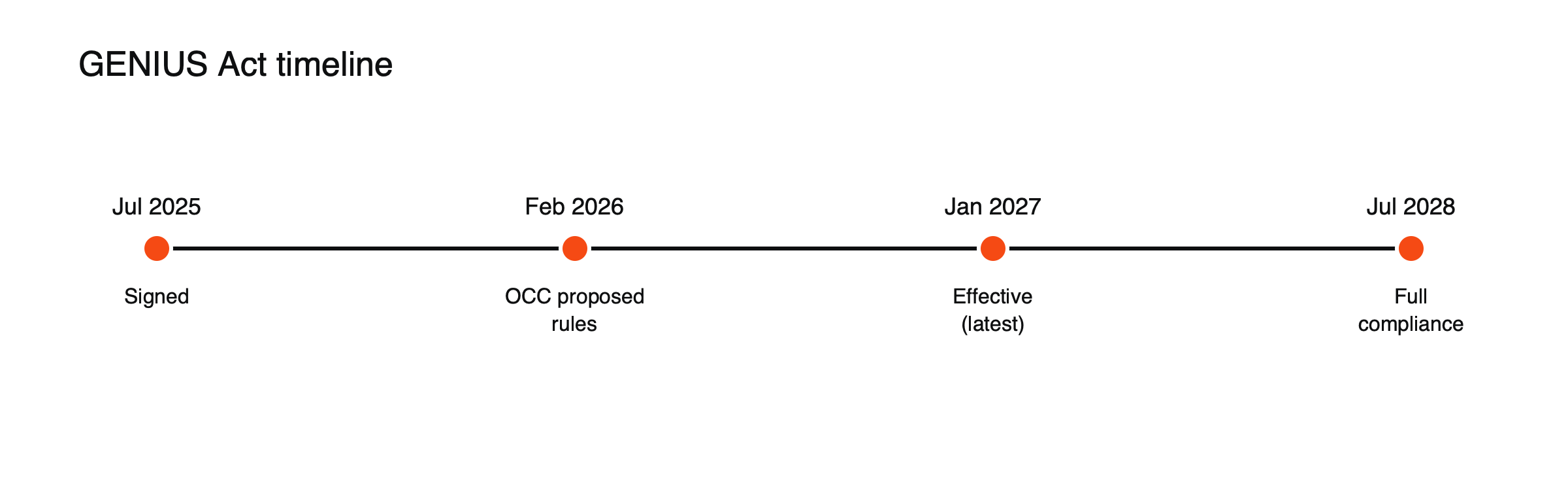
Figure: From signature to full compliance.
Limits
The law covers payment stablecoins offered in the US; foreign issuers face comparability tests, and rules differ from the EU’s MiCA. See stablecoin regulation in the EU vs US and how client money segregation protects traders.
GENIUS and MiCA compared
The European Union’s Markets in Crypto-Assets regulation also requires stablecoin issuers to be authorized, hold reserves and honor redemptions, and it limits interest on certain tokens. Differences include licensing routes, reserve composition and how foreign issuers are treated. Issuers serving both markets must meet both sets of rules, and some coins have been withdrawn from certain venues in one region while remaining available in the other.
What it means for traders
For traders who use stablecoins to move money between platforms or hold cash between trades, the law offers clearer protections for US-regulated coins, particularly in an issuer failure. It does not remove the other risks: platform risk on exchanges holding the coins, smart contract risk on blockchains and the risk that a coin temporarily trades below $1 in secondary markets during stress, as some did in March 2023. See what a stablecoin is.
What to watch through 2028
- Final rules from federal and state regulators
- Which issuers obtain licenses, and when
- How foreign issuers are treated under comparability tests
- Monthly reserve reports from major issuers
Why rules were needed
Stablecoins have failed before. In May 2022, the algorithmic stablecoin TerraUSD collapsed, wiping out about $40 billion in value, because it relied on a linked token rather than real reserves. In March 2023, a major reserve-backed coin briefly fell below $1 when part of its reserves was held at a failed US bank. These episodes showed that reserve quality, transparency and redemption rights matter, and they shaped the law’s requirements. See what happened when TerraUSD collapsed.
What counts as a reserve
The law limits reserves to high-quality, liquid assets: coins and currency, bank deposits, short-term Treasury bills, certain repurchase agreements backed by Treasuries and money market funds holding such assets. Riskier assets, such as corporate bonds, crypto or long-term securities, do not qualify. The aim is that reserves can be turned into cash quickly at full value, even in stress.
Financial crime rules
Licensed issuers are treated as financial institutions for anti-money-laundering purposes. They must run customer checks, monitor transactions and be able to freeze or block tokens when required by law, which brings stablecoins closer to the rules that apply to banks and payment firms.
Common misreadings
- Assuming all stablecoins are now federally regulated.
- Treating a regulated coin as a bank deposit with deposit insurance.
Stablecoins and Treasury demand
Because licensed issuers must hold reserves largely in cash and short-term Treasury bills, growth in regulated stablecoins adds demand for US government debt. Some large issuers already hold more Treasury bills than many countries. Policymakers have noted that this demand could support the Treasury market, while others warn that large, sudden redemptions could force issuers to sell bills quickly in stress.
What changes for exchanges and wallets
Trading platforms and wallet providers that offer stablecoins to US customers will increasingly need to work with licensed or approved issuers. Some coins that do not meet the standards may be delisted or restricted for US users. For traders, the practical effect is likely to be a narrower set of fully compliant coins, with clearer disclosures about their reserves.
Effects on crypto markets
Stablecoins provide much of the liquidity on crypto exchanges, where they are used to price and settle trades. Clearer rules could encourage more institutions to use regulated coins, deepening liquidity, while restrictions on non-compliant coins could shift trading toward compliant ones. Stablecoin market capitalization is also watched as a gauge of capital ready to be deployed in crypto markets.
Tokenized deposits
Banks are developing tokenized deposits, digital versions of bank deposits that can move on blockchains. Unlike stablecoins, they remain bank liabilities and may carry deposit insurance where it applies. The two may compete for the same uses.
A checklist for users
- Is the issuer licensed or approved under the new rules?
- Are monthly reserve reports published?
- How easily can coins be redeemed at $1?
- Where are the coins held, and by whom?
How the law came about
Congress debated stablecoin legislation for several years before the GENIUS Act passed with support from both parties in 2025. Lawmakers aimed to protect users and the financial system while allowing innovation in payments. The law left many details to regulators, which is why final rules and their interpretation will shape its real impact over the following years.
Interest and competition with banks
The ban on paying interest to holders reflects concern that interest-bearing stablecoins could draw deposits away from banks. Some platforms offer rewards through separate programs, a practice regulators may scrutinize. How regulators treat such programs will affect which stablecoins are attractive, and users should read the terms, because rewards paid by a platform carry that platform’s own risks rather than the issuer’s.
Frequently asked questions
Does the GENIUS Act make stablecoins risk-free?
No. It strengthens reserve and redemption rules but does not remove platform, technical or market risks.
Can I still earn yield on stablecoins?
Not from regulated issuers simply for holding the coin. Any yield must come from separate products, which carry their own risks.
This article is educational content and does not constitute financial, investment, legal or tax advice. Digital assets are volatile and you may lose the amount you invest.
Sources
- The GENIUS Act (signed July 18, 2025; monthly disclosures examined by an independent accounting firm; no interest; effective date rules) — Eco
- GENIUS Act (1:1 reserves in cash, deposits or short-term Treasuries; super-priority claim; state issuers up to $10 billion) — Paxos
- The GENIUS Act: establishing a federal framework (annual audited financials for issuers over $50 billion; priority claims) — NameScan
- 2026 GENIUS Act latest status (OCC proposed rules February 2026; full compliance by July 18, 2028) — KuCoin Blog
- Stablecoin Market Report: July 2026 (total market cap $318.3 billion on August 2, 2026; down more than $10 billion from the May peak) — Stablecoin Insider
- Stablecoin Developer Ecosystem Report 2026 (record about $323 billion in May 2026; BIS conservative estimate about $270 billion in March 2026) — Stablecoin Insider
- How an algorithmic stablecoin wiped out $40 billion (TerraUSD and LUNA, May 2022) — Netcoins