
Why Exchanges Halt Trading in a Stock
Exchanges pause a single stock for pending news, extreme price moves or regulatory concerns. The types of halts, how long they last and what happens after.
A trading halt is a pause in trading for a single stock. Exchanges halt stocks when major company news is about to be released, when prices move too fast, or when regulators have concerns. Most volatility pauses last five minutes; news halts usually last until the information has been published. When trading resumes, prices can gap sharply.
Types of halts
News pending. The exchange pauses trading before a company releases material news, such as a merger, earnings surprise or regulatory decision, so all investors can see it at the same time.
Volatility pauses (limit up–limit down). If a stock moves outside a price band, typically 5%, 10% or 20% depending on the stock, within a five-minute window, and the move persists for 15 seconds, trading pauses for five minutes. Several such pauses happen across US stocks every day.
Regulatory halts. Regulators can suspend trading over concerns about inaccurate information or possible fraud.
Technical halts. Problems at an exchange can stop trading on that venue.
Market-wide halts. Separate rules pause the whole market when the S&P 500 falls 7% or more. See how circuit breakers work.
A volatility pause, illustrated
Suppose a stock trading at $50 has a 5% price band. (Illustrative scenario.) If heavy selling pushes offers down to $47.40, outside the band of about $47.50 to $52.50 calculated from recent prices, the stock enters a 15-second limit state. If prices do not return within the band, trading pauses for five minutes. During the pause, buyers and sellers can enter orders, and trading restarts with an auction that sets a single reopening price. The pause gives the market time to attract new buyers rather than letting prices fall through thin order books.
News halts in practice
Companies often ask exchanges to halt their shares shortly before releasing news that could move the price sharply, such as merger agreements, clinical trial results or major legal decisions. The halt usually lasts until the announcement has been published and investors have had time to read it, often 30 to 60 minutes, sometimes longer. When trading resumes, the opening auction absorbs the flood of orders created by the news.
What happens when trading resumes
Trading usually restarts with an auction that matches waiting orders. Because buyers and sellers react to the news at once, the reopening price can be far from the last trade.
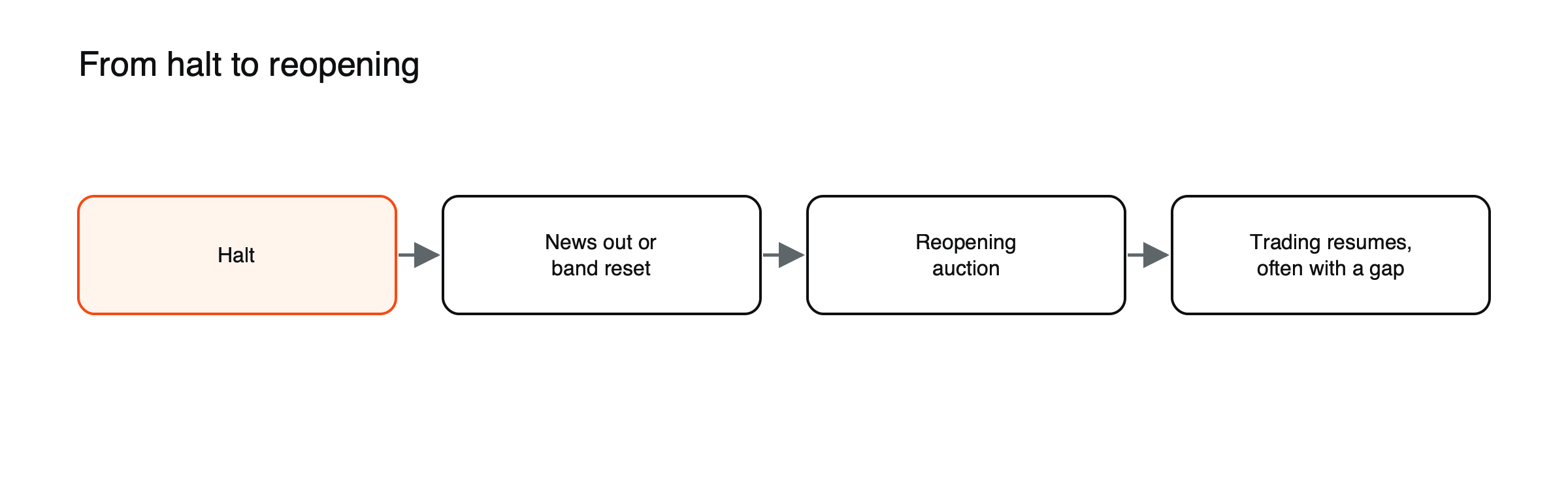
Figure: How a halted stock reopens.
GameStop in 2021
During the January 2021 short squeeze, GameStop shares were halted repeatedly as volatility pauses kicked in during extreme swings, and some brokers restricted buying. The halts did not stop the swings, but they broke up the trading into shorter bursts, giving participants brief moments to reassess. The episode showed how often volatility pauses can trigger in a stock that moves tens of percent within minutes. See what happened in the GameStop short squeeze.
What it means for traders
- Open orders may fill at very different prices after a halt.
- Stop orders can execute well beyond their trigger level.
- Positions cannot be closed while trading is halted.
See how market surveillance catches manipulation and why best execution matters for traders.
Halts and CFDs
When an underlying stock is halted, CFDs on that stock are usually suspended too, because the provider has no reliable price. Open positions remain open but cannot be closed until trading resumes. When it does, the CFD price jumps to reflect the reopening price, and stop orders are filled at the first available price, which can be far from the stop level. Guaranteed stops, where offered, protect against this gap for a fee. See stop-loss orders explained.
Halts outside the US
Other exchanges use similar tools. Many European markets use volatility interruptions that switch a stock into a short auction when prices move beyond set thresholds, rather than halting outright. Asian markets often use daily price limits, capping how far a stock can move in a single session. The specific rules vary, but the aim is the same: to slow trading when prices move too fast for the order book to keep up.
Crypto has no halts
Crypto markets trade around the clock without exchange-wide halts, although individual platforms sometimes pause trading for technical reasons. Without halts, prices can fall very quickly through thin order books, as in the October 10, 2025 sell-off, when more than $19 billion of leveraged positions were liquidated. Traders used to halts in share markets should not expect the same pauses in crypto.
A checklist for halt risk
- Hold smaller positions in stocks with major news due.
- Expect stop orders to fill at the reopening price, not the stop level.
- Check whether your provider offers guaranteed stops.
- Know that positions cannot be closed during a halt.
Why reopenings can be volatile
During a halt, orders pile up on one side as investors digest news. When trading resumes, the auction must match all of them at a single price, which can be far from the last trade. The first minutes after a halt often bring wide spreads and rapid moves as the market settles. Traders who place market orders at the reopen can receive fills well away from expectations.
Regulatory suspensions, illustrated
Suppose a regulator suspends trading in a small company because of doubts about information it has published. (Illustrative scenario.) The suspension may last days or weeks while the regulator investigates. Shareholders cannot sell during that time, and when trading resumes, the price may have fallen sharply, or the company may be delisted. Such suspensions are rare for large companies but more common among small, thinly traded stocks.
Halts and index futures
When a single stock is halted, index futures keep trading, and the stock’s value is estimated from other prices. In a market-wide halt, futures have their own limits but often keep moving, signaling where shares might reopen.
Halt codes
Exchanges publish codes explaining each halt, such as news pending, volatility pause or regulatory concern. Checking the code helps traders understand what to expect when trading resumes.
Common misreadings
- Believing a halt protects open positions.
- Assuming the reopening price will be close to the last trade.
Halts around earnings
Companies usually release earnings outside market hours to avoid the need for halts, but unexpected news, such as a profit warning or merger announcement, can arrive during trading. Exchanges may then halt the stock until the news is fully published. Large moves after such halts are common, and traders holding positions through company announcements face gap risk whether or not a halt occurs. See how earnings reports move stock prices.
Halts in other markets
Futures exchanges use price limits and brief pauses known as velocity logic when prices move too quickly. Currency markets have no halts, though liquidity can vanish in extreme moments, as in the Swiss franc’s surge in January 2015.
Halts and leveraged positions, illustrated
Suppose a trader holds a CFD position on 500 shares bought at $40, with a stop at $37, when the stock is halted on news. (Illustrative scenario.) If the shares reopen at $30, the stop triggers at about $30, not $37, and the loss is about $5,000 rather than $1,500. With leverage, that loss could exceed the margin on the position. Guaranteed stops, where offered, would limit the loss to the stop level for a fee.
During a halt
Traders can review the news behind the halt, check how related stocks or index futures are trading and decide in advance how to act at the reopen, rather than reacting to the first chaotic prints.
Why halts exist at all
Halts aim to make markets fairer and more orderly: news halts ensure that all investors receive important information at the same time, and volatility pauses prevent prices from collapsing or spiking through thin order books because of a temporary imbalance. Critics argue that halts can trap investors and create larger gaps, but regulators have generally concluded that brief pauses do more good than harm in modern, fast markets. The debate continues, especially as more markets move toward longer trading hours and compete with crypto.
Frequently asked questions
How long do halts last?
Volatility pauses usually last five minutes; news halts until the news is published; regulatory halts can last days or longer.
Can I place orders during a halt?
On many exchanges, yes, for the reopening auction, but CFD providers may not accept new orders until prices resume.
This article is educational content and does not constitute financial, investment, legal or tax advice. Digital assets are volatile and you may lose the amount you invest.
Sources
- Trading halts and circuit breakers (news pending halts; LULD 15-second limit state then 5-minute pause) — CertFuel
- Circuit breakers and trading halts (LULD bands 5%–20%; several halts daily; post-halt gaps) — Fin Still
- Stock market circuit breakers (security-specific halts ahead of news; technical halts) — Schwab
- What is a short squeeze? (NYSE halted GameStop several times; brokers restricted trades) — BrokerChooser
- DeFi TVL drops 39% in 2026 (October 10, 2025 crash erased more than $19 billion of leveraged positions) — Cointelegraph, June 2026