
What Happens in a Margin Call and a Stop-Out?
A margin call warns your account is near its limit; a stop-out is when positions are closed. Thresholds, a worked example and how to avoid both.
A margin call is a warning that your account equity has fallen close to the margin needed to hold your positions, typically at a 100% margin level. A stop-out is when the provider starts closing positions automatically, often at 50%, to stop further losses. In fast markets, positions can be closed at prices much worse than the stop-out level.
Worked example
- Balance: $5,000
- Long 1 lot EUR/USD at 1.1000, used margin $3,666.67 (30:1, example value)
- Each 0.0001 move = $10
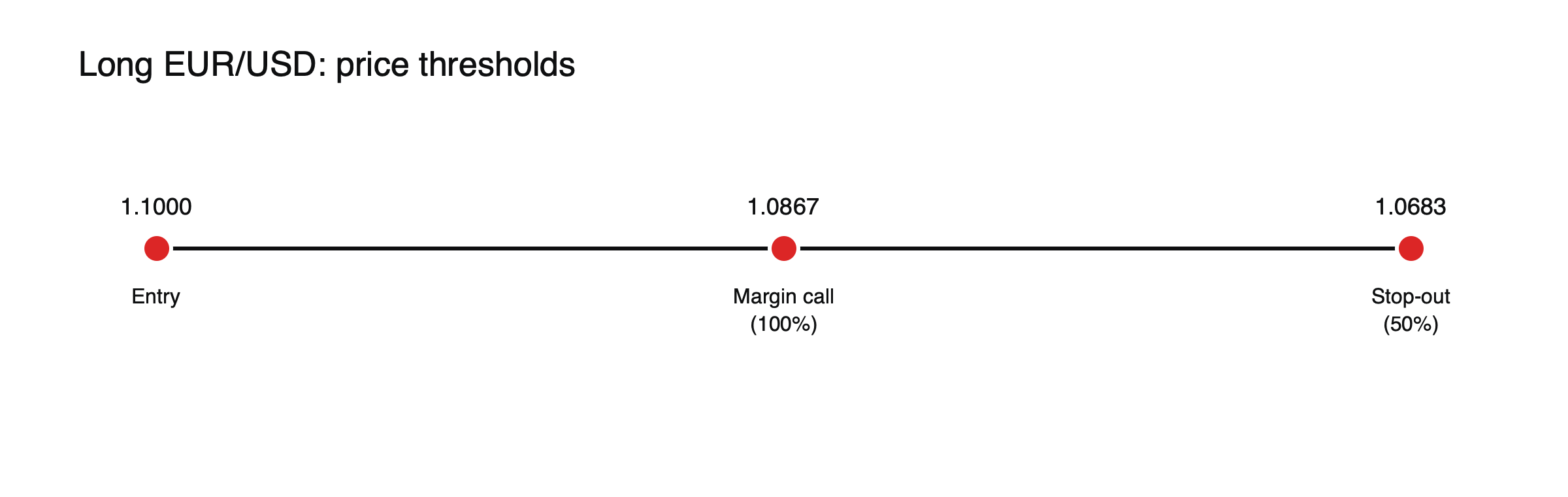
Figure: How far the price can fall before each threshold (example values).
Margin call at 100%: equity falls to $3,666.67, a loss of $1,333.33, at about 1.0867.
Stop-out at 50%: equity falls to $1,833.33, a loss of $3,166.67, at about 1.0683.
A 2.9% fall in the euro would trigger the stop-out and lose about 63% of the account.
A margin call, hour by hour
Continue the example above. (Illustrative timeline.)
- 09:00: EUR/USD trades at 1.0950. The position is down $500, equity is $4,500 and margin level about 123%.
- 11:30: a weak data release pushes the pair to 1.0867. Equity reaches about $3,667, margin level 100%. The platform sends a margin call and blocks new positions.
- 12:00: the trader does nothing, hoping for a bounce.
- 14:15: the pair slides to 1.0683. Equity falls to about $1,833, margin level 50%, and the position is closed automatically.
From the first warning to forced closure took less than three hours. Adding funds or reducing the position at 11:30 would have kept control in the trader’s hands.
What happens at each stage
Margin call: you are usually blocked from opening new positions and alerted. You can add funds or reduce positions.
Stop-out: the provider closes positions, often starting with the biggest loss, until the margin level is back above the threshold.
Your options at a margin call
| Action | Effect | Trade-off |
|---|---|---|
| Deposit more funds | Raises equity and margin level | Puts more money at risk on a losing trade |
| Reduce the position | Lowers used margin and future losses | Locks in part of the loss |
| Close the position | Ends the risk | Locks in the whole loss |
| Do nothing | Waits for a recovery | Leaves the outcome to the market and the stop-out |
Most professional risk managers treat a margin call as a signal that the original position was too large, not as an invitation to add money.
The 50% rule
Under the rules European regulators introduced for retail clients in 2018, providers must close positions once an account’s equity falls to 50% of the margin required for its open positions. The aim is to stop losses before they exceed the account, though in fast markets prices can move past the stop-out level before positions are closed. Some providers in other jurisdictions use different levels.
Which positions close first
When several positions are open, providers usually close them one at a time, often starting with the position showing the largest loss, until the margin level is back above the threshold. That can leave the account holding positions you would not have chosen to keep, so knowing your provider’s rule in advance matters.
When stop-outs go wrong
Prices can gap past the stop-out level. When the Swiss National Bank removed its euro floor on January 15, 2015, the franc rose almost 30% in minutes; some stops could not be filled near their levels, leaving traders with negative balances. See why prices gap over weekends and what negative balance protection is.
What the 2015 franc shock showed
When the Swiss National Bank removed its cap on the franc in January 2015, there were almost no executable prices for a period, according to data later published by the broker FXCM. Stop orders and margin closures could not be carried out near their intended levels, and many traders ended with negative balances. Some brokers suffered losses large enough to threaten their survival. The episode is why negative balance protection and conservative leverage became central to retail rules.
After a stop-out
Once positions are closed, what remains is the account’s equity at the moment of closure, minus any costs. If the closure happened during a fast move, the realized loss may be larger than the margin call level implied. Before trading again, it is worth working out what size of position would have kept the margin level comfortably high through the same move, and treating that as the new maximum.
Stop-loss orders versus stop-outs
A stop-loss and a stop-out both close positions automatically, but they are very different. A stop-loss is your decision, set in advance at the price where your trade idea is wrong, and it usually closes one position at a loss you have already accepted. A stop-out is the provider’s decision, triggered by the state of the whole account, and it closes positions at whatever losses they have reached. In the example above, a stop-loss 40 pips below entry would have cost about $400, while the stop-out cost about $3,167. Using stop-losses well inside the stop-out level means the account’s survival never depends on the provider’s emergency mechanism. See what a stop-loss order is. Many traders set the stop so that the planned loss is a small share of the whole account, such as 1% or 2%, which keeps margin calls rare even when several trades go wrong together.
How to avoid them
- Use less leverage than the maximum.
- Size positions by risk, not by available margin.
- Set stop-loss orders well before stop-out levels.
- Watch margin level, not just balance.
See equity, free margin and margin level explained and what leverage is in CFD trading.
Negative balances
If a gap takes prices past the stop-out level, losses can exceed the account’s equity, leaving a negative balance. For retail clients in the EU, UK and Australia, negative balance protection means the client does not owe more than the funds in the account. Elsewhere, and for professional clients, that protection may not apply. See what negative balance protection is.
Frequently asked questions
Will I always get a margin call before a stop-out?
Usually, but not always in time to act. In a fast market, the move from the margin call level to the stop-out level can happen within minutes, or in a single gap.
Can I set my own stop-out level?
No, the stop-out level is set by the provider and the rules that apply to it. You can, however, set stop-loss orders that close positions much earlier, at levels you choose.
Leverage, margin and cost figures in this article are example values for illustration. Actual terms depend on the provider, the instrument and the rules in your country.
This article is educational content and does not constitute financial, investment, legal or tax advice. Digital assets are volatile and you may lose the amount you invest.
Sources
- Margin level, margin call, free margin (margin call below 100%; stop out below 50%) — XTB
- Margin call level and stop out level example — BabyPips
- Swiss National Bank crisis (franc up almost 30%; negative balances; brokers hit) — investingLive
- FXCM publishes data on the SNB event (almost no executable quotes; stops and margin calls could not be executed) — Finance Magnates