
How Leverage Limits Work for Crypto CFDs
Retail crypto CFD leverage is capped at 2:1 in the EU and Australia, meaning 50% margin, and the UK bans them for retail. Why the limits exist, what they mean.
Crypto CFD leverage limits cap the position retail clients can open for a given deposit. In the EU since 2018 and Australia since March 2021, retail crypto CFD leverage is capped at 2:1, so at least 50% of the position’s value must be posted as margin. The UK has banned crypto derivatives for retail clients since January 2021.
The limits
| Jurisdiction | Retail crypto CFD rule |
|---|---|
| EU (ESMA) | Maximum 2:1 (50% margin) |
| Australia (ASIC) | Maximum 2:1 from March 29, 2021 |
| United Kingdom (FCA) | Retail sale banned from January 6, 2021 |
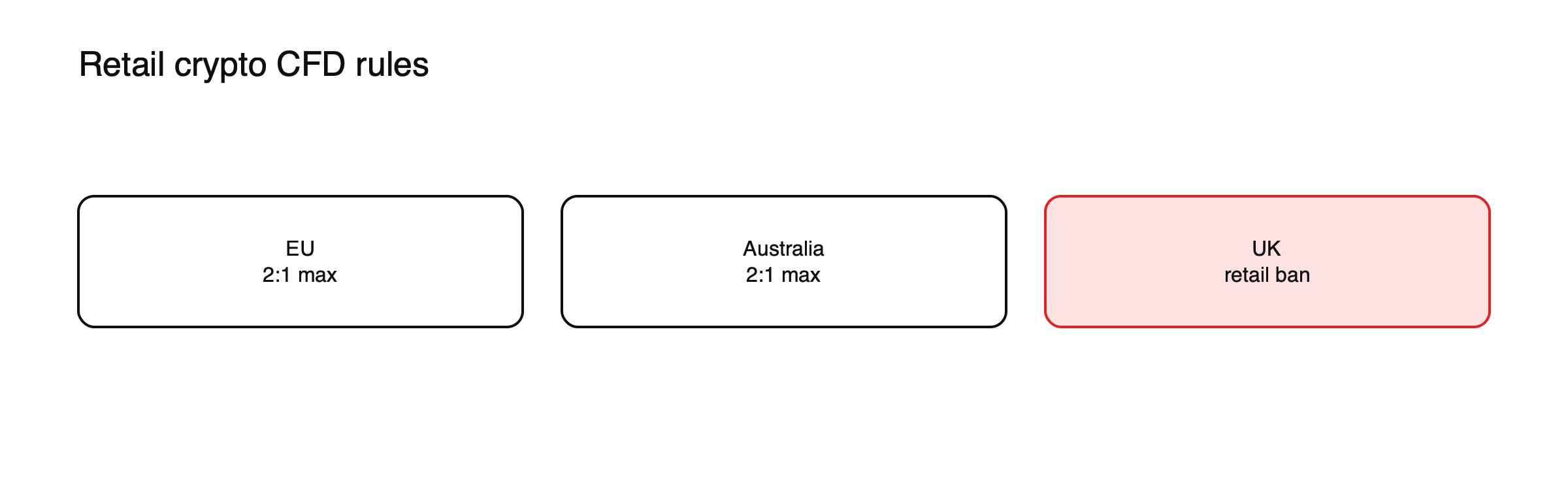
Figure: Retail crypto CFD rules by jurisdiction.
What 2:1 means in practice
A $10,000 position needs $5,000 of margin. A 50% fall in the coin would wipe out the margin entirely; margin close-out rules usually close the position earlier. See what happens in a margin call and a stop-out.
Close-out, worked through
A trader deposits $5,000 and opens a $10,000 bitcoin CFD position at 2:1, using all $5,000 as margin. Under EU rules, positions are closed when equity falls to half the required margin, $2,500. That takes a loss of $2,500, a fall of 25% in bitcoin. If the trader had deposited $8,000 instead, keeping $3,000 spare, the close-out would come only after a loss of $5,500, a fall of 55%. The leverage cap is the same; the extra cash changes how much room the position has. (Illustrative figures.)
Why 2:1 and not 10:1
At 10:1, a 10% move against a position would wipe out the margin entirely, and bitcoin has fallen 10% in a single day many times. At 2:1, the same move costs 20% of the margin. Regulators chose the low limit so that ordinary crypto volatility would not routinely wipe out retail accounts.
Why crypto gets the lowest limit
Regulators pointed to crypto’s extreme volatility, the difficulty of valuing it and large retail losses. Crypto’s 2:1 cap is the strictest of all CFD asset classes, compared with 30:1 on major currency pairs.
Professional clients and other jurisdictions. Rules differ elsewhere, and professional status requires meeting experience and wealth tests while giving up some protections.
See what retail protections apply to crypto CFDs, how leverage limits differ across countries and what a crypto CFD is.
Maximum leverage versus effective leverage
The 2:1 cap is a maximum. Effective leverage is the total position value divided by account equity, and many experienced traders keep it well below the maximum. A $5,000 account holding a $3,000 bitcoin position has effective leverage of 0.6, meaning the account is not even fully exposed to bitcoin’s moves. Lower effective leverage leaves more room for volatility and makes close-outs much less likely. See leverage in CFD trading.
Becoming a professional client
In the EU, clients can request professional treatment if they meet at least two of three tests: having carried out significant trades at an average frequency of about ten per quarter over the previous four quarters, holding a portfolio of cash and financial instruments above €500,000, or having worked in the financial sector for at least a year in a relevant role. Professional clients can access higher leverage but lose protections such as negative balance protection and the standardized close-out rule.
Leverage on crypto exchanges
Some crypto exchanges offer leverage of 50:1 or more on perpetual futures, often to clients in jurisdictions with lighter rules. The contrast with the 2:1 retail CFD cap is large, but so is the risk: at such levels, small moves can liquidate positions within minutes. See crypto CFDs vs crypto futures.
Leverage and financing
Financing on a CFD is charged on the full position value, not on the margin. A $10,000 bitcoin position held for a year at an illustrative 8% costs about $800, which is 16% of the $5,000 margin. Leverage magnifies holding costs relative to the money committed just as it magnifies price moves, so long-held leveraged positions need to earn more than the financing to break even.
Leverage in a crash
In the crypto crash of October 10, 2025, more than $19 billion of leveraged positions were wiped out across exchanges, many of them at leverage far above 2:1. Positions at 2:1 with spare cash in the account were far more likely to survive the move than those at 20:1 or more. The episode illustrated why regulators set the lowest leverage limits for crypto.
How crypto compares with other assets
| Asset class | EU retail leverage limit |
|---|---|
| Major currency pairs | 30:1 |
| Non-major currency pairs, gold, major indices | 20:1 |
| Other commodities, non-major indices | 10:1 |
| Individual shares | 5:1 |
| Cryptocurrencies | 2:1 |
The ranking reflects regulators’ view of each asset’s volatility and risk.
Setting your own limit
Many traders set a personal limit below the regulatory maximum, for example keeping total crypto exposure at or below the account balance, effective leverage of 1:1 or less. That way, even a sharp fall does not trigger a close-out, and the account can survive several bad trades in a row.
Common misreadings
- Treating the maximum leverage as a target.
- Forgetting that financing applies to the full position.
Why leverage is not free money, illustrated
Suppose bitcoin falls 20% and then rises 20%. Without leverage, $5,000 becomes $4,000 and then $4,800, a 4% loss. With a $10,000 position on the same $5,000 at 2:1, the first fall costs $2,000, leaving $3,000 of equity; held through the rebound, the now $8,000 position gains about $1,600, ending near $4,600, an 8% loss, twice the unleveraged result. And in practice a 20% fall at 2:1 brings the account close to the close-out level. (Illustrative figures, ignoring costs.) Leverage magnifies losses as well as gains, and volatile sequences hurt leveraged positions more.
Leverage and behavior
Higher leverage makes each price move feel larger, which can lead to rushed decisions, moving stops or adding to losing positions. Lower effective leverage makes it easier to stick to a plan through normal volatility, which matters more in crypto than in calmer markets.
A leverage checklist
- What is the total position value compared with account equity?
- At what price would a close-out happen?
- How many normal daily moves would that take?
Leverage after a winning streak
After several profitable trades, it is tempting to increase size and use more of the available leverage. Crypto’s volatility punishes that habit: a single sharp move against a larger position can erase weeks of gains. Increasing size gradually, and only in line with a growing account rather than with growing confidence, keeps leverage under control. Many experienced traders set a fixed maximum for total crypto exposure as a share of the account and review it only at set intervals, such as once a month, rather than after every win or loss.
Frequently asked questions
Can I use more than 2:1 leverage on crypto CFDs?
Only if you are classified as a professional client or trade in a jurisdiction with different rules, and both come with fewer protections.
Does lower leverage mean lower risk?
It reduces the chance that normal volatility wipes out your margin, but crypto positions can still lose heavily, especially on large or sudden moves.
This article is educational content and does not constitute financial, investment, legal or tax advice. Digital assets are volatile and you may lose the amount you invest.
Sources
- ESMA adopts CFD measures (2:1 for cryptocurrencies; 50% margin close-out; negative balance protection) — Finadium
- Read this before trading CFDs (from March 29, 2021, 2:1 for CFDs referencing crypto-assets; margin close-out; negative balance protection) — ASIC
- FCA bans the sale of crypto-derivatives to retail consumers (from January 6, 2021) — FCA