
Crypto CFDs vs Buying Crypto
Buying crypto gives you coins to hold, move and use; a crypto CFD gives price exposure with leverage and shorting but no coins and financing costs. Compared.
Crypto CFDs vs buying crypto comes down to ownership. Buying crypto gives you coins you can hold, move, spend or stake, with no financing charge. A crypto CFD gives only price exposure, with leverage and easy shorting, but no coins and overnight financing on positions held. Each suits different goals.
Side by side
| Buying crypto | Crypto CFD | |
|---|---|---|
| Ownership | Yes, coins | No, a contract |
| Wallet and custody | Needed | Not needed |
| Leverage | Usually none | Yes (2:1 for EU retail) |
| Short selling | Difficult | Easy |
| Holding costs | Custody or none | Overnight financing |
| Staking and use | Possible | Not possible |
| Main risk | Price, custody, hacks | Price, leverage, provider |
| Availability | Widely available | Banned for UK retail |
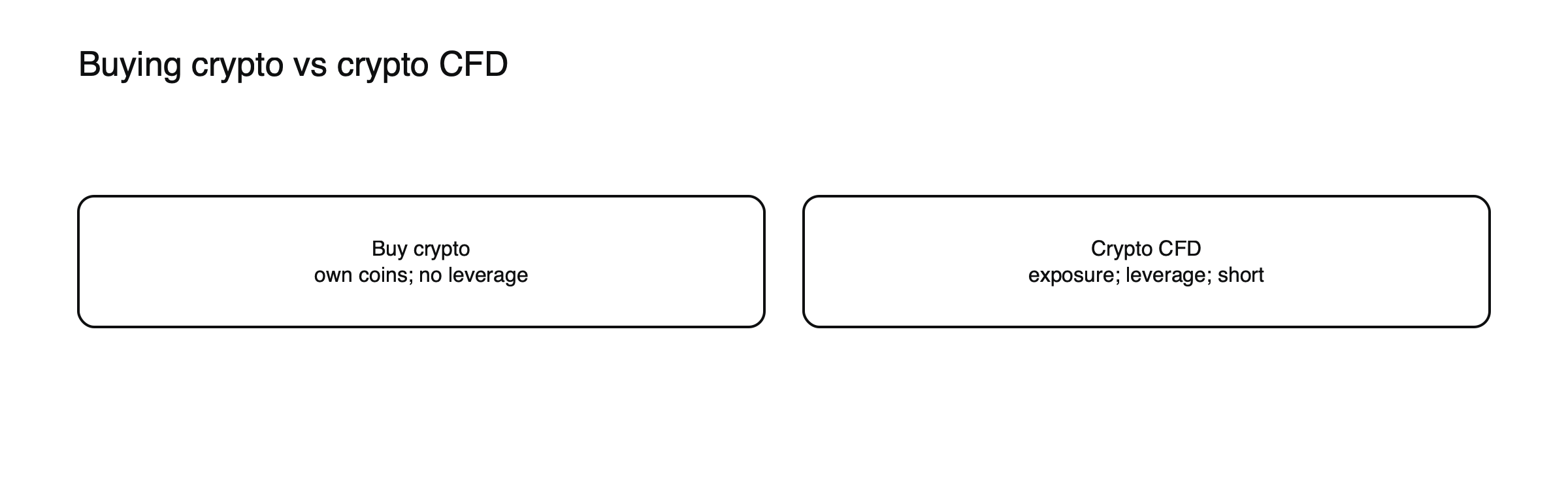
Figure: Ownership vs exposure.
Costs over a year, illustrated
Suppose an investor wants $6,000 of bitcoin exposure for a year. (Illustrative figures.) Buying coins on an exchange might cost a trading fee of about 0.5%, $30, plus perhaps a small withdrawal fee to a personal wallet, and nothing further to hold. A crypto CFD for the same exposure has no purchase fee beyond the spread, but at an illustrative 8% a year, financing would cost about $480 over twelve months. For short holding periods, the CFD’s costs can be competitive; for long ones, buying is usually far cheaper.
Leverage, illustrated
With a CFD at 2:1, $3,000 of margin controls $6,000 of bitcoin. A 20% rise doubles the gain relative to the money committed: $1,200 on $3,000, or 40%. A 20% fall loses $1,200, 40% of the margin. Buying $3,000 of coins outright would gain or lose $600, 20%. Leverage changes the scale of outcomes, not the probability of being right.
When buying makes sense
Long-term holding, using coins on networks, or avoiding leverage and financing. See how to set up a hardware wallet.
When a CFD may fit. Shorter-term trading, hedging an existing holding, or going short without borrowing coins. See how to hedge crypto holdings with CFDs.
Custody risk and counterparty risk
Owning coins brings custody risk: exchanges can be hacked or fail, and private keys can be lost. Holding coins in a personal wallet removes exchange risk but makes the owner fully responsible for security. A CFD avoids these, but replaces them with the risk that the provider fails or restricts trading. Regulated providers in many jurisdictions must keep client money segregated, which reduces but does not remove that risk. See what client money segregation is.
Hedging an existing holding, illustrated
An investor holding 0.5 BTC who fears a short-term fall but does not want to sell, for example for tax reasons, could sell a CFD on 0.5 BTC. If bitcoin falls from $60,000 to $54,000, the coins lose $3,000 in value while the short CFD gains about $3,000, less costs. When the risk passes, the CFD is closed and the coins are kept. See how to hedge crypto holdings with CFDs.
When avoiding custody is not the whole story
“CFDs avoid custody risk” is partly true, but you take on the provider’s counterparty risk instead, and leverage can cause losses far faster than holding coins.
See what a crypto CFD is and CFD trading vs owning the underlying asset.
Combining both
Some investors hold coins for the long term and use CFDs for shorter-term trades or hedges around them. This combines ownership with flexibility, but requires managing two sets of risks and costs, and keeping track of total exposure across both.
Taxes
Tax treatment of buying crypto and trading CFDs can differ significantly by country, including how gains are calculated and whether losses can be offset. Checking local rules, or speaking to a tax adviser, before choosing between them is sensible.
Shorting compared
Selling crypto you do not own is difficult without a derivatives account: it requires borrowing coins through a lending platform or using futures on a crypto exchange. A CFD makes a short as simple as a long, within the same leverage limits. For someone who expects a fall, or wants to hedge, that convenience is one of the main reasons to choose a CFD.
Staking and using coins
Owning coins lets you use them: sending them, paying with them, using them in applications or staking them to earn rewards on networks such as Ethereum. A CFD offers none of this, because there are no coins involved. For investors interested in the technology itself, or in staking income, buying is the only route. See what staking in crypto is.
Getting started
Buying crypto usually involves opening an account with an exchange or broker, completing identity checks and, for self-custody, setting up a wallet and safely storing its recovery phrase. Trading CFDs involves opening an account with a regulated provider, completing identity and suitability checks and funding the account. Neither is instant, but self-custody adds responsibilities that CFD trading does not.
Which suits which goal
| Goal | Usually better fit |
|---|---|
| Long-term holding | Buying coins |
| Short-term trading | CFD |
| Short selling or hedging | CFD |
| Staking or using coins | Buying coins |
| Avoiding leverage | Buying coins |
A crash, illustrated
Suppose bitcoin falls 25% in a weekend sell-off, like the sharp drops seen in crashes such as October 10, 2025, when more than $19 billion of leveraged positions were wiped out. (Illustrative scenario.) An investor holding $6,000 of coins loses $1,500 on paper and can wait for a recovery. A CFD trader with $6,000 of exposure on $3,000 of margin loses $1,500, which may trigger a margin close-out, crystallizing the loss before any rebound. The same price move has very different consequences.
When the intermediary fails
Crypto exchanges have failed in the past, sometimes leaving customers unable to recover coins held on them. CFD providers can fail too, though regulated ones in many countries must segregate client money and may be covered by compensation schemes up to set limits. Understanding what protections apply to each route is part of choosing between them.
Choosing in practice
Many people start by asking what they want: long-term ownership of a technology they believe in, or short-term exposure to price moves. The first points to buying coins and learning safe custody; the second may point to CFDs, with strict risk limits. Those unsure can start small with whichever route matches their main goal, learn its costs and risks and only then decide whether the other route adds anything useful. Whichever route is chosen, sizing positions so that a severe crypto crash remains survivable is the most important decision.
Frequently asked questions
Which is cheaper?
For short holding periods, CFDs can be competitive because there is no purchase fee beyond the spread. For holding periods of months or years, buying coins is usually much cheaper because CFDs charge financing every night.
Which is safer?
Neither is safe. Buying avoids leverage but carries custody risks; CFDs avoid custody but add leverage, financing and provider risk.
This article is educational content and does not constitute financial, investment, legal or tax advice. Digital assets are volatile and you may lose the amount you invest.
Sources
- ESMA adopts CFD measures (2:1 for cryptocurrencies; 50% margin close-out; negative balance protection) — Finadium
- FCA bans the sale of crypto-derivatives to retail consumers (effective January 6, 2021; covers crypto CFDs, futures, options and ETNs) — FCA
- DeFi TVL drops 39% in 2026 (October 10, 2025 crash erased more than $19 billion in leveraged positions) — Cointelegraph, June 2026