
How Nonfarm Payrolls Moves the Dollar
The monthly US jobs report moves the dollar by changing expectations for Fed rates. What the report contains, how markets react and the risks on release day.
Nonfarm payrolls, the monthly US jobs report, moves the dollar by changing expectations for Fed rates. A much stronger-than-expected report suggests higher rates for longer and tends to lift the dollar; a weak one tends to weaken it. It is usually released on the first Friday of the month, 8:30 a.m. New York time.
What the report contains
- Payrolls: jobs added or lost outside farming.
- Unemployment rate.
- Average hourly earnings: wage growth, watched for inflation pressure.
- Revisions to earlier months, which can matter as much as the headline.
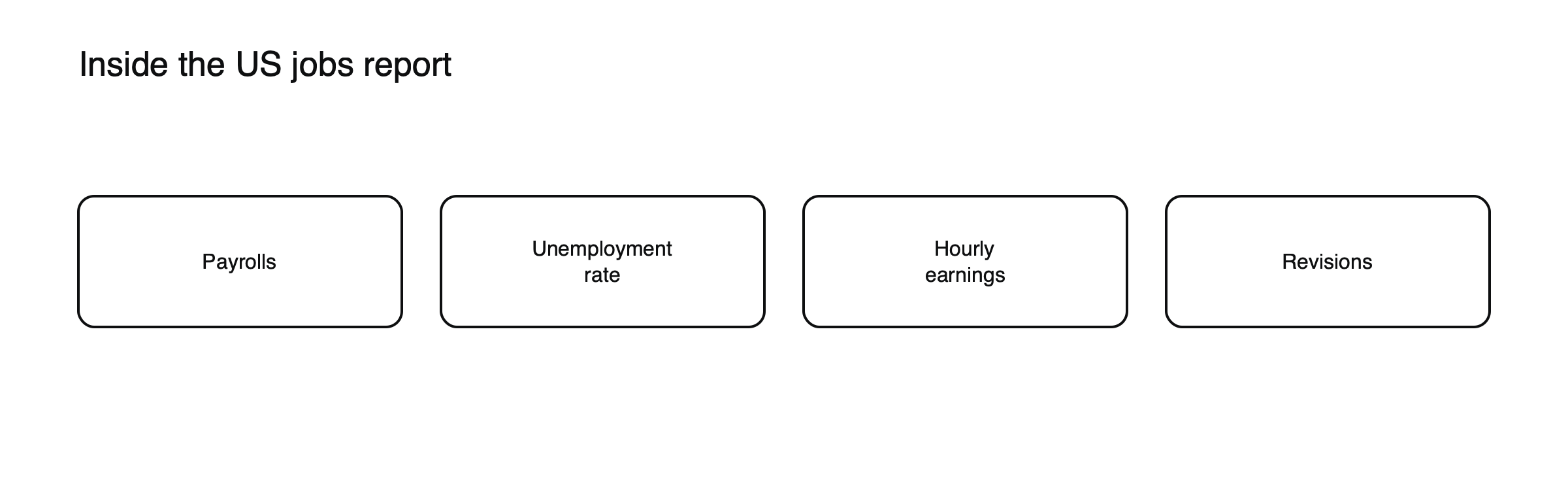
Figure: What markets read in the jobs report.
Two surveys in one report
The jobs report combines two separate surveys. The establishment survey of employers produces the payrolls figure and average earnings. The household survey produces the unemployment rate. Because they measure different things in different ways, they sometimes disagree for a month or two, which can confuse the market’s first reaction. When the headline payroll number and the unemployment rate point in opposite directions, traders often wait for wage data and revisions before deciding which signal to trust.
How the dollar usually reacts
Strong jobs and wage growth → higher expected rates → stronger dollar, especially against low-yielding currencies such as the yen. Weak data → lower expected rates → weaker dollar. In October 2022, strong jobs data pushed risk assets lower because it pointed to more rate hikes.
A report, worked through
Suppose economists expect 150,000 new jobs, unemployment at 4.2% and monthly wage growth of 0.3%. (Illustrative figures.) The report shows 260,000 jobs, unemployment at 4.0% and wages up 0.5%. Every part points to a stronger labor market, so traders scale back expected rate cuts, the two-year Treasury yield rises and the dollar jumps against most currencies. Now imagine the same 260,000 jobs but with the previous two months revised down by 150,000 and wages up only 0.1%. The headline looks strong, but the overall picture is mixed, and the dollar may rise briefly and then give back the move.
Why the reaction can be messy
- Mixed signals: strong payrolls with weak wages, or the reverse.
- Revisions that change the story.
- Context: when markets worry about recession, a strong report can lift risk assets and the dollar together, or not at all.
The influence of payrolls varies over time. One 2026 study found bitcoin’s reaction to payroll surprises had faded while its reaction to inflation surprises had grown.
Revisions in practice
Each report revises the payroll figures for the previous two months as more employer responses arrive. Large revisions can change the story completely: a run of seemingly strong months can turn out to have been much weaker. Traders compare the three-month average after revisions with expectations, rather than reacting only to the latest headline.
Why wages matter so much
Average hourly earnings show whether pay is rising fast enough to keep inflation going, particularly in services. A report with modest job gains but strong wage growth can be read as hawkish, while strong hiring with soft wages may worry markets less. Some traders look at wages first.
Release-day risk. Spreads widen sharply around the release, and prices can move dozens of pips in seconds, filling stops at worse prices. Many traders reduce positions beforehand. See how stop-loss orders work and why they can slip.
See why payroll data can move bonds before stocks and what moves currency prices.
How different pairs react
USD/JPY is often the most responsive major pair to the jobs report, because the yen is especially sensitive to changes in US yields. EUR/USD and GBP/USD usually move in the opposite direction to the dollar’s gain, while AUD/USD can be pulled two ways: a strong report lifts the dollar but may also improve global risk appetite. Canada often releases its own labor market data at the same moment, so USD/CAD can move sharply when the two reports surprise in opposite directions. See why USD/JPY follows US Treasury yields and why USD/CAD moves with oil prices.
A simple plan for jobs day
- Note the consensus for payrolls, unemployment and wages, and the previous months’ figures.
- Decide in advance whether to trade the release, hold through it or stay flat.
- Reduce positions that would be badly hurt by a fast 1% move.
- Avoid entering in the first minute, when spreads are widest.
- Look at the full report, including revisions, before drawing conclusions.
Common misreadings
- Treating the headline payroll number as the whole story.
- Ignoring revisions that change the trend.
- Assuming a strong report is always good for stocks and the dollar at the same time.
Other US labor data
The monthly report is the biggest labor release, but not the only one. Weekly jobless claims give a timely read on layoffs, a private payrolls estimate is usually released earlier in the same week, and a separate survey tracks job openings and quits. Markets use these to adjust expectations before the main report, so a surprise in the official payrolls figure is measured against an expectation that has already moved during the week.
Why the Federal Reserve cares
The Federal Reserve has a dual mandate: maximum employment and stable prices. The jobs report speaks directly to the first and, through wages, indirectly to the second. When inflation is high, strong jobs data raise fears that wage growth will keep prices rising, pushing rate expectations up. When inflation is close to target, weak jobs data can quickly raise expectations of cuts to support employment. The same report can therefore carry different weight depending on which part of the mandate is under more pressure.
Reading the report in order
Many traders read the report in a fixed order. First the payrolls headline against the consensus, then the unemployment rate, then average hourly earnings, then the revisions to the previous two months and finally the participation rate, which shows how many people are working or looking for work. A rise in unemployment can be less worrying if it comes with more people joining the labor force, and a fall can be less encouraging if people are dropping out. Going through the pieces in the same order every month builds a feel for which combinations usually move the dollar and which tend to fade within the first hour. Writing down a quick verdict for each piece before even looking at the price reaction is a simple but useful discipline.
Jobs data near turning points
Around the start of recessions, payroll reports can swing sharply and be revised heavily, and the unemployment rate tends to rise faster than expected once it starts climbing. Markets become especially sensitive to signs of weakness at such times, so a single soft report can move the dollar more than usual. In stable periods, the report may produce only modest moves.
When payrolls matter less
The jobs report’s influence changes with the economic story. When inflation is the main concern, inflation reports can move markets more than payrolls; when growth is in question, payrolls take center stage. Research on other assets has found similar shifts over time, a reminder to judge each release by what markets are worried about at that moment.
Frequently asked questions
When is the US jobs report released?
Usually on the first Friday of each month at 8:30 a.m. New York time, published by the Bureau of Labor Statistics. The schedule can shift around holidays.
Why does the dollar sometimes fall after strong jobs data?
Because other parts of the report, such as wages or revisions, may be weak, or because the strong number was already expected and priced in. The market reacts to the overall surprise, not just the headline.
This article is educational content and does not constitute financial, investment, legal or tax advice. Digital assets are volatile and you may lose the amount you invest.