
What Is a Safe-Haven Currency?
Safe-haven currencies such as the US dollar, yen and Swiss franc tend to rise when markets panic. Why they attract money in stress and when they fail to.
A safe-haven currency is one investors buy, or stop selling, when markets panic. The US dollar, yen and Swiss franc play this role most often. They tend to rise in sell-offs thanks to deep markets, large foreign assets and the unwinding of trades that borrowed in them. The role is a tendency, not a guarantee.
The US dollar
The world’s funding currency: it is on one side of 89% of FX trades. In a crisis, borrowers and investors need dollars to meet obligations, so demand jumps, as in March 2020.
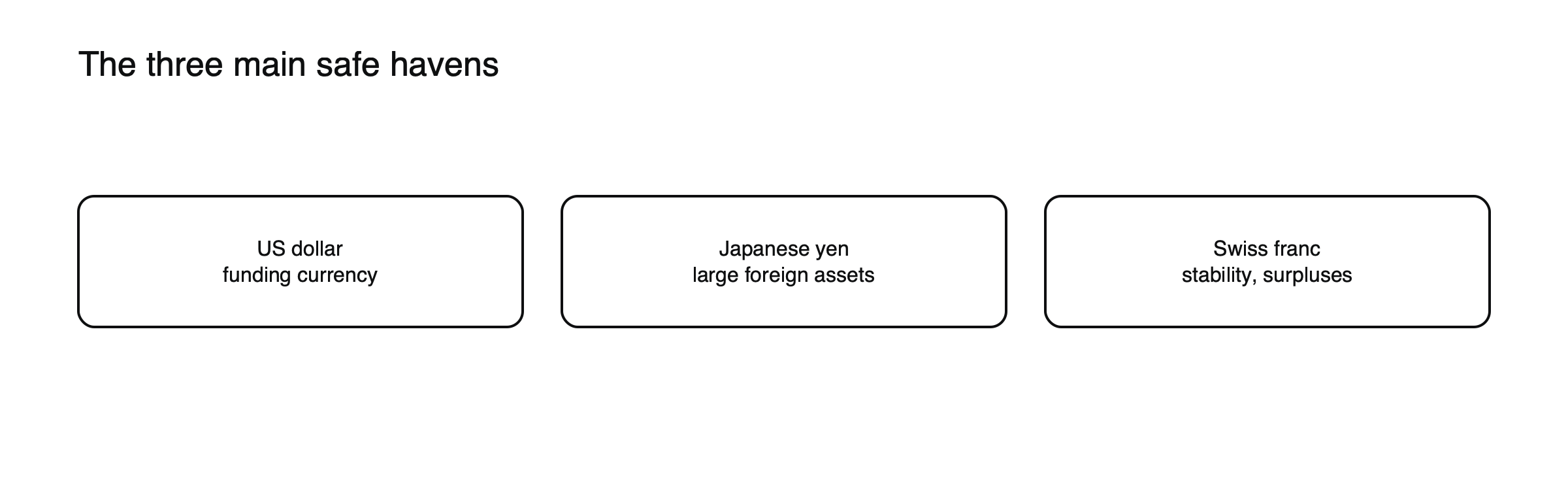
Figure: The three main havens and why.
The Japanese yen
Japan has one of the world’s largest net foreign investment positions, and the yen is often borrowed for carry trades. In stress, money comes home and borrowed yen are repaid. In July and August 2024, the yen rose about 14% against the dollar in under a month.
The Swiss franc
Political stability, low inflation and a large current account surplus. Its pull was strong enough that the Swiss National Bank capped it from 2011 until January 2015.
The March 2020 dash for cash
As markets crashed at the start of the pandemic in March 2020, companies, funds and governments around the world scrambled for dollars to pay debts and meet margin calls. The dollar rose against almost every currency, including other havens, until the Federal Reserve opened emergency lines to supply dollars to other central banks. The episode showed that in the most extreme stress, the dollar’s role as the world’s funding currency outweighs everything else.
The Swiss franc floor
Demand for the franc during the euro area’s debt crisis was so strong that in September 2011 the Swiss National Bank set a minimum exchange rate of 1.20 francs per euro and promised to defend it with unlimited sales of francs. When it abandoned the floor in January 2015, the franc surged in minutes. The episode shows both the power of haven demand and the risks for traders when a central bank stops resisting it. See the 2015 Swiss franc floor removal.
When havens fail
- Shocks from home: a crisis that starts in the US can weaken the dollar, as in April 2025, when the dollar fell during the tariff sell-off.
- Policy: central banks can intervene against their own currency’s strength.
- Rate gaps: a large interest rate disadvantage can outweigh haven demand for long periods, as with the yen in 2022–2024.
See risk-on vs risk-off, Bitcoin, gold and the dollar under market stress and what moves currency prices.
April 2025: when the dollar did not behave as a haven
During the stock market sell-off that followed sweeping US tariff announcements in April 2025, the dollar fell rather than rose. Because the shock started in the United States and raised questions about US policy itself, investors sold US assets, including the dollar, while the yen, the Swiss franc and gold gained. The episode was a reminder that haven status depends on where a crisis comes from, not only on how severe it is.
Havens and interest rates
Low interest rates can strengthen haven behavior, because currencies with low rates are often borrowed to fund carry trades, and those loans are repaid in a panic. But low rates also make havens expensive to hold in calm periods: buying the yen or franc against a higher-yielding currency costs rollover every night. That is why havens can weaken steadily for long periods, as the yen did from 2022 to 2024, and then jump sharply when fear returns.
How traders use safe havens
Some traders hold small haven positions as a hedge against a broad sell-off in their other trades. Others watch haven currencies as a gauge of market mood: a falling AUD/JPY or a rising Swiss franc often signals rising fear before it shows clearly in stock prices. Using havens as hedges works best when the position is sized as insurance, accepting a small, steady cost in exchange for protection in a crisis. See risk-on vs risk-off.
Gold and newer candidates
Gold is the oldest safe haven and often rises alongside the yen and franc in a crisis, though it can fall when investors sell everything to raise cash. Bitcoin has sometimes been described as digital gold, but its record during sell-offs is mixed: it has often fallen with stocks rather than protecting against them. See Bitcoin, gold and the dollar under market stress.
What makes a currency a haven
Safe-haven currencies tend to share several features: deep and liquid markets, so large amounts can be bought quickly; a strong legal and political system; low and stable inflation; and a country with large net holdings of foreign assets, whose investors bring money home in a crisis. Free convertibility matters too: investors need to be confident they can move money in and out. Few currencies tick every box, which is why only a handful play the role consistently.
A typical crisis pattern
| Asset | Usual direction in a sudden sell-off |
|---|---|
| US dollar | Up against most currencies, especially emerging market ones |
| Japanese yen | Up, often sharply when carry trades unwind |
| Swiss franc | Up, particularly against the euro |
| Gold | Often up, though it can dip when investors raise cash |
| Commodity and emerging market currencies | Down |
(General tendencies, not rules.)
Part-time havens
Other currencies sometimes behave like havens. The euro has at times gained in crises that started in the United States, and the Singapore dollar and some Nordic currencies have shown haven traits in regional stress. Their role is less consistent than the big three’s.
A simple haven hedge, illustrated
Suppose an account holds a $50,000 long position in AUD/USD, a currency that tends to fall in sell-offs. (Illustrative example.) The trader adds a smaller $20,000 position that benefits if the yen strengthens. In a sudden risk-off week, AUD/USD falls 5%, costing about $2,500, while the yen rises 4%, gaining about $800. The hedge cuts the loss by about a third. In calm weeks, the yen position typically costs a little in rollover and may drift lower, which is the price of the protection. Sizing the hedge as insurance, not as a second bet, keeps that cost manageable.
Havens and your account currency
The effect of a haven move depends on the currency your account is held in. For a trader whose account is in Swiss francs or yen, a crisis that lifts those currencies shrinks the value of positions and profits held in other currencies. For an account in euros or sterling, the same move makes yen or franc positions worth more.
Common misreadings
- Assuming the dollar always rises in a crisis, even one that starts in the United States.
- Buying a haven after the move has already happened.
- Ignoring the rollover cost of holding low-yielding havens for long periods.
How long haven rallies last
Haven moves are often fast and partly temporary. In many sell-offs, the yen and Swiss franc jump within hours as positions are closed, then give back part of the gain once calm returns and investors rebuild riskier positions. When the shock reflects a lasting change, such as a shift in interest rates or a recession, the haven’s gains are more likely to hold. Judging which kind of episode is unfolding matters for anyone using havens as a hedge: a hedge that is kept too long after the panic passes can turn into a loss, while one removed too early may miss the second leg of a sell-off. Reviewing a haven hedge once the first wave of selling has passed, rather than keeping it by default, helps avoid both outcomes and keeps its cost in line with its protection.
Frequently asked questions
Which safe haven is most reliable?
None is reliable every time. The dollar dominates in funding crises, the yen and franc often rise when carry trades unwind, and gold tends to benefit when confidence in governments or currencies weakens. Each can fail in particular circumstances.
Does a safe-haven currency always rise in a crisis?
No. It is a tendency based on past behavior, and the source of the crisis, interest rates and central bank policy can all override it.
This article is educational content and does not constitute financial, investment, legal or tax advice. Digital assets are volatile and you may lose the amount you invest.
Sources
- Global FX trading hits $9.6 trillion per day (dollar on one side of 89% of trades) — BIS, September 2025
- Carry trade unwind (yen +14% against the dollar; Japan’s $3.3 trillion net foreign investment position) — Schwab via Advisor Perspectives
- How the S&P 500 recovered all of its losses for the year (the dollar sank during the April 2025 sell-off) — AP via Yahoo Finance
- FXCM publishes data on the SNB event (removal of the 1.20 EUR/CHF floor in January 2015) — Finance Magnates