
Accumulating vs Distributing ETFs
Distributing ETFs pay dividends out; accumulating ETFs reinvest them inside the fund. How each works and compares on income, compounding and tax.
Accumulating vs distributing ETFs differ in what happens to dividends. A distributing ETF pays them out, usually quarterly or semi-annually; an accumulating ETF reinvests them so the share price rises instead. Both can track the same index; the choice depends on income needs and how your country taxes each type.
Side by side
| Distributing | Accumulating | |
|---|---|---|
| Dividends | Paid out in cash | Reinvested in the fund |
| Share price | Drops on ex-dividend date | Grows with reinvested income |
| Suits | Income needs | Long-term compounding |
| Admin | Reinvest yourself if you want | Automatic |
| Tax | Depends on jurisdiction | Depends on jurisdiction |
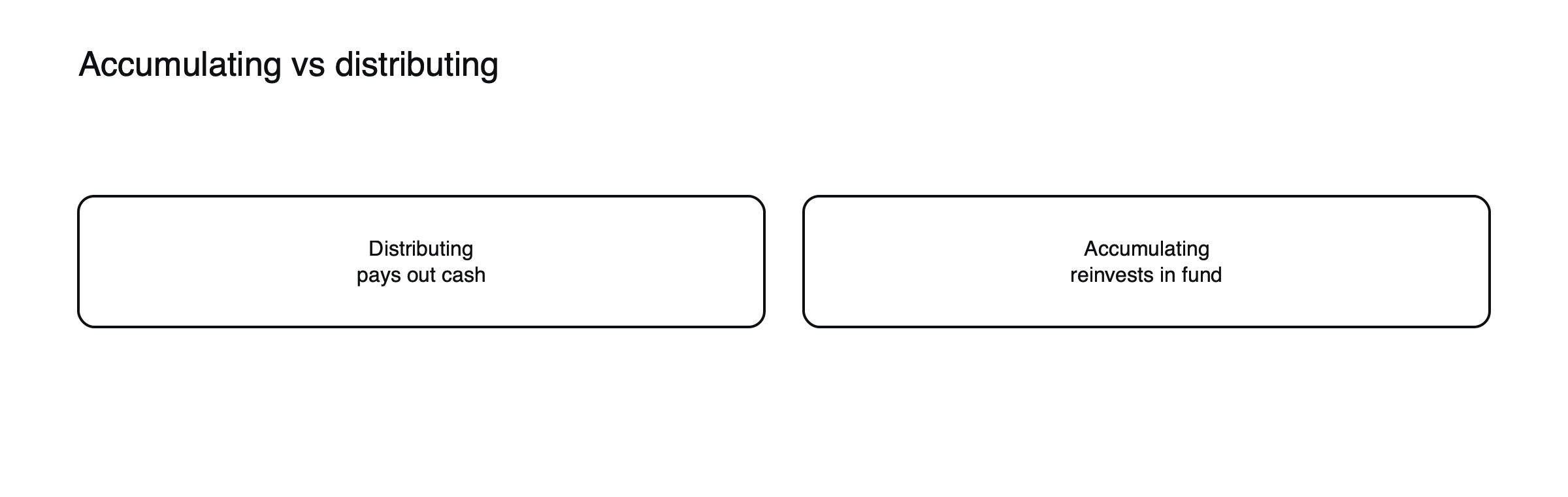
Figure: What happens to dividends.
Accumulating share classes are common among European UCITS ETFs; most US ETFs distribute.
Two share classes, illustrated
Suppose an index yields 2% in dividends and its prices grow 5% a year, and an investor puts $10,000 into each version of an ETF for ten years. (Example values, ignoring fees and tax.) The accumulating version grows by about 7% a year to about $19,672. The distributing version’s price grows to about $16,289, and it pays out roughly $2,516 in dividends over the period, about $18,805 in total if those dividends are simply held as cash. Reinvesting the dividends promptly would close most of the gap, but only if the investor actually does it.
Compounding
Accumulating funds reinvest automatically, so you avoid leaving cash idle or paying trading costs to reinvest small amounts.
The ex-dividend drop, illustrated
When a distributing ETF goes ex-dividend, its price falls by roughly the amount paid. A fund at $100 paying a $2 distribution opens at about $98 on the ex-date, and holders receive $2 per share in cash a few days later. Nothing is lost; value moves from the share price to the investor’s cash. An accumulating ETF shows no such drop, because the income stays inside the fund.
Payment schedules
Distributing ETFs typically pay quarterly or twice a year, depending on the fund and the income its holdings generate. Bond ETFs often pay monthly. Payment dates and amounts are published on the fund’s website and factsheet.
Tax
Some countries tax reinvested income as if it were paid out; others defer tax until sale. Check local rules or ask a tax adviser.
CFDs on ETFs
For a CFD on a distributing ETF, dividends are passed through as cash adjustments; on an accumulating ETF, they are reflected in the price. See what happens to a stock CFD on ex-dividend day.
When accumulating is not the better choice
“Accumulating is always better for growth” ignores tax: in some jurisdictions it can be less efficient than distributing.
See what an ETF is and how much an ETF’s expense ratio costs over 10 years.
Reinvesting yourself
Investors in distributing funds can reinvest dividends themselves, but small amounts may be hard to invest efficiently because of commissions, minimum trade sizes or whole-share requirements. Some brokers offer automatic dividend reinvestment, which removes that friction. Accumulating funds do the same automatically inside the fund.
Planning for income
Investors who need regular income, for example in retirement, may prefer distributing funds, because the payments arrive without having to sell shares. Those still building wealth often prefer accumulating funds, because there is nothing to manage. Some investors hold accumulating funds and sell small amounts when they need cash, which can produce a similar result with more control over timing.
CFD adjustments, worked through
A trader holds a long CFD on 100 shares of a distributing ETF when it goes ex-dividend with a $2 payment. The price drops about $2, reducing the position’s value by about $200, and the provider credits about $200 as a dividend adjustment, so the net effect is roughly zero. A short position would see the reverse: a gain of about $200 from the price drop and a debit of about $200. (Example values.)
Where each type is common
In the United States, ETFs almost always distribute income, partly because of tax rules. In Europe, many ETFs are domiciled in Ireland or Luxembourg under UCITS rules and offer both accumulating and distributing share classes of the same fund, letting investors choose. The same index exposure can therefore be bought in either form, with identical holdings and similar fees.
Reading the yield
Distributing ETFs publish a distribution yield, the income paid over the past year divided by the current price. It indicates the income a holder might expect but changes as dividends and prices change. Accumulating funds have no distribution yield, though their holdings generate the same income; it simply stays inside the fund.
Matching the type to the account
In some countries, tax-advantaged accounts shelter income from tax, which can make the choice between share classes mostly a matter of convenience inside such accounts. In ordinary taxable accounts, local rules on how income and reinvested income are taxed matter much more. Checking how each type is treated where you live avoids unwelcome surprises.
Keeping records
For distributing funds, records of each payment help with tax returns. For accumulating funds, some tax systems require investors to track reinvested income each year, even though no cash is received, which can make records more complex.
Common misreadings
- Believing an accumulating fund avoids tax everywhere.
- Treating the ex-dividend price drop as a loss.
Distributions from bond ETFs
Bond ETFs distribute the interest earned on their holdings, often monthly, which makes distributing bond funds popular with income-focused investors. Accumulating bond ETFs reinvest the interest, so their price rises steadily over time apart from changes in bond prices.
The currency of payments
A distributing ETF pays in its base currency, which may differ from the investor’s own. A euro-based investor in a dollar-denominated distributing fund receives payments whose value in euros changes with the exchange rate, and may pay conversion costs. Accumulating funds avoid these conversions until the shares are sold.
Choosing, step by step
Start with whether you need regular income. Then check how each type is taxed in your country and account, whether your broker reinvests dividends automatically and whether the fund is available in both forms. If income is not needed, tax treatment is neutral and reinvesting would be awkward, an accumulating class is usually simpler; if income is needed or taxes favor payouts, a distributing class may fit better.
How reinvestment works inside the fund
An accumulating ETF receives dividends from its holdings and uses them to buy more of the index’s securities, rather than paying them out. The fund’s net asset value per share rises accordingly. The process is invisible to investors, who simply see a share price that includes all reinvested income.
When needs change
An investor who builds wealth in an accumulating fund may later need income. Rather than switching funds, which can trigger costs and tax, they can sell small amounts of shares periodically, creating their own income stream. Alternatively, they can direct new savings into a distributing class while leaving existing holdings in place. Planning the eventual move from accumulation to income early, and checking the tax consequences of each option, keeps choices open later.
Fees and share classes
Accumulating and distributing classes of the same fund usually charge the same fee and hold the same assets, so their returns are almost identical once distributions are reinvested. Small differences can arise from the timing of reinvestment and from how each class handles cash. Tax and convenience matter far more than these effects.
Frequently asked questions
Which is better for long-term growth?
Before tax, they deliver similar results if dividends are reinvested promptly. After tax, the answer depends on where you live.
Can I switch between share classes?
Usually only by selling one and buying the other, which may trigger costs and tax.
This article is educational content and does not constitute financial, investment, legal or tax advice. Digital assets are volatile and you may lose the amount you invest.