
ETF vs Mutual Fund
ETFs trade all day at market prices and are usually cheaper; mutual funds price once a day at NAV and are often active. How they differ in trading and fees.
ETF vs mutual fund differ mainly in trading and cost. ETFs trade on an exchange all day at market prices and mostly track indices with low fees. Mutual funds are bought from the fund company once a day at net asset value (NAV) and are more often active with higher fees. Both pool money into diversified portfolios.
Side by side
| ETF | Mutual fund | |
|---|---|---|
| Trading | Throughout the day on an exchange | Once a day at NAV |
| Price | Market price, close to NAV | NAV |
| Typical management | Mostly index-tracking | Often active |
| Typical fees | Low | Higher on average |
| Minimum investment | One share | Often a set minimum |
| Transparency | Holdings often daily | Usually periodic |
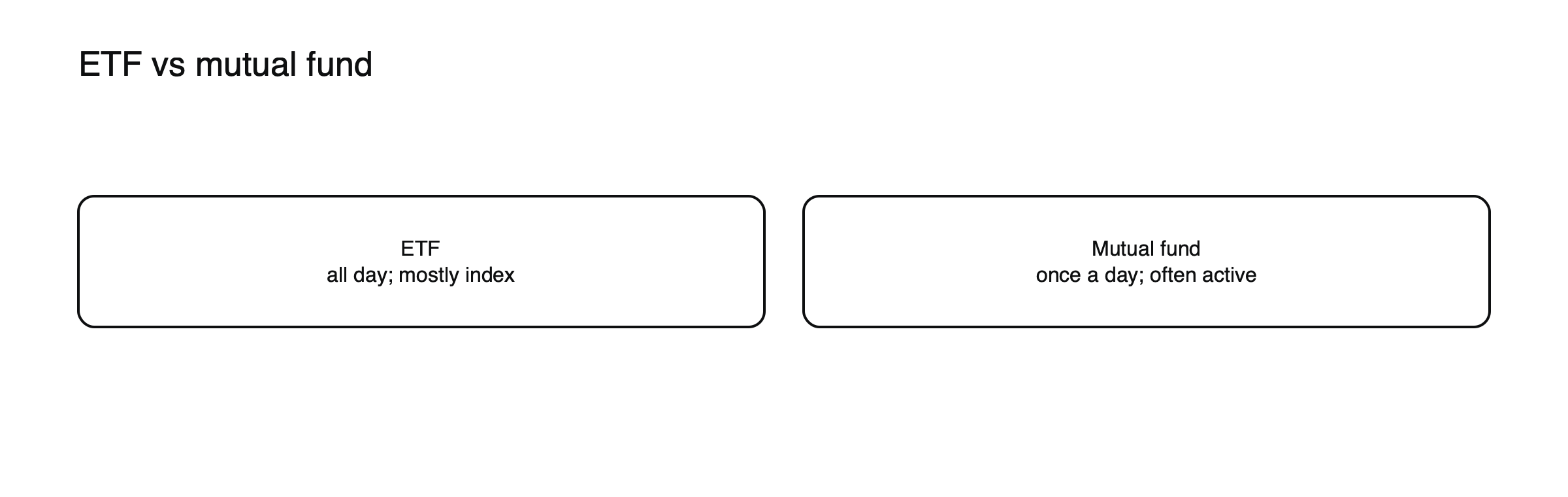
Figure: Two fund structures.
Trading mechanics, illustrated
An investor places an order to buy an ETF at 10 a.m. and it is filled within seconds at the current market price, which they can see. Another places an order for a traditional mutual fund at 10 a.m. and receives that day’s net asset value, calculated after the market closes, so they do not know the exact price until later. If markets fall sharply during the afternoon, the mutual fund investor buys at the lower closing value; if they rise, at the higher one. The ETF investor can also use limit orders to control the price.
Costs over ten years, illustrated
Suppose $10,000 grows 7% a year before fees for ten years. (Example values.) An index ETF charging 0.05% leaves about $19,580; an active mutual fund charging 0.75% leaves about $18,335, about $1,245 less. The active fund needs to beat its benchmark by more than its extra fee each year just to match the cheaper fund, which many active funds fail to do over long periods.
Why money has shifted to ETFs
Low costs and passive investing have driven huge flows: global ETF assets rose from $6.4 trillion in early 2020 to a record $23 trillion in 2026.
Tax efficiency
In the United States, ETFs are often more tax-efficient than mutual funds. When investors leave a mutual fund, the fund may have to sell securities, realizing gains that are distributed to remaining investors and taxed. ETFs usually meet redemptions by handing over securities in kind to authorized participants, which can avoid realizing gains inside the fund. Tax rules differ in other countries, so the advantage is not universal.
When mutual funds still fit
Automatic investing plans, certain retirement accounts and specialist active strategies that are not available as ETFs.
When ETFs are not the cheaper choice
“ETFs are always cheaper” is not universal: some index mutual funds charge fees as low as ETFs, and frequent ETF trading adds spreads and commissions.
See what an ETF is, ETF CFDs vs buying ETF shares and how much an ETF’s expense ratio costs over 10 years.
Index mutual funds
Not all mutual funds are expensive or active. Many fund companies offer index mutual funds tracking the same indices as ETFs, sometimes with comparable fees. For investors who prefer to buy directly from a fund company, invest fixed amounts automatically or avoid spreads, these can be as cost-effective as ETFs.
Share classes and charges
Mutual funds may offer several share classes with different fee structures, and some charge sales commissions on purchase or sale in certain markets. ETFs generally have a single share class traded on an exchange, with costs limited to the expense ratio, spreads and any brokerage commission.
Liquidity in stressed markets
Both structures can face strain when the underlying assets become hard to trade. Mutual funds may suspend redemptions in extreme cases, especially those holding illiquid assets. ETF shares continue to trade on the exchange, but their prices can move away from the value of their holdings, as some bond ETFs did in March 2020. See why ETF prices can trade away from their NAV.
Which suits whom
| Need | Usually better fit |
|---|---|
| Trading during the day | ETF |
| Automatic monthly investing in set amounts | Mutual fund, or ETF where brokers allow fractional shares |
| Lowest cost index exposure | Either, if fees are comparable |
| Specialist active strategy | Whichever offers it |
Active ETFs
The line between the two structures has blurred. Many fund managers now offer active strategies as ETFs, and some have converted mutual funds into ETFs. Active ETFs trade like other ETFs but charge fees closer to those of active mutual funds. The structure no longer tells you whether a fund is active or passive; its strategy does.
Automatic investing
Mutual funds have long suited automatic monthly investments of a fixed amount, because they accept fractional units. ETFs historically required buying whole shares, but many brokers now offer fractional shares and automatic investment plans for ETFs, narrowing the difference.
Minimum investments
Many mutual funds set minimum initial investments, while an ETF can be bought for the price of one share, or less with fractional shares. For investors starting with small amounts, that flexibility can matter.
Performance after costs
What matters to investors is return after all costs. A low-cost index fund, whether an ETF or a mutual fund, has a structural advantage over higher-cost active funds, many of which trail their benchmarks over long periods. Comparing net returns over several years, and against the same benchmark, gives a fair picture.
Common misreadings
- Assuming every ETF is a low-cost index fund.
- Overlooking spreads and commissions when trading ETFs often.
Switching from a mutual fund, illustrated
An investor holds $50,000 in an active mutual fund charging 0.75% and considers moving to an index ETF charging 0.05%, a saving of about $350 a year. (Example values.) If selling the fund triggers taxable gains, the tax bill may exceed several years of savings, so the switch may make sense only gradually, in tax-sheltered accounts or when gains are small. In accounts without tax on switching, the decision is mostly about costs and preferences.
Retirement accounts
Some workplace retirement plans offer only mutual funds, while personal retirement accounts often allow ETFs. Within tax-sheltered accounts, the tax efficiency advantage of ETFs matters less, and the choice comes down to fees, available funds and convenience.
Closures and mergers
Both ETFs and mutual funds can close or merge if they fail to attract enough assets. Investors usually receive the value of their holdings, but closures can create unexpected tax events and the need to reinvest. Larger, established funds are less likely to close.
Transparency
Most ETFs publish their full holdings every day, so investors always know what they own. Many mutual funds publish holdings monthly or quarterly, often with a delay. For investors who want to check exposure closely, such as overlap with other holdings, daily transparency is a practical advantage of ETFs.
A decision checklist
- Do you want to trade during the day or invest automatically?
- Which funds are available in your account or retirement plan?
- How do total costs compare, including spreads and commissions?
- Are there tax differences where you live?
- Is the strategy you want available in both forms?
Costs beyond fees
ETF investors pay the bid-ask spread and any commission each time they trade, which matters for frequent small purchases. Mutual fund investors avoid spreads but may face sales charges in some markets or minimum holding periods. For buy-and-hold investors adding money every month, comparing these trading costs alongside the annual fee shows which structure is actually cheaper for their pattern of investing. Commission-free brokers have reduced, but not removed, the difference for most investors.
Frequently asked questions
Can I lose more in an ETF than in a mutual fund?
Not because of the structure. Both rise and fall with their holdings; the difference lies in how they trade and what they cost.
Why do some investors still prefer mutual funds?
For automatic investment plans, retirement account rules or access to particular active managers.
This article is educational content and does not constitute financial, investment, legal or tax advice. Digital assets are volatile and you may lose the amount you invest.
Sources
- Global ETF assets hit record $23T in May (over $1 trillion of inflows in 2026 by May, per ETFGI) — The Daily Upside, 2026
- First $1 trillion ETF (global ETF assets $21.9 trillion at end-April 2026 vs $6.4 trillion in early 2020; 83 months of net inflows, per ETFGI) — 21st Century Business Herald, June 2026