
What Do Analyst Upgrades and Downgrades Mean for a Stock?
Analysts rate stocks buy, hold or sell and set price targets. How upgrades and downgrades move prices, why the effect often fades and how to read them.
Analyst upgrades and downgrades are changes in an analyst’s view of a stock, usually between buy, hold and sell, often with a new price target. They can move a stock, especially from influential analysts or when reversing a long-held view, but the effect is often short-lived unless it reflects new earnings information.
How ratings work
- Ratings: buy (outperform), hold (neutral) and sell (underperform), with wording varying by firm.
- Price targets: the analyst’s estimate of fair value, usually over 12 months.
- Estimates: forecasts for revenue and earnings that feed the consensus. See how earnings reports move share prices.
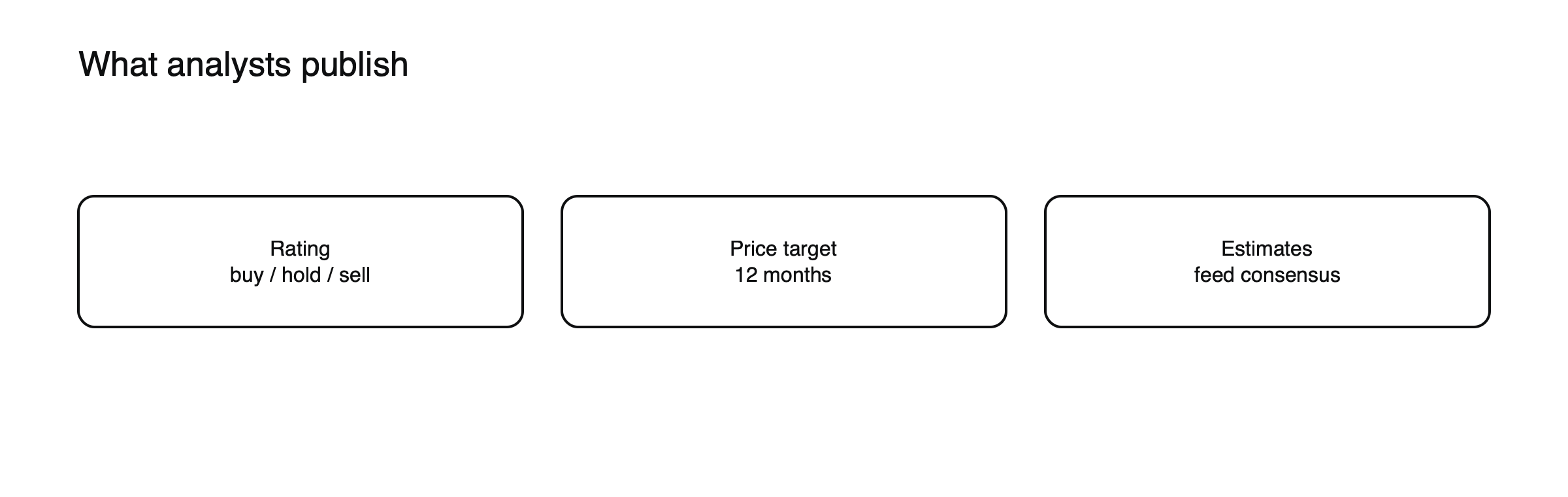
Figure: What analysts publish.
How a price target is built
Many price targets combine a forecast of earnings with a multiple. If an analyst expects ExampleCo to earn about $2.15 a share next year and thinks it deserves 22 times earnings, the target is about $47, about 21% above the current $39. Another analyst using 18 times would get about $39, implying no upside. (Hypothetical figures.) Small differences in assumptions produce very different targets, which is why targets are best read as a guide to the analyst’s thinking rather than a forecast.
Why they move prices
They can change how many investors want to own a stock, and estimate changes shift the consensus a company will be judged against next quarter.
A rating change, illustrated
Suppose a widely followed analyst who has rated a company hold for two years upgrades it to buy, raising the target from $40 to $52, on the view that a new product will lift margins. The shares rise 4% the next morning. Over the following week, other analysts publish notes; if they agree and raise estimates, the move may extend; if they do not, it often fades. (Hypothetical scenario.)
Initiations
When an analyst starts covering a company, called an initiation, the first rating can move the shares, especially for smaller companies with few existing analysts. Initiations often follow a company’s share sale or listing, when the banks involved begin coverage.
Why to read them critically
- Most ratings are buys: sell ratings are relatively rare, so a downgrade to hold can be a meaningful signal.
- Conflicts of interest: analysts’ firms may have business relationships with the companies they cover.
- Herding: analysts often move together after a big price move, following rather than leading.
- Targets change with price: targets are frequently adjusted after the stock has already moved.
Estimate revisions
Changes in analysts’ earnings forecasts, often called revisions, tend to matter more than rating changes. When many analysts raise their estimates for a company, the consensus moves up and the company faces a higher bar, but rising estimates have historically been associated with rising share prices. Data providers track revision trends, and some investors use them as a signal in their own right.
Consensus ratings
Data services combine individual ratings into a consensus, often shown as the share of analysts rating a stock buy, hold or sell, and an average price target. Because most ratings are buys, a stock with 60% buy ratings may be relatively less favored than it sounds. Changes in the consensus over time are more informative than its level.
Independent and sell-side research
Analysts at banks and brokers, known as the sell side, publish research partly to support their firms’ trading and advisory businesses. Independent research firms and analysts at investment funds, the buy side, may take different views, but their work is often not public. Reading several sources helps balance any one perspective.
How long the effect lasts
Rating changes that reflect new information, such as a detailed industry check or a change in a company’s outlook, can have lasting effects. Those that follow a large price move, or simply move a target closer to the current price, usually fade within days. The best test is whether estimates change along with the rating.
What it means for traders
Single rating changes often cause brief moves that fade. Changes in earnings estimates across many analysts matter more than one headline. See what company guidance is and what moves stock prices.
Reading an analyst note
A typical note opens with the rating, the price target and a summary of the argument, followed by changes to estimates, the reasons behind them and the main risks. The most useful parts are often the estimate changes and the assumptions behind the target, not the rating itself. Comparing an analyst’s numbers with the consensus shows how far the view differs from the market’s.
Ratings and short-term traders
Rating changes are often released before the market opens, so shares may gap on the news. For traders holding positions, a surprise downgrade can cause a loss at the open, much like a small earnings gap. For those looking to enter, the first move after a rating change is often the largest, and chasing it carries the same risks as chasing any news-driven move.
A quick check on any rating change
- Is the analyst widely followed, and how often have their calls been right?
- Did estimates change, or only the rating and target?
- What new information does the note contain?
- Did the change come after a big price move?
- Are other analysts moving the same way?
Answering these takes a minute and usually shows whether a rating change is real news or simply noise around a price move that has already happened.
Frequently asked questions
Why are sell ratings so rare?
Partly because analysts’ firms may want business relationships with the companies they cover, and partly because companies may limit access to analysts who are persistently negative. A downgrade to hold can therefore be the equivalent of a sell.
Should I trade on an upgrade or downgrade?
Single rating changes often produce short-lived moves. It is usually more useful to check whether the change reflects new information and whether estimates are moving with it.
This article is educational content and does not constitute financial, investment, legal or tax advice. Digital assets are volatile and you may lose the amount you invest.