
What Is Company Guidance and Why Can It Outweigh Earnings?
Guidance is a company's own forecast for revenue or earnings. Why markets often react more to guidance than to the quarter just reported, with Meta's 2022 case.
Company guidance is management’s own forecast of future results, such as next quarter’s revenue or full-year earnings per share. It can outweigh the quarter just reported because prices reflect expected future profits. A raised forecast can lift a stock after weak results; a cut can sink it, as Meta’s did in 2022.
What guidance includes
- Revenue ranges for the next quarter or year.
- Earnings per share or profit targets.
- Margins, costs and investment plans, such as capital spending.
- Qualitative comments about demand and risks.
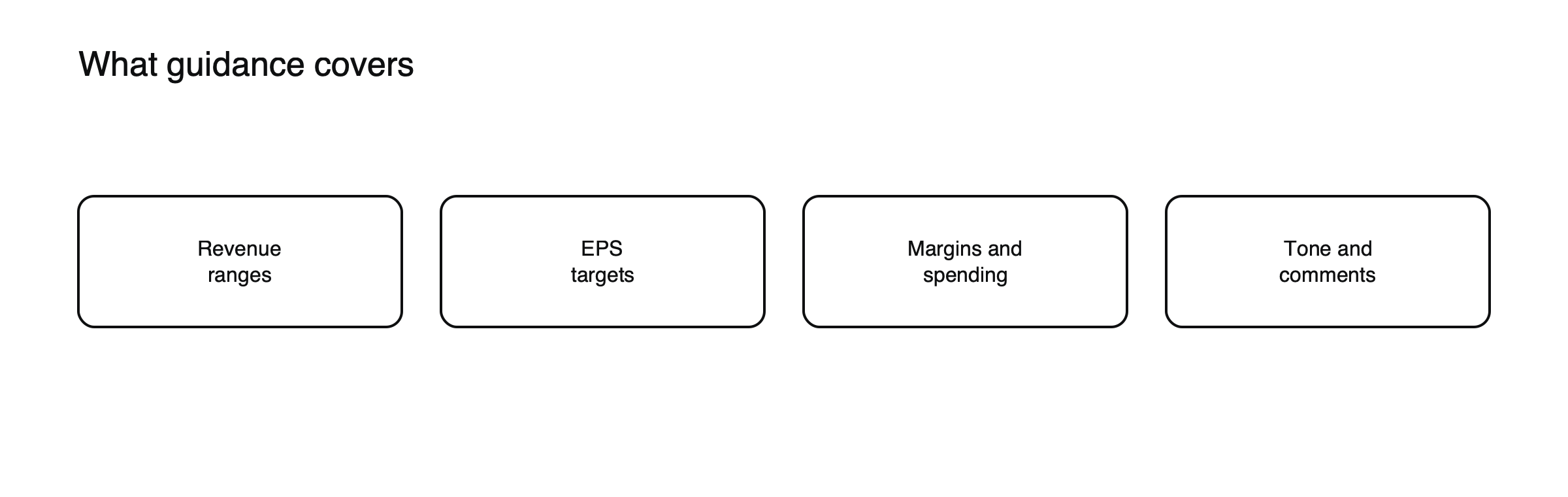
Figure: What companies typically guide on.
Some companies give detailed guidance; others give little or none.
Forms of guidance
Guidance comes in several forms. Some companies give a range for next quarter’s revenue and EPS; others give full-year targets updated each quarter. Some offer only qualitative comments about demand, and some publish long-term targets, such as margins they aim to reach in three to five years. The more specific the guidance, the more closely analysts’ estimates tend to follow it.
Why it moves prices
Analysts adjust their estimates to guidance, and investors reprice the stock on the new expected path. A cut in guidance means lower expected profits across many future periods, not just one quarter.
Guidance against consensus, worked through
Suppose a company guides to full-year EPS of $2.05 to $2.15, a midpoint of $2.10, while analysts had expected $2.20. The midpoint is about 4.5% below consensus. Analysts will likely cut their estimates toward the guidance, and if investors were paying 20 times expected earnings, the lower forecast alone implies a share price about 4.5% lower, more if the market also lowers the multiple because growth looks weaker. (Hypothetical figures.)
Example: Meta, February 2022
Meta forecast first-quarter revenue below expectations, citing Apple’s privacy changes and competition. Shares fell 26% the next day, erasing over $200 billion of market value. Analysts said the guidance, more than the quarter, spooked investors.
Example: Nvidia, May 2023
Guidance can lift a share as dramatically as it can sink one. In May 2023, Nvidia guided to about $11 billion of revenue for the next quarter, roughly 50% above the analyst consensus of about $7.2 billion, citing demand for its artificial intelligence chips. The shares rose 24% the next day, and analysts across the industry raised their forecasts.
Example: Netflix, April 2022
Netflix’s April 2022 report showed a loss of about 200,000 subscribers, and its guidance for a further loss of about 2 million in the following quarter told investors the problem was not a one-off. The shares fell 35% the next day. For subscription companies, guidance on subscriber numbers can matter as much as guidance on profits.
Reading guidance:
- Compare it with analyst consensus, not with the previous quarter.
- Watch for changes in tone: “cautious,” “softening demand.”
- Note whether a company has a habit of guiding conservatively and then beating.
See how earnings reports move share prices, why stocks sometimes fall after beating earnings and what moves stock prices.
Beat and raise
Many companies guide conservatively, so they can report results above their own forecasts. When a company habitually beats and raises its guidance, investors begin to expect it, and a quarter where it merely meets guidance can disappoint. Knowing a company’s track record helps judge whether its guidance is cautious, realistic or optimistic.
Withdrawn guidance
In periods of extreme uncertainty, companies sometimes withdraw guidance altogether, as many did at the start of the pandemic in 2020. Withdrawal removes an anchor for analysts’ estimates and often coincides with high volatility in the shares. Reinstating guidance later can be read as a sign of returning confidence.
Companies that do not guide
Some companies give little or no formal guidance, arguing that it encourages short-term thinking. Their shares can react more sharply to results, because analysts have less to go on and expectations are more dispersed. For these companies, management commentary on the call carries extra weight.
Guidance and analysts
After each report, analysts update their models, often moving close to the company’s guidance. The new consensus becomes the bar for the next report. Tracking revisions in the days after results shows how much the guidance changed expectations.
The language of guidance
Companies use standard words when updating guidance. They “raise” or “lower” a range, “reiterate” or “reaffirm” an existing one and “narrow” a range by bringing its ends closer together. A narrowed range that keeps the same midpoint signals more confidence; one that drops the top end is a quiet cut. Small wording changes can move a share if they shift where investors think results will land.
Narrowing a range, illustrated
Suppose a company had guided to full-year EPS of $2.00 to $2.20 and now narrows it to $2.05 to $2.15. The midpoint is unchanged at $2.10, but the range is tighter. If consensus was $2.15, the narrowing removes the chance of the top-end result analysts were hoping for, and the share may slip. If consensus was $2.05, the same update reassures investors. (Hypothetical figures.)
How consensus is formed
Analysts covering a company build models of its revenue, costs and earnings and publish forecasts. Data providers collect these into a consensus, usually the average or median. Analysts tend to move their numbers toward a company’s guidance after each report, so guidance and consensus are closely linked, though analysts may sit above or below guidance if they think the company is being too cautious or too optimistic.
Investor days and long-term targets
Some companies hold investor days every few years, setting out multi-year targets for growth, margins and cash returns. These targets can shift long-term expectations more than quarterly guidance, and missing them later can damage management’s credibility.
Guidance and CFD positions
Because guidance often drives the largest moves, CFD traders holding positions through reports face the risk of gaps whichever way the outlook surprises. Sizing for a gap, rather than for a normal day’s move, is the main protection. See how earnings reports move share prices.
Guidance across sectors
What companies guide on varies by industry. Retailers often guide on same-store sales and margins; software companies on recurring revenue and billings; energy producers on output and capital spending; banks on interest income and costs. Knowing which guided figures matter most in a sector helps identify the line that will drive the reaction, which may not be revenue or EPS at all.
Guidance that is too cautious or too bold
Some managements consistently guide low, so they can beat and raise; investors learn to discount their caution. Others guide optimistically and later have to cut, which damages credibility and often leads to larger falls when cuts come, because investors begin to doubt every forecast. A company’s history of guiding, visible by comparing past guidance with actual results, is one of the most useful pieces of context for interpreting a new forecast.
When guidance surprises
A large guidance surprise, in either direction, changes the share’s expected path for many quarters, which is why reactions can be so large. After such a surprise, it helps to ask three questions: what drove the change, how confident management sounded on the call and whether peers are likely to see similar effects. A raise driven by one large order may be less durable than one driven by broad demand; a cut caused by a temporary supply problem may be less damaging than one caused by weakening customers. Writing down the answers, and checking them against the next quarter’s results, builds a clear, useful record of how reliable each management team’s forecasts have been over time.
Frequently asked questions
Is guidance legally binding?
No. It is management’s forecast, usually accompanied by warnings that actual results may differ, though companies are expected not to mislead investors.
Why do some shares rise after guidance is cut?
Because investors may have expected an even larger cut, or because the cut removes uncertainty, so the outcome is better than feared.
This article is educational content and does not constitute financial, investment, legal or tax advice. Digital assets are volatile and you may lose the amount you invest.
Sources
- Meta shares plummet 26% on tepid forecast (guidance spooked investors) — Reuters via Euronews, February 2022
- Facebook parent Meta falls behind Nvidia (first-quarter forecast missed estimates; record 26% drop) — Benzinga, February 2022
- Why Nvidia stock skyrocketed 239% in 2023 (Q2 revenue guidance of $11 billion vs $7.2 billion consensus; shares +24% on May 25, 2023) — The Motley Fool, January 2024
- Nvidia Q1 beat (EPS $1.09 vs $0.92 expected; revenue $7.19 billion vs $6.52 billion) — StreetBeat / Benzinga, May 2023
- Netflix shares fall 35% after revealing drop in streaming subscribers ($54 billion of market value; closed at $226.19; forecast loss of another 2 million subscribers) — Bloomberg via The Irish Times, April 2022
- Netflix suffers first loss in worldwide subscribers in its history (200,000 lost vs a forecast gain of 2.5 million) — AP, April 2022