
Common Mistakes When Buying Altcoins
The altcoin mistakes that cost buyers most, from chasing listings and ignoring unlocks to thin liquidity and false diversification, and what to do instead.
Of all altcoin mistakes, the costliest is buying at peak attention, usually right after a big exchange listing or a viral rally, when early holders are selling. A study of tokens listed on major exchanges in 2024 found most later fell, by about half on average. Ignoring unlocks, liquidity and position size completes the list.
Rules, not regrets
Most lists of altcoin mistakes describe what went wrong after the money is gone. The rules below turn the same lessons into habits you can apply before buying. Each comes with the evidence behind it and a quick way to check it.
Let the listing settle before you buy
The excitement around a new listing is the most expensive moment to buy. Among 389 tokens listed on six major exchanges in 2024, the average token jumped around its listing and 89% later fell from their listing price, by an average of 52%. Gains tend to come between the announcement and the first hours of trading, when early holders and fast traders are already selling to latecomers. Waiting for the first weeks of trading to pass costs little and shows how the token behaves once the initial rush is over. See why new token listings move prices.
Read the unlock schedule before the chart
A price chart shows what happened; an unlock schedule shows what is coming. Tokens with a small share of supply in circulation and large releases ahead face steady selling as insiders receive their allocations. Before buying, find the vesting schedule in the project’s documents or an unlock tracker, and add up how much will be released over the next twelve months as a share of today’s circulating supply. If that number is large, demand has to grow fast just to keep the price steady. See what token unlocks are.
Size the trade to the market, not to your hopes
On a small token, the price you see is often not the price you get. Thin order books and shallow liquidity pools mean that buying moves the price up against you and selling moves it down, sometimes by several percent for a modest order. Check the order book depth or the pool size for the amount you plan to trade, and assume you will face the same cost on the way out, probably at a worse moment. See what slippage is.
Count ten altcoins as one bet
Spreading money across many altcoins feels like diversification, but in sell-offs most of them fall together with bitcoin, and usually by more. A portfolio of ten small tokens can behave like a single leveraged bet on crypto sentiment. Size the whole altcoin portion as one position, decide how much of your total savings it can be, and keep it there. See why most cryptocurrencies move together.
Buy the token, not the name
Popular names attract imitators. The same name can exist on several networks, as wrapped or bridged versions, or as outright fakes with copied logos. Confirm the official contract address from the project’s own website or documentation, check that the network matches the one you are using, and be suspicious of any token reached through a link in a message or advert.
Check that the product needs the token
Themes such as AI, gaming or real-world assets attract money quickly, and many tokens ride a theme without a working product behind them. Ask two questions: do people use the product today, and would it work just as well if users paid in a stablecoin instead of the token? If the answer to the second is yes, the token’s role may be mostly promotional. See utility tokens vs governance tokens.
Decide in advance what would make you sell
Tokens rarely collapse in a day; most fade as development slows, liquidity leaves and exchanges delist them. More than half of the tokens CoinGecko tracked since 2021 had stopped trading by the end of 2025. Writing down, before buying, the conditions that would make you exit, such as a delisting, an abandoned roadmap or a major unlock, makes it easier to act while there is still a market. Price targets alone tend to be renegotiated as the price falls.
Use money that can sit through a long decline
Altcoins can fall 80% or more and stay down for years. Money you may need for rent, bills or a planned purchase is the money most likely to be sold at the worst moment. Only put into altcoins what you could leave untouched through a long bear market without changing your plans.
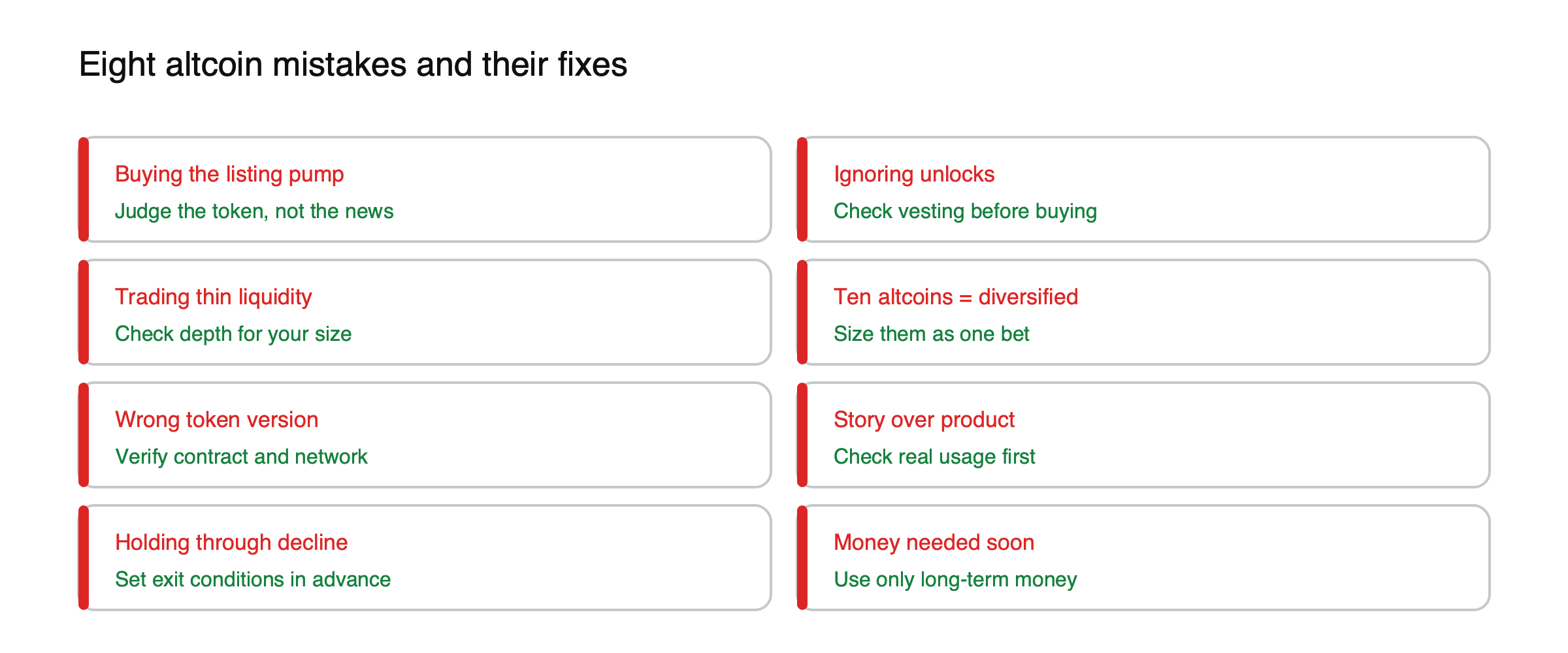
Figure: The eight mistakes in this article and what to do instead.
Treat airdrops and points as a cost, not free money
Chasing future airdrops by using new protocols can look like a free option, but it has real costs: network fees, time, the risk of interacting with untested contracts and the chance that the reward never comes or is worth little when it does. Many airdropped tokens fall sharply once recipients start selling. Before farming, estimate what you are spending and what you are risking, and treat any reward as a bonus rather than the reason for the activity. See what a crypto airdrop is.
Keep records from the first trade
Altcoin trading often means many small swaps across several exchanges and wallets, and in many countries each swap can be a taxable event. Reconstructing a year of trades from memory is painful and error-prone. Exporting histories regularly and noting the value of each trade when it happens saves time later and prevents overpaying tax. See how to keep records of your crypto transactions. A simple spreadsheet updated every month is usually enough for most casual traders, and dedicated crypto tax software helps once trades number in the hundreds each tax year.
The checks in one table
| Check | Where to look | Red flag |
|---|---|---|
| Listing timing | Exchange announcements | Buying within hours of a big listing |
| Unlocks | Project documents, unlock trackers | Large releases in the next year |
| Liquidity | Order book or pool depth | Your order would move the price noticeably |
| Concentration | Block explorer top holders | A few wallets hold most of the supply |
| Contract | Official site, explorer | Address differs from the official one |
| Product | Usage data, app itself | No users, or no need for the token |
For a full research routine, read how to research a crypto asset. For what altcoins are, see what an altcoin is.
This article is educational content and does not constitute financial, investment, legal or tax advice. Digital assets are volatile and you may lose the amount you invest.