
Why Do New Token Listings Move Prices?
Exchange listings often lift a token's price on the news, then most of the gain fades. See what drives the listing effect, what studies found and what to watch.

The token listing price effect comes mainly from access: a large exchange opens a token to millions of new buyers, and traders rush to buy before they arrive. Most of the move happens on the announcement and the first hours of trading. Recent studies show the gains usually fade below the listing price.
What pushes the price around a listing
New buyers and new liquidity
A major exchange brings users who could not easily buy the token before. Traders anticipate that demand and price it in quickly, often within minutes of an announcement.
Traders getting in first
Many buy between the announcement and the start of trading, hoping to sell to the new arrivals. That is why returns tend to be concentrated before the listing goes live rather than after.
A perceived seal of approval
Some buyers read a listing as a sign that the exchange reviewed the project and found it credible, which adds to demand even if the review was limited.
Sellers waiting for the same moment
Early investors and teams often wait for deep liquidity before selling, so the listing that brings buyers also brings supply. In tokens with large holdings by insiders, this can overwhelm the new demand.
The market around it
In a rising market, listings tend to jump harder and fade more slowly; in a falling one, the effect can be close to zero or negative from the start.
What the studies found
- The early “Coinbase effect.” An analysis by Messari found that tokens listed by Coinbase gained an average of 29% in the five days after the announcement, while Binance and Gemini announcements showed slightly negative five-day averages in the same study. A 2020 study by eToro and The TIE found Coinbase-listed tokens rose about 43% between announcement and listing, and about 7.5% more on listing day, before falling the next day.
- Recent listings faded. A study of 389 tokens listed in 2024 on six major exchanges found an average jump of 54% around the listing, after which 89% fell, by an average of 52%. Binance listings jumped most, about 87%, and fell furthest, about 70%; Coinbase listings jumped about 41% and fell about 28%.
- Long-term returns. Research by Four Pillars on tokens listed on Binance in 2024 found median returns of about 1% after one day and 2.9% after 30 days, but about −60% after six months.
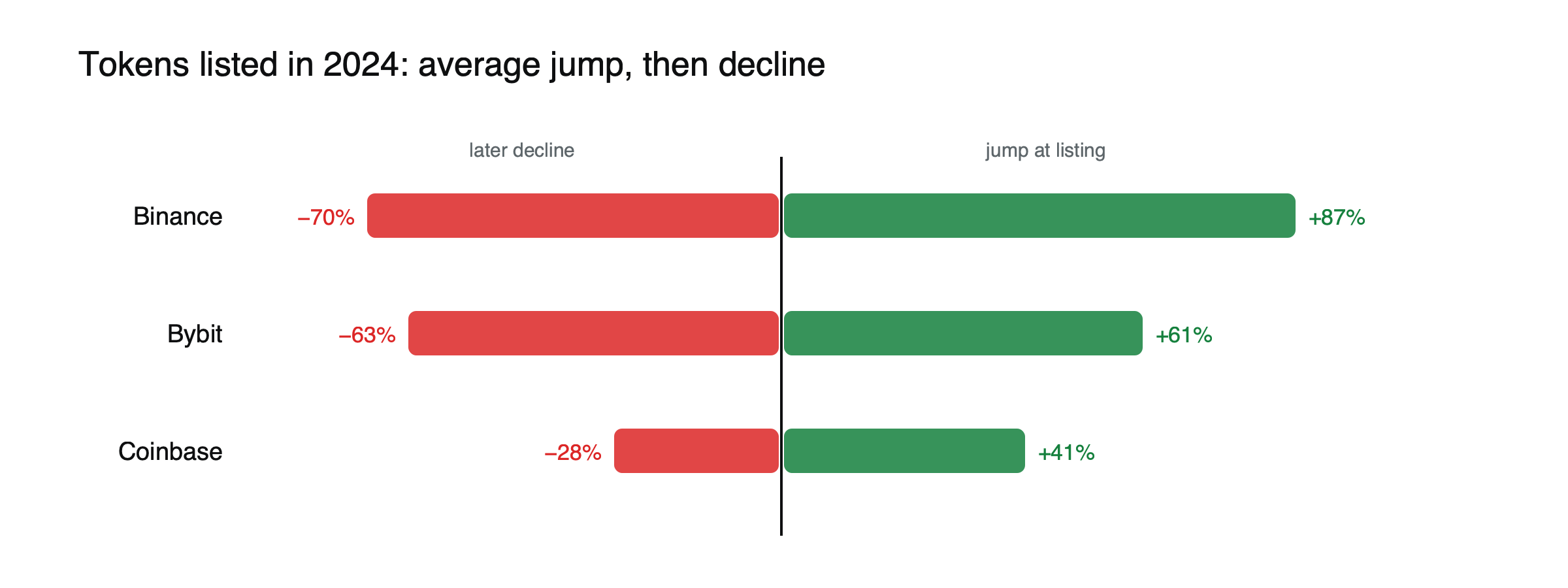
Figure: Pump and dump by exchange for 389 tokens listed in 2024. Source: CryptoNinjas and Storible study via BitPinas.
A listing day, step by step
A typical listing follows a pattern. The exchange announces the token and a start time. Deposits open first, so holders on other venues can move tokens in ahead of trading, which is when insiders who plan to sell get ready. Trading starts, often with a sharp spike as pent-up orders fill against thin early order books, then swings widely during the first hour. If the token came with an airdrop or a large unlocked allocation, recipients start selling as soon as they can. Within days, the price usually settles somewhere well below the first-hour high, and attention moves to the next listing.
Centralized listings versus decentralized trading
Many tokens now trade on decentralized exchanges long before any major centralized exchange lists them. In those cases, the listing does not create access from nothing; it moves trading to a venue with more users and deeper order books. The price effect then depends on how much demand was waiting outside the decentralized market, which is usually less than in the days when a listing was a token’s first chance to trade at all.
Futures listings and short sellers
When an exchange also lists perpetual futures on a token, traders can bet on its price falling as well as rising. Early backers can use futures to hedge holdings they cannot yet sell, and short sellers can target tokens they see as overvalued. A futures listing therefore tends to add selling pressure that a spot listing alone does not, which partly explains why recent listings have faded faster than those in earlier years.
Market makers and listing arrangements
Exchanges and projects often rely on professional market makers to keep order books deep after a listing. In some arrangements, the market maker borrows tokens from the project to quote prices and holds options to buy them later, which can lead to selling if the token rises. These deals are rarely disclosed in full, but they shape how a token trades in its first months. Thin disclosure is one more reason to be cautious about buying in the first days after a listing.
Listings also affect tokens that are not being listed. When a major exchange adds a new token, money can flow out of older tokens in the same category as traders rotate into the newest name, and attention on social media shifts with it. During busy periods, a steady stream of new listings competes for the same pool of buyers, which is one reason why so many recent listings faded quickly: each new token drew capital that might otherwise have supported the last one. For holders of existing tokens, watching the listing calendar can explain sudden weakness that has nothing to do with the project itself, and can help avoid reading a market-wide rotation as a problem specific to one token.
Why the effect has weakened
Exchanges compete to list tokens early, so many tokens now launch on several venues at once and the “first big listing” is less of an event. Tokens also arrive with large valuations and supply waiting to unlock, so early backers have both the reason and the liquidity to sell. And the pattern is well known, so more traders try to sell into the pop.
What to watch around a listing
- The gap between announcement and trading, when most of the move tends to happen.
- How much supply is unlocked at listing and over the following months.
- Where the token already trades and how deep those markets are.
- The broader market trend, which can overwhelm any listing effect.
For the mistakes this leads to, read common mistakes when buying altcoins. For how exchanges list and trade assets, see how crypto exchanges work, and for context, what an altcoin is.
This article is educational content and does not constitute financial, investment, legal or tax advice. Digital assets are volatile and you may lose the amount you invest.
Frequently asked questions
Should I buy a token when its listing is announced?
The studies above suggest that most gains around a listing happen quickly and often reverse. Buying after an announcement means competing with traders who moved first and holders waiting to sell, so the odds favor caution rather than speed.
Does delisting have the opposite effect?
Usually. Removing a token from a major exchange cuts off access and liquidity, and prices often fall when a delisting is announced, sometimes sharply for smaller tokens with few other venues.
Sources
- Excitement over the ‘Coinbase effect’ (Messari: 29% average five-day return; Binance and Gemini slightly negative) — Fortune, April 2021
- How exactly do exchange listing announcements impact asset prices? (eToro and The TIE, 2020 data: 43% then 7.5%) — CT Markets Pro
- Study: 98% of Binance-Listed Tokens Dump After Pump (389 tokens, 2024) — BitPinas, 2025
- The 98% of new tokens listed on CEX experience a price crash (54% average pump) — The Cryptonomist, March 2025
- Binance listing: flash or fade? (median +1.0% at 1 day, +2.9% at 30 days, −60% at 6 months) — Four Pillars Research