
What Is BNB?
BNB is the token behind Binance and BNB Chain, used for fees, discounts and network gas. Learn how its burn works, how it started and the concentration risks.
BNB is the native token of BNB Chain and the token most closely tied to the Binance exchange. It pays gas fees on BNB Chain and brings fee discounts and other benefits on Binance. BNB began in 2017 with 200 million tokens; regular burns aim to cut that to 100 million. Its fortunes remain closely linked to one company.
From exchange token to network gas
BNB was created in 2017 as a token on Ethereum to fund and promote the Binance exchange. It later moved to Binance’s own blockchain and became the gas token for BNB Smart Chain, a network compatible with Ethereum’s smart contracts. Today BNB has two roles: a utility inside Binance’s products and the fuel for applications on BNB Chain. Our guide to exchange tokens covers how this type of token works in general.
BNB by the numbers
| Created | 2017 |
| Initial supply | 200 million BNB |
| Target supply | 100 million BNB |
| Supply in November 2024 | About 144 million BNB |
| Main uses | Gas on BNB Chain; benefits on Binance |
How the supply shrinks
BNB started with 200 million tokens. Binance committed to remove half of them over time, and does so through regular burns:
- Quarterly auto-burns follow a published auto-burn formula.
- Real-time burns remove part of the gas fees paid on BNB Chain.
By November 2024, after the 29th quarterly burn, total supply stood at about 144 million BNB, with about 43.5 million still to burn to reach the 100 million target.
What the burns add up to
Going from about 144 million to 100 million would remove roughly 30% of the supply that existed in late 2024. Burns reduce supply only if demand holds steady; they do not create demand on their own. The quarterly amount also depends on a formula tied to BNB’s price and the number of blocks produced, so a higher price can mean fewer tokens burned in a quarter, not more. See inflationary vs deflationary tokens.
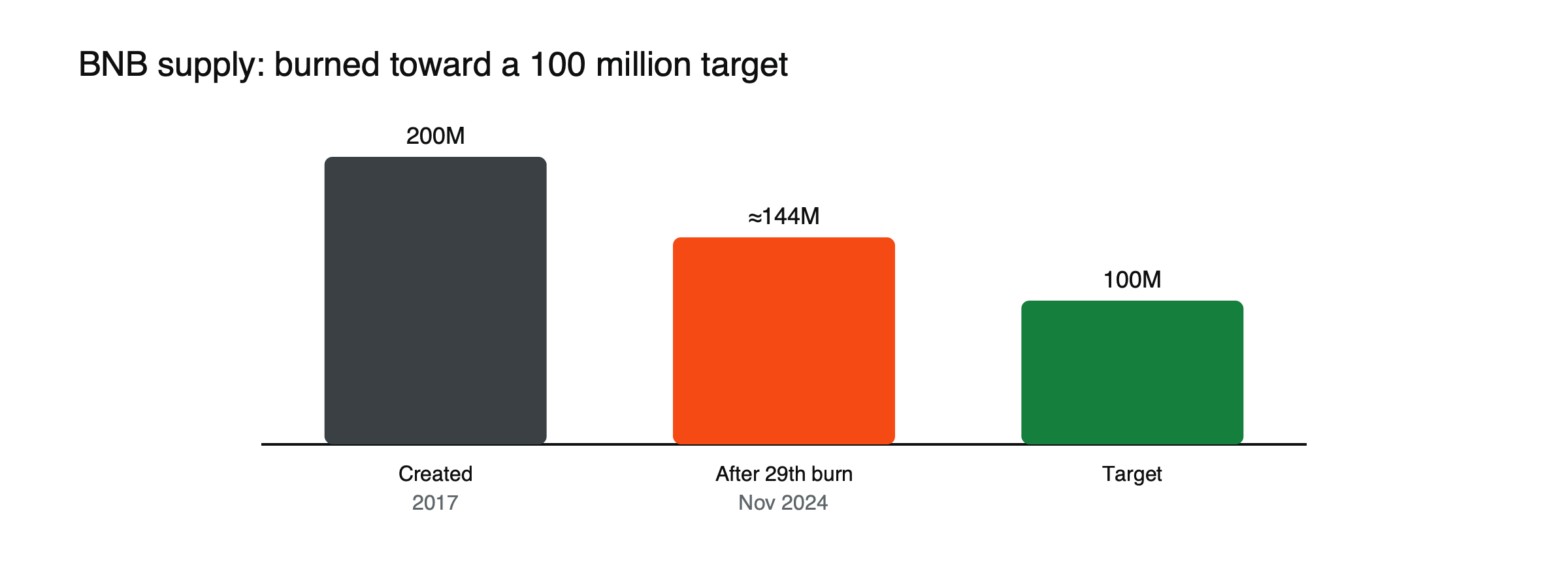
Figure: BNB’s supply path. Source: ForkLog, November 2024 (29th quarterly burn).
What BNB gives holders on Binance
Much of BNB’s demand comes from inside the exchange. Holders can use it to pay trading fees at a discount, and Binance has offered programs in which users lock BNB to receive allocations of new tokens or other rewards. These benefits tie the token’s appeal closely to Binance’s popularity: when trading on Binance is busy, using and holding BNB is more attractive; when activity moves elsewhere, the benefits shrink.
BNB Chain beyond the exchange
BNB Chain runs applications compatible with Ethereum’s smart contracts, with lower fees and faster blocks than Ethereum’s main chain. That made it popular for trading, games and token launches, especially among users in Asia and emerging markets. It achieves its speed with a relatively small set of validators, which keeps the network efficient but concentrates control more than on Ethereum. For users, that is a familiar trade-off: lower costs in exchange for more reliance on a limited group of operators.
How it started, and a dispute about that
BNB’s token sale ran from late June to July 3, 2017, at about $0.15 per token, and Binance said it raised $15 million by selling 100 million BNB. A 2023 Forbes investigation, based on blockchain analysis, concluded that only about 10.8 million BNB had actually gone to sale buyers, implying the sale raised less than $5 million, with much of the rest retained by Binance. Forbes also estimated that Binance-linked wallets controlled about 76% of total BNB supply as of August 2023.
The 2023 settlement
On November 21, 2023, Binance pleaded guilty and agreed to pay more than $4.3 billion in a settlement with US authorities, and founder Changpeng Zhao stepped down as CEO. BNB continued to trade, but the case showed how directly events at Binance can affect the token.
Following BNB’s supply yourself
Burns are recorded on-chain, so the reduction in supply can be checked rather than taken on trust. Each quarterly burn is announced with its amount, and tokens sent to the burn address can be seen on a block explorer. Comparing the announced figures with the on-chain record, and tracking total supply from one quarter to the next, shows whether the program is running as described and how far it is from the 100 million target.
BNB among exchange tokens
Many exchanges issued their own tokens after BNB’s success, usually offering fee discounts and access to promotions. BNB stands out because it also became the gas token of a widely used blockchain, giving it a use beyond the exchange itself. Most other exchange tokens lack that second leg, which leaves them more exposed to the fortunes of a single platform. See what an exchange token is.
Because so much of BNB’s value depends on one company, news about Binance matters as much as news about the token. Changes in leadership, regulatory settlements, licensing decisions in different countries and shifts in Binance’s market share all feed directly into demand for BNB. Holders effectively take a view on the exchange’s future along with the token’s supply schedule. Following Binance’s announcements and regulatory filings, alongside BNB Chain activity, gives a more complete picture than the price chart alone. A diversified crypto holder may also want to limit how much exposure to any single exchange, through its token or through balances held on it, builds up in one place. Concentration in any one platform is a real risk in itself.
What could go wrong
- Concentration: a large share of supply has been linked to Binance and its founder.
- Single-company dependence: regulatory or legal trouble at Binance affects BNB’s demand and reputation.
- Volatility: like other altcoins, BNB can fall sharply in broad sell-offs.
For how exchanges like Binance operate, read what a cryptocurrency exchange is. For the wider category, see what an altcoin is. For how token sales of that era worked, see the 2017 ICO boom.
This article is educational content and does not constitute financial, investment, legal or tax advice. Digital assets are volatile and you may lose the amount you invest.
Frequently asked questions
Is BNB the same as Binance shares?
No. BNB gives no ownership in Binance or claim on its profits. Its value comes from its uses on Binance and BNB Chain and from the reduction in supply through burns.
Can I use BNB without a Binance account?
Yes. BNB is the gas token for BNB Chain, so it can be held in self-custody wallets and used with applications on that network. The fee discounts and exchange programs require a Binance account.
Sources
- Binance burns BNB worth over $1.07 billion (29th quarterly burn; ~144 million supply; 43.5 million left to 100 million target) — ForkLog, November 2024
- Binance’s story as told by Forbes (200 million BNB; ~10.78 million sold; under $5 million raised; ~76% controlled as of August 2023) — ForkLog, 2023
- Binance Coin (BNB): ICO June 26 – July 3, 2017 at $0.15; November 2023 $4.3 billion settlement — Cryptoactu