
What Is Cardano?
Cardano is a proof-of-stake blockchain built through peer-reviewed research, with ADA capped at 45 billion. Learn how it works, its upgrade path and the risks.
Cardano is a proof-of-stake blockchain launched in September 2017, led by Ethereum co-founder Charles Hoskinson and known for building its protocol through peer-reviewed academic research. Its native coin, ADA, pays fees, is staked to secure the network and now carries voting rights. ADA’s supply is capped at 45 billion.
How Cardano works
Cardano runs on Ouroboros, a proof-of-stake protocol designed and published as academic research. Holders delegate ADA to stake pools, which take turns producing blocks. Delegating does not mean sending coins to the pool: the ADA stays in the holder’s own wallet.
Cardano was developed in planned eras: first basic payments, then decentralized block production, then smart contracts, scaling and finally governance. Smart contracts arrived with the Alonzo upgrade in September 2021, four years after launch. In 2024, the Chang upgrade and the Plomin hard fork introduced on-chain governance, giving ADA holders a formal role in decisions about the protocol and its treasury.
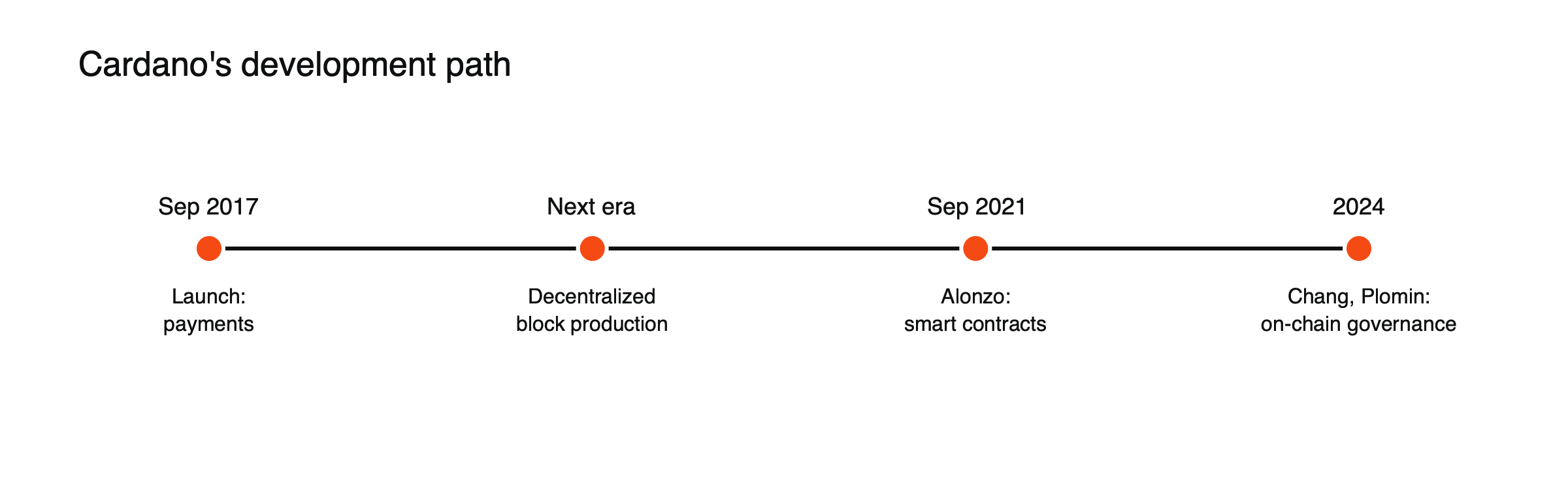
Figure: Cardano’s planned eras. Dates shown where the sources give them.
A roadmap of named eras
Cardano’s development was organized into eras, each named after a historical figure: Byron for the initial payments network, Shelley for decentralized block production by community stake pools, Goguen for smart contracts, Basho for scaling and Voltaire for on-chain governance. The eras overlapped in practice, but they show the project’s approach: build each layer, publish the research behind it, then move on. Supporters see a careful, engineering-led method; critics see years of delays while competitors captured users. The approach also shaped Cardano’s culture: changes tend to arrive with formal specifications and published papers, and community debate often centers on whether a feature has been proven rather than how quickly it can ship. For holders, the practical result is a network that changes slowly and deliberately, which some value as stability and others see as a cost in a market where users and developers tend to go wherever new applications happen to launch first.
A different accounting model
Cardano tracks balances using an extended version of Bitcoin’s UTXO model rather than Ethereum’s account model. Each transaction consumes specific outputs and creates new ones, and smart-contract data travels with those outputs. This makes transaction results more predictable before they are submitted, since a transaction either succeeds as expected or fails without costing fees beyond a deposit. It also makes some applications harder to build, because many users cannot easily interact with the same piece of contract state at the same moment, a challenge developers have worked around with new designs. See what a UTXO is.
ADA supply
ADA’s maximum supply is 45 billion. About 31 billion were created at launch, most of them sold to investors in public sales between 2015 and early 2017, with the rest allocated to the organizations developing Cardano. The remainder of the supply is released over time as staking rewards.
| Launched | September 2017 |
| Consensus | Ouroboros proof of stake |
| Maximum supply | 45 billion ADA |
| Smart contracts | Since September 2021 (Alonzo) |
| On-chain governance | Since 2024 (Chang, Plomin) |
Staking without lockups
Staking on Cardano works differently from many networks. Holders delegate their ADA to a stake pool directly from their wallet, and the coins never leave it: they can be spent at any time, and there is no lockup or exit queue. Rewards are paid automatically every epoch, a period of about five days. There is no slashing of delegators’ funds. The trade-off is that rewards depend on the pool’s performance and fees, and very large pools earn less per ADA once they pass a saturation point, a rule designed to encourage stake to spread across many pools. See what staking is in crypto.
Governance in practice
Since its governance upgrades, ADA holders can vote on treasury spending and protocol changes, directly or by delegating votes to elected representatives. A constitution sets out the rules. The system gives holders real influence over how the network’s treasury is spent, but voting power follows stake, so large holders and active representatives carry most of the weight.
Strengths and criticisms
Supporters point to its research-first approach, energy efficiency, flexible staking with no lockup, and a governance system that lets holders direct development.
Critics point to the slow pace of delivery, smart contracts arriving years after rivals, and an application ecosystem and stablecoin base that remain smaller than those on Ethereum or Solana.
Measuring progress
Because Cardano’s market value has often been ahead of its usage, it helps to look at activity directly. Useful measures include the amount of value locked in its decentralized applications, the supply of stablecoins issued on the network, the number of active addresses and transactions, participation in governance votes and how widely stake is spread across pools. Comparing these over time, and against other networks of similar size, says more about Cardano’s trajectory than announcements about future upgrades.
Risks to know
- Adoption: activity on the network has lagged behind its market value at times.
- Governance outcomes: on-chain voting can be dominated by large holders.
- Volatility: ADA rose to about $2.96 in September 2021 and fell far below that level in later years.
For how staking differs across networks, read what staking is in crypto and what proof of stake is. For the wider category, see what an altcoin is.
This article is educational content and does not constitute financial, investment, legal or tax advice. Digital assets are volatile and you may lose the amount you invest.
Frequently asked questions
Can I lose ADA by delegating to a stake pool?
No. Delegation leaves the ADA in your wallet, and Cardano does not slash delegators. The risk is only earning lower rewards if the pool performs poorly, charges high fees or becomes oversaturated.
Why did smart contracts take so long on Cardano?
The project chose to research and formally specify each component before releasing it, and its accounting model required new approaches to smart contracts. That method aimed for reliability but meant contracts arrived in 2021, years after Ethereum’s launch.
What is ADA used for?
Paying transaction fees, staking through stake pools and voting on governance decisions, including how the network’s treasury is spent.
Sources
- Cardano (blockchain platform) (initial release September 2017; 45 billion supply limit; Chang and Plomin governance, 2024) — Wikipedia
- Cardano (Alonzo smart contracts, September 2021; Ouroboros; Hoskinson) — Decrypt
- Cardano (ADA) price and profile (~31 billion created at launch; $2.96 high in September 2021) — Blockworks