
What Happens When All 21 Million Bitcoin Are Mined?
The last BTC is due around 2140, and the real cap is just under 21 million. Here is what changes for miners, fees and network security after that.
When the last of the 21 million bitcoin is issued, around the year 2140, miners stop receiving new BTC and are paid only through transaction fees. Nothing else about the network has to change. The open question is whether fees alone will pay miners enough to keep Bitcoin as secure as it is today.
The cap is a little under 21 million
The round number is a simplification. The block subsidy started at 50 BTC and is cut in half every 210,000 blocks. Bitcoin’s software counts in satoshis, the smallest unit (one hundred-millionth of a BTC), and when halving would produce a fraction of a satoshi, the fraction is dropped.
Add up every subsidy the rules allow and the true maximum comes to 20,999,999.9769 BTC. The last block that pays any subsidy at all is block 6,929,999, and from block 6,930,000 onward the subsidy is zero. At 10 minutes per block, that lands around 2140.
Most of the supply already exists
The schedule front-loads issuance heavily. By the April 2024 halving, 19,687,500 BTC had been created, 93.75% of the total. The remaining 6.25% will trickle out over more than a century.
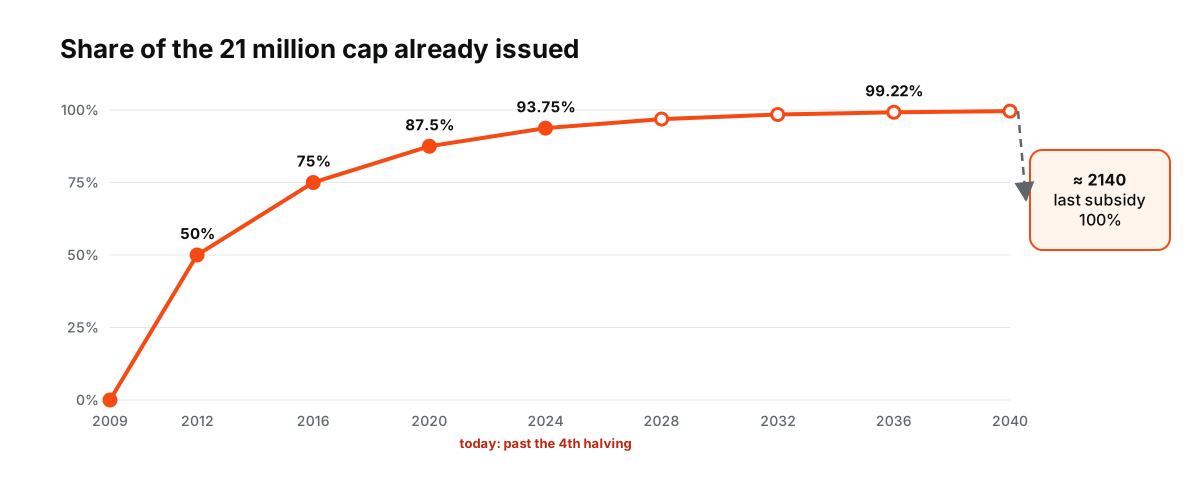
Figure: Share of the 21 million cap issued at each halving. Calculated from the subsidy schedule; years after 2024 are estimates.
| Halving | Approximate year | Total issued after that era | Share of 21 million |
|---|---|---|---|
| 4th | 2024 | 19,687,500 BTC at the halving | 93.75% |
| 5th | 2028 | 20,343,750 BTC | 96.9% |
| 6th | 2032 | 20,671,875 BTC | 98.4% |
| 7th | 2036 | 20,835,937.5 BTC | 99.2% |
Figures are calculated from the subsidy schedule; the years are estimates because block times vary.
In practice, then, the “end of mining” is less a cliff in 2140 than a slope that is already well under way. Each halving makes fees a bigger part of how miners are paid, decades before the subsidy reaches zero. Our guide to the Bitcoin halving lists the dates so far.
Bitcoin’s supply growth in percentage terms
Another way to see the slope is as an annual growth rate. After the 2024 halving, about 450 new bitcoin are created a day, or roughly 164,000 a year. Against a supply of about 19.7 million, that is growth of a little over 0.8% a year. After the 2028 halving, daily issuance falls to about 225 BTC, around 82,000 a year, and the growth rate to roughly 0.4%. (Approximate figures calculated from the schedule.) Each halving roughly halves the rate at which the supply expands, which is the property holders mean when they describe bitcoin as getting scarcer over time.
What keeps miners mining once the subsidy is gone
Mining does not stop when issuance stops. Blocks still need to be produced, and miners still collect every fee paid by the transactions they include. What changes is where the money comes from.
There is already a real-world glimpse of a fee-heavy block. Block 840,000, mined on April 20, 2024, paid its miner the new 3.125 BTC subsidy and about 37.6 BTC in fees, more than 12 times the subsidy. That block was exceptional. Most blocks pay far less in fees, which is exactly why the long-term question matters.
The security budget debate
Miners spend money on hardware and electricity because the rewards justify it. That spending is what makes rewriting Bitcoin’s history expensive. The total paid to miners is sometimes called the network’s security budget.
There are three broad views on what happens when the budget comes entirely from fees:
- Fees will be enough. If Bitcoin is widely used for high-value settlement, users will compete for scarce block space and pay fees that keep miners well funded.
- Fees might fall short. If most activity moves to systems built on top of Bitcoin, such as the Lightning Network, fewer transactions may compete for on-chain space, and fee income could be lower and more volatile than subsidy income ever was.
- It depends on a century of change. Hardware efficiency, energy costs, the value of BTC and how people use the chain will all look different by 2140. Projections that far out carry very wide error bars.
Developers and researchers continue to debate this, and no consensus answer has emerged.
Could the 21 million cap be changed?
Technically, the cap is just a rule in the software. In practice, changing it would require the people running nodes across the network to adopt new rules that create more BTC. Anyone who kept running the old software would reject those blocks as invalid, and the result would be a split into two networks.
The fixed supply is also one of the main reasons many holders value Bitcoin at all, which makes users unlikely to accept such a change. That is why the cap is generally treated as permanent, even though nothing in physics enforces it. Social agreement, not code alone, is what keeps it in place.
Lost coins make the effective supply smaller
Some BTC will never move again: coins sent to addresses whose keys were lost, wallets from the early years that were never backed up, and coins sent to unspendable outputs. Estimates of how much is lost vary widely, and none can be confirmed, because a dormant coin and a lost coin look the same on the blockchain.
What can be said is that the number of coins that can actually be spent is lower than the number issued. Our guide to what a crypto wallet is explains why losing a seed phrase usually means losing access permanently.
For the mechanics of how new BTC enters circulation in the first place, see our pillar guide on how Bitcoin mining works.
Common questions about the 21 million limit
When will the last bitcoin be mined?
Around 2140. The exact date depends on how quickly blocks are produced over the next century.
Will Bitcoin stop working after 2140?
No. Transactions continue, blocks continue, and miners are paid through fees instead of new BTC.
Why 21 million?
The number follows from three design choices: a starting subsidy of 50 BTC, a halving every 210,000 blocks and a 10-minute block target. Together they produce a total just under 21 million.
This article is educational content and does not constitute financial, investment, legal or tax advice. Digital assets are volatile and you may lose the amount you invest.
Sources
- Bitcoin Core source, validation.cpp (block subsidy calculation) — Bitcoin Core, GitHub
- Bitcoin Core source, amount.h (COIN = 100,000,000 satoshis; MAX_MONEY) — Bitcoin Core, GitHub
- Bitcoin Core source, chainparams.cpp (210,000-block halving interval) — Bitcoin Core, GitHub
- Block 840,000 (subsidy and fees) — Blockchain.com Explorer
- Bitcoin: A Peer-to-Peer Electronic Cash System — Satoshi Nakamoto, October 2008