
How to Estimate Bitcoin Mining Profitability
Estimate Bitcoin mining profitability with one formula: your share of hash rate, block rewards, BTC price, pool fees and power cost, with a worked example.
Daily profit = (your hash rate ÷ network hash rate) × blocks per day × (subsidy + average fees) × BTC price × (1 − pool fee) − electricity cost. That single line covers most of Bitcoin mining profitability. The hard part is choosing honest inputs, because two of them, network hash rate and price, change constantly.
The inputs you need
| Input | What it means | Where it comes from |
|---|---|---|
| Your hash rate | How many hashes per second your machine produces, usually in TH/s | Manufacturer spec, then real measurements |
| Network hash rate | The estimated total for all miners, usually in EH/s | Mining data sites; it is an estimate derived from difficulty |
| Blocks per day | About 144, one every 10 minutes on average | Protocol target |
| Subsidy | New BTC per block, 3.125 BTC since April 2024 | Protocol schedule |
| Average fees per block | Varies with demand for block space | Recent block data |
| BTC price | Converts BTC income into your local currency | Market price |
| Pool fee | The share the pool keeps, often a few percent | Your pool’s terms |
| Power draw and price | Machine watts and your cost per kWh | Hardware spec, electricity bill |
One unit conversion trips people up more than anything else: 1 EH/s equals 1,000,000 TH/s. If you mix those up, your result is off by a factor of a million.
Worked example: one machine, step by step
All numbers below are illustrative. Live values differ by machine, pool, location and market conditions.
Inputs
- Machine: 200 TH/s, drawing 3,500 W (17.5 J/TH)
- Network hash rate: 1,000 EH/s, which is 1,000,000,000 TH/s
- Subsidy: 3.125 BTC; average fees: 0.05 BTC per block
- BTC price: $100,000
- Pool fee: 2%
- Electricity: $0.06 per kWh
Step 1: your share of the network
200 TH/s ÷ 1,000,000,000 TH/s = 0.0000002, or 0.00002%.
Step 2: BTC the whole network earns per day
144 blocks × (3.125 + 0.05) BTC = 457.2 BTC per day.
Step 3: your expected BTC per day
457.2 BTC × 0.0000002 = 0.00009144 BTC, which is 9,144 satoshis.
Step 4: convert to dollars and remove the pool fee
0.00009144 BTC × $100,000 = $9.14 per day. After a 2% pool fee: $8.96.
Step 5: electricity
3.5 kW × 24 hours = 84 kWh per day. 84 kWh × $0.06 = $5.04 per day.
Step 6: daily margin before hardware costs
$8.96 − $5.04 = $3.92 per day.
That $3.92 still has to pay for the machine itself, cooling, hosting, maintenance and downtime. A machine that costs a few thousand dollars needs a long run of days like this one just to earn back its purchase price, and the inputs will not stay still that long.
The same machine at a lower price
Change one input. Leave everything else the same and drop the BTC price to $60,000.
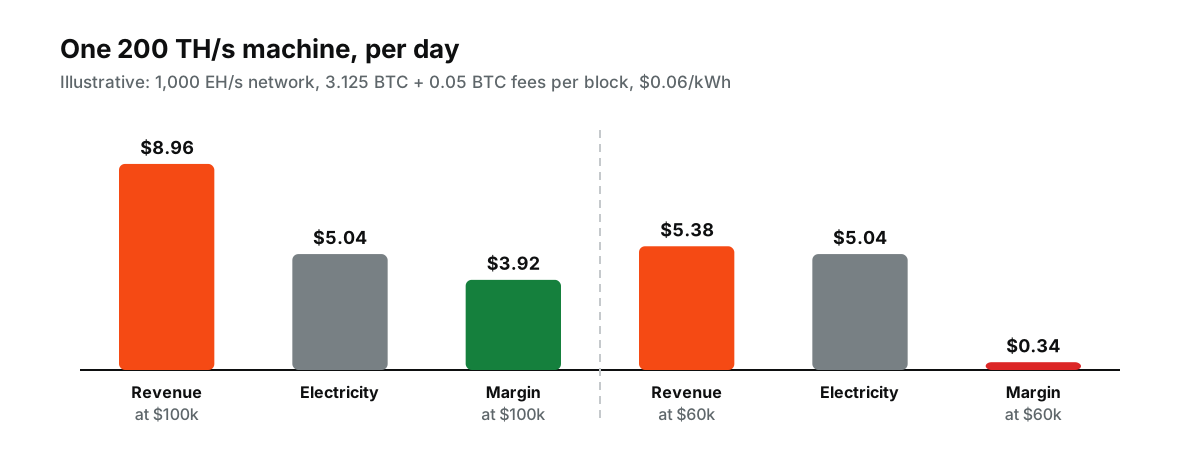
Figure: Same machine, two BTC prices. Electricity stays fixed while revenue moves with price. Illustrative inputs from the worked example.
- Revenue: 0.00009144 BTC × $60,000 = $5.49 per day
- After the 2% pool fee: $5.38
- Electricity: still $5.04
- Daily margin: $0.34
A 40% fall in price cut this machine’s margin by more than 90%. That is the core economics of mining: electricity is a fixed cost in dollars, while revenue is a variable amount of BTC whose dollar value moves with the market. Thin margins turn negative quickly.
Your break-even electricity price
Another way to read the example is to ask how expensive electricity can get before the machine stops covering its running costs. Divide the daily revenue after pool fees by the daily energy use:
- At $100,000 per BTC: $8.96 ÷ 84 kWh ≈ $0.107 per kWh
- At $60,000 per BTC: $5.38 ÷ 84 kWh ≈ $0.064 per kWh
Above those prices, the machine loses money on every day it runs, before counting the cost of the machine itself. This is why mining gravitates to places with very cheap power, and why miners with expensive electricity switch off first when prices fall.
Payback: when the machine pays for itself
Suppose the machine cost $3,000. At the first example’s margin of $3.92 a day, it would take about 765 days, a little over two years, to earn back its price, if every input stayed the same. They will not. Network hash rate tends to rise as new machines are plugged in, which shrinks your share, and the next halving, expected around 2028, will cut the block subsidy in half. Realistic payback estimates therefore assume falling BTC income per machine over time, which can stretch the payback period well beyond the simple calculation or prevent it altogether.
Home mining vs hosting
Running a modern mining machine at home is harder than it sounds. A single machine drawing 3,500 watts produces as much heat as several space heaters and noise comparable to a vacuum cleaner, and it may need a dedicated electrical circuit. Hosting providers rent space in facilities built for mining, with cheaper power and cooling, but charge a hosting fee per kWh or per machine that must be included in the calculation. Either way, electricity price and uptime decide whether the numbers work.
Hashprice: the industry shortcut
Miners often skip the step-by-step and quote hashprice, the expected revenue per unit of hash rate per day, usually in dollars per PH/s per day. In the first example, the machine earns $9.14 per day from 0.2 PH/s, so hashprice is about $45.70 per PH/s per day before fees. At $60,000 per BTC, it falls to about $27.40.
Hashprice is useful because it folds network hash rate, block rewards, fees and price into a single number. You multiply it by your own hash rate and subtract your costs. It moves every day, so check a current figure rather than relying on an old one.
What the simple formula leaves out
Rising difficulty. Network hash rate tends to grow as new machines come online. When it grows, your share shrinks even if nothing about your setup changes. Our explainer on Bitcoin mining difficulty shows how the network adjusts every 2,016 blocks. A 12-month projection that assumes today’s network hash rate will look too optimistic.
The next halving. The subsidy drops from 3.125 BTC to 1.5625 BTC at block 1,050,000, expected around 2028. On the day it happens, the subsidy part of every miner’s revenue halves. Our guide to the Bitcoin halving covers the schedule.
Fee swings. Fees are usually small next to the subsidy, but they can spike during congestion. Use a recent average and treat spikes as upside, not a base case.
Real-world efficiency. Machines run hotter, slower or offline more often than their spec sheets suggest. Measure actual hash rate and actual power draw at the wall before trusting any estimate.
Taxes and accounting. How mined BTC is treated for tax purposes depends on where you live, and it can change the answer meaningfully.
If you are new to how blocks are produced in the first place, start with our guide to how Bitcoin mining works.
This article is educational content and does not constitute financial, investment, legal or tax advice. Digital assets are volatile and you may lose the amount you invest.
Sources
- Bitcoin Core source, validation.cpp (block subsidy and halving schedule) — Bitcoin Core, GitHub
- Bitcoin Core source, chainparams.cpp (210,000-block halving interval, 10-minute target spacing) — Bitcoin Core, GitHub
- Breaking: Bitcoin Halving Is Sealed After Mining of Block 840,000 — Finance Magnates, April 2024