
What Is the Lightning Network?
The Lightning Network moves Bitcoin payments off-chain through payment channels. Learn how channels and routing work, what it costs and where its limits are.
The Lightning Network is a payment system built on top of Bitcoin that lets people send BTC almost instantly and for very small fees. Instead of recording every payment on the blockchain, two parties lock funds into a shared channel and update the balance between them off-chain. Only opening and closing the channel touch the Bitcoin blockchain.
The problem Lightning solves
Bitcoin’s base layer produces a block about every 10 minutes, and each block has limited space. That is fine for settling larger amounts, but awkward for buying a coffee: you would wait for confirmation and pay a fee that, at busy times, could exceed the price of the coffee. Our guide to blockchain transaction fees explains why on-chain fees rise when blocks fill up.
Lightning moves the frequent, small payments to a second layer while keeping Bitcoin as the final settlement system. The protocol is defined in a set of open specifications called BOLTs, and several independent software teams build compatible implementations.
How a payment channel works
A channel is a small agreement between two people, enforced by Bitcoin’s own rules.
- Opening. Alice and Bob lock BTC into an on-chain output that needs both of their signatures to spend. Say Alice puts in 0.01 BTC.
- Paying. When Alice pays Bob 0.002 BTC, they both sign a new version of the “how to split this output” transaction: 0.008 to Alice, 0.002 to Bob. Nothing is broadcast. They each keep the latest signed version.
- Paying again. Every further payment replaces the previous version. They can do this thousands of times without touching the blockchain.
- Closing. Either party can broadcast the latest version to settle the final balances on-chain.
The clever part is the penalty system. If Bob tried to broadcast an old version that gave him more than he is owed, Alice could use a secret from the newer state to take the entire channel balance. That threat keeps both sides honest.
How Lightning sends payments to people you have no channel with
You do not need a channel with everyone you pay. Payments can hop across a path of channels: Alice pays Carol by routing through Bob, if Alice has a channel with Bob and Bob has one with Carol.
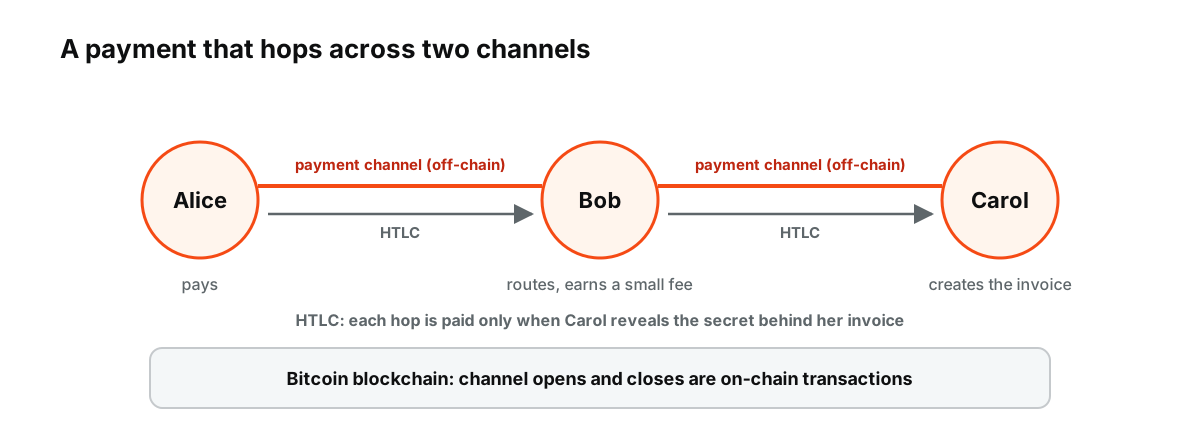
Figure: A routed Lightning payment. Only opening and closing channels touch the Bitcoin blockchain.
Routing is made safe by hashed time-locked contracts (HTLCs). Carol creates a secret and gives Alice its hash inside an invoice. Each hop along the route only releases funds when the secret is revealed, and the secret can only come from Carol once she has been paid. Either the whole route completes, or none of it does, so intermediaries cannot steal funds in transit.
Payment requests, the long strings or QR codes starting with “lnbc”, are called invoices and are standardized in BOLT 11. An invoice typically includes the amount, a description and an expiry time.
Fees and limits
Routing nodes charge a small fee for forwarding payments, usually a fixed base fee plus a proportional fee measured in parts per million. For everyday amounts the total is often a fraction of a cent, though it varies by route.
Lightning works best within certain limits:
- Channel size caps payments. A payment can only be as large as the capacity along its route. Large payments may fail or need to be split into parts.
- Liquidity has a direction. To receive, someone has to have funds on their side of a channel with you. New users often discover they can send but not receive until they have “inbound liquidity.”
- Opening and closing cost on-chain fees. If fees are high when you need to open or close a channel, that cost lands on you.
- Non-custodial wallets need monitoring. To catch a counterparty broadcasting an old state, your wallet needs to come online periodically, or rely on a watchtower service that watches on its behalf.
A payment’s journey, with the fees added up
Suppose Alice wants to pay Dave 50,000 sats, and the best route runs through two routing nodes, Bob and Carol. Each charges a base fee of 1 sat plus 100 parts per million of the amount forwarded. (Example values; real fees vary by node.) Each hop costs about 1 + 50,000 × 0.0001 = 6 sats, so the two hops add about 12 sats, roughly 0.02% of the payment. Alice’s wallet finds the route, adds the fees and sends the payment in a way that lets each node know only the hop before and after it.
Invoices, expiry and privacy
Most Lightning payments use an invoice created by the recipient. An invoice is usually for a specific amount, can be paid only once and expires after a set time, so an old invoice cannot simply be reused. Lightning payments are not broadcast to the whole network the way on-chain transactions are, which gives them more privacy, although opening and closing channels still appear on the Bitcoin blockchain.
Custodial and non-custodial Lightning wallets
Many Lightning apps are custodial: the provider runs the channels and you hold a balance in its system. That is simple, but you are trusting the provider with your funds, just as with an exchange account.
Non-custodial wallets keep your keys on your device and manage channels for you, often automatically. They give you control, at the cost of a bit more complexity around backups and liquidity. Our comparison of custodial and non-custodial wallets covers the trade-off in general.
When to use Lightning and when to stay on-chain
| Lightning | On-chain Bitcoin | |
|---|---|---|
| Speed | Seconds | About 10 minutes per confirmation, more for larger amounts |
| Typical fees | Very low | Depends on network demand |
| Best for | Small, frequent payments | Larger amounts, long-term storage |
| Settlement | Final when the channel closes on-chain | Final after confirmations |
| Unit used | Often millisatoshis internally | Satoshis |
Before you send, make sure the receiving side supports Lightning. An exchange address for on-chain BTC is not a Lightning invoice, and treating one as the other is a common source of failed or stuck transfers. Our checklist on how to withdraw crypto safely covers matching the network on both sides.
If the units confuse you, our guide on how to convert between satoshis and Bitcoin explains why Lightning apps often show amounts in sats.
Common questions about the Lightning Network
Is the Lightning Network a separate cryptocurrency?
No. Lightning moves BTC. Channels are funded with BTC and settle back to the Bitcoin blockchain.
Can I send from a Lightning wallet to a regular Bitcoin address?
Not directly through Lightning. Some wallets offer a “swap” service that converts a Lightning payment into an on-chain one, usually for a fee.
This article is educational content and does not constitute financial, investment, legal or tax advice. Digital assets are volatile and you may lose the amount you invest.