
What Are UTXOs?
UTXOs are the unspent outputs that make up a Bitcoin balance. See how wallets spend them, why change comes back to you, and how they affect fees.
A UTXO, short for unspent transaction output, is a chunk of BTC created by an earlier transaction that has not been spent yet. Bitcoin does not store account balances. Your wallet balance is simply the sum of all the UTXOs your keys can spend, and every payment you make spends some of them whole and creates new ones.
Coins as pieces, not a running total
Think of UTXOs as banknotes in a wallet rather than a number in a bank account. If you hold a 0.05 BTC note and a 0.012 BTC note, your balance is 0.062 BTC, but it exists as two separate pieces.
Each transaction does two things:
- Spends inputs. It points to existing UTXOs and proves, with a signature, that you are allowed to spend them. Each input is spent in full; there is no way to spend half of one.
- Creates outputs. It creates new UTXOs locked to the recipient’s address and, almost always, one locked back to you as change.
Once an output has been used as an input, it is gone. The network only has to remember the outputs that are still unspent, which is why this collection is called the UTXO set. Every full node keeps a copy and checks new transactions against it, which is how Bitcoin prevents anyone spending the same coin twice.
A worked example with change and fees
Your wallet holds three UTXOs: 0.05 BTC, 0.012 BTC and 0.0031 BTC. You want to pay 0.06 BTC.
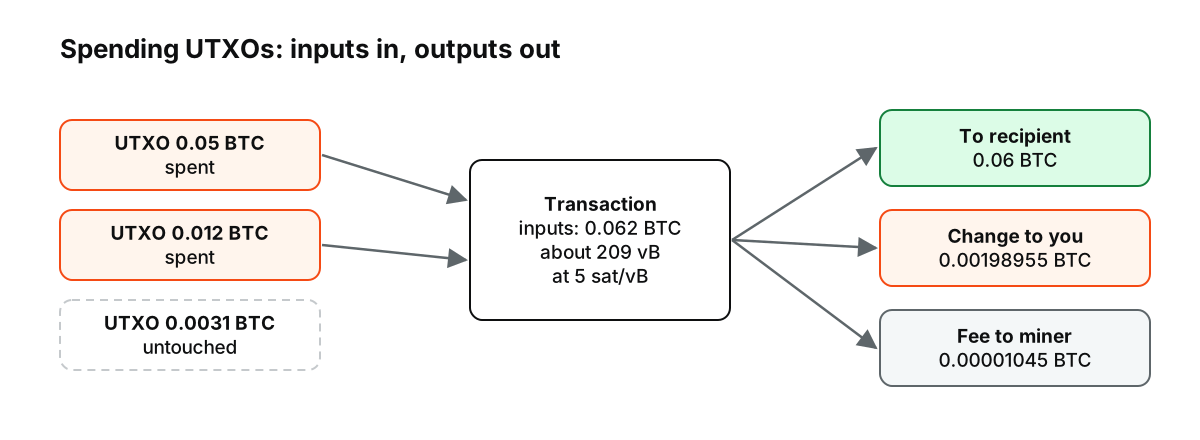
Figure: The worked example as a transaction. Inputs are spent in full; the difference that is not an output is the fee.
- The wallet picks inputs. No single UTXO covers 0.06 BTC, so it selects 0.05 + 0.012 = 0.062 BTC. The 0.0031 BTC piece is left alone.
- It creates the payment output. 0.06 BTC goes to the recipient.
- It calculates the fee. This transaction has two inputs and two outputs and comes to about 209 virtual bytes. At an illustrative 5 satoshis per virtual byte, the fee is 1,045 satoshis, or 0.00001045 BTC.
- It sends the rest back as change. 0.062 − 0.06 − 0.00001045 = 0.00198955 BTC goes to a new address the wallet controls.
There is no separate fee field in a Bitcoin transaction. The fee is whatever the inputs add up to minus what the outputs add up to, and miners collect it. If a wallet forgot to create the change output, the entire 0.002 BTC difference would go to the miner as a fee. Well-built wallets do not let that happen, but it is why hand-crafting transactions is risky.
Why UTXOs affect what you pay in fees
Bitcoin fees depend on how much data a transaction takes up, not on how much value it moves. Every input adds data, so a payment funded by 20 small UTXOs costs far more to send than the same amount funded by one large UTXO.
That has practical consequences:
- Many small deposits get expensive to spend. Wallets that receive lots of small payments, such as mining payouts, can face a large fee when the coins are finally moved.
- Consolidation is cheapest when the network is quiet. Some users combine many small UTXOs into one during periods of low fees, so that later payments need fewer inputs.
- Dust can become unspendable in practice. A UTXO worth less than the fee needed to spend it has no practical use. Bitcoin Core’s default relay policy also treats very small outputs as “dust” and will not relay transactions that create them; under default settings that line sits around 546 satoshis for older address types and 294 satoshis for native SegWit addresses.
Our guide to blockchain transaction fees explains how the fee rate itself is set. Address type also changes how much data each input uses, which is covered in Bitcoin address types.
UTXOs and privacy
Combining inputs leaks information. When a transaction spends two UTXOs together, anyone looking at the blockchain can reasonably guess that both belonged to the same owner. The Bitcoin white paper acknowledged this in its privacy section: multi-input transactions reveal that their inputs were owned by the same person.
Change outputs leak information too, because it is often possible to tell which output is the payment and which is coming back to the sender. Wallets use new change addresses and smarter coin selection to reduce these clues, but they cannot remove them.
Choosing which coins to spend
Most wallets pick UTXOs automatically when you send a payment, usually to keep the fee low. Some offer “coin control,” which lets you choose exactly which UTXOs to spend. That helps in two ways: you can avoid combining coins from different sources, such as an exchange withdrawal and a private payment, which would link them publicly, and you can pick the inputs that produce the smallest transaction when fees are high. Wallets with coin control usually show each UTXO’s size and where it came from.
Dust and consolidation
Very small UTXOs can cost more to spend than they are worth, because every input adds to the transaction’s size and therefore its fee. These are often called dust. A wallet full of small UTXOs, for example from many small payments or mining payouts, can become expensive to use when fees rise. A common practice is to consolidate: when fees are low, send several small UTXOs to yourself in one transaction, creating a single larger one that is cheaper to spend later. Consolidation has a privacy cost, since it links those coins together on the blockchain, so it is best done with that trade-off in mind.
UTXOs vs the account model
Not every blockchain works this way. Ethereum and many networks built like it use an account model: each address has a balance, and a transaction subtracts from one balance and adds to another, much like a bank ledger.
| UTXO model (Bitcoin) | Account model (Ethereum) | |
|---|---|---|
| What is stored | Unspent outputs | A balance per address |
| How you pay | Spend whole outputs, receive change | Subtract from your balance |
| Fee depends on | Data size, including number of inputs | Computation used (gas) |
| Privacy | New address per payment is natural | One address is often reused |
Our guide to what a crypto transaction is compares both models in more depth, and what Bitcoin is puts UTXOs in the context of the whole network.
This article is educational content and does not constitute financial, investment, legal or tax advice. Digital assets are volatile and you may lose the amount you invest.
Sources
- Bitcoin: A Peer-to-Peer Electronic Cash System (Section 9, Combining and Splitting Value; Section 10, Privacy) — Satoshi Nakamoto, October 2008
- Bitcoin Core source, policy.h (default dust relay fee) — Bitcoin Core, GitHub
- BIP 141: Segregated Witness (virtual size and witness discount) — Bitcoin Improvement Proposals, GitHub