
What Is a Blockchain Fork? Hard Forks vs Soft Forks
A blockchain fork is a change or split in a chain's rules. Learn hard vs soft forks, real Bitcoin examples and what a fork means for your coins.
A blockchain fork happens when a network’s rules change or when nodes temporarily disagree about the latest block. A soft fork tightens the rules in a way older nodes still accept. A hard fork changes them in a way older nodes reject, so everyone has to upgrade, and if some refuse, the chain can split into two separate networks.
Three things people call a “fork”
The word gets used for different events, which causes confusion.
Temporary forks. Two miners or validators produce valid blocks at almost the same time. For a moment the network has two versions of the latest block, then it settles on one and the other is discarded. This happens routinely and needs no action from users. Our guide to why network confirmations matter explains why platforms wait a few blocks.
Soft forks. A rule change that is backward-compatible.
Hard forks. A rule change that is not backward-compatible, which may or may not lead to a permanent split.
Soft forks: tightening the rules
A soft fork makes the rules stricter. Blocks created under the new rules still look valid to nodes running old software, so non-upgraded nodes keep following the chain, even if they do not fully understand every new feature.
Example: SegWit on Bitcoin. Segregated Witness changed how signature data is stored and counted, and activated in 2017 at block 481,824. It was deployed as a soft fork, so users who did not upgrade were not cut off. Our guide to Bitcoin address types shows the new address format it introduced.
Soft forks still need broad support. If the miners or validators producing blocks do not enforce the new rules, the change does not take hold.
Hard forks: changing the rules
A hard fork loosens or changes the rules so that blocks valid under the new rules are invalid under the old ones. Every node has to upgrade to stay on the same chain.
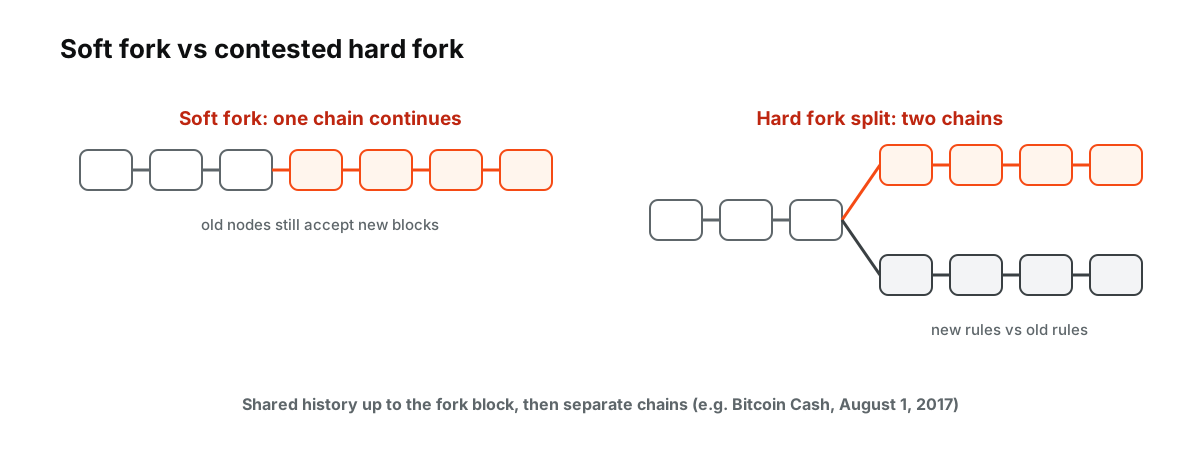
Figure: Soft fork versus contested hard fork. In a split, both chains share history up to the fork block.
There are two very different outcomes:
A planned upgrade. If essentially everyone upgrades, the network continues as one chain with new rules. Ethereum has used scheduled hard forks for most of its major upgrades, including the switch to proof of stake in September 2022. Our guide to proof of stake covers that change.
A contested split. If a significant group refuses to upgrade, or deliberately runs incompatible rules, two chains continue from the same history. On August 1, 2017, a group that wanted bigger blocks split from Bitcoin and launched Bitcoin Cash as a separate network. Our guide to the Bitcoin block size war tells the full story.
Hard fork vs soft fork at a glance
| Soft fork | Hard fork | |
|---|---|---|
| Rule change | Stricter | Different or looser |
| Old nodes | Still follow the chain | Reject new blocks |
| Upgrade needed | Recommended | Required to stay on the new chain |
| Risk of a permanent split | Low | Possible if support is divided |
| Bitcoin example | SegWit (2017) | Bitcoin Cash split (2017) |
How a fork gets switched on
A rule change does not take effect the moment developers publish it. Networks use activation mechanisms so that everyone switches at the same point:
- Miner or validator signaling. Block producers mark their blocks to show they are ready, and the change activates once a set share of recent blocks signals support. Bitcoin used this approach for SegWit, though it stalled for months before activating.
- Flag days. The change activates at a specific block height or time, whether or not everyone has signaled. Ethereum’s scheduled upgrades work this way: client software is released in advance with the activation block built in.
- User-activated soft forks. Node operators set a date after which their nodes will reject blocks that do not follow the new rules, putting pressure on block producers to comply. Bitcoin’s BIP 148 in 2017 was the best-known example. See the Bitcoin block size war.
The choice of mechanism says a lot about who holds power on a network. Signaling gives block producers a veto; flag days and user-activated forks put more weight on the people running nodes.
Forks as routine upgrades
On some networks, hard forks are not dramatic events at all. Ethereum has used a long series of scheduled hard forks to add features and change economics, including the London upgrade of August 2021, which introduced the burning of part of every transaction fee, and the Merge in September 2022, which replaced mining with staking. Because client teams, exchanges and node operators coordinated in advance, the network continued as a single chain each time. The difference between an upgrade and a split is not the type of fork but whether nearly everyone agrees to follow it. Users holding ether through those upgrades did not need to do anything at all.
What a fork means for your coins
After a planned upgrade: nothing, as long as your wallet or exchange supports the new rules. Most users never notice.
After a contested split: anyone holding coins before the split usually holds the same balance on both chains, because they share history up to that block. Holders of BTC at the time of the Bitcoin Cash split, for example, received an equal amount of the new coin.
That brings practical risks:
- Replay risk. On some splits, a transaction on one chain can be copied onto the other unless the new chain adds protection. Many exchanges pause deposits and withdrawals around a split for this reason.
- Platform support varies. Whether you can access the new coin depends on your wallet or exchange choosing to support it.
- Scams spike. Fake “claim your forked coins” websites ask for seed phrases. No legitimate process requires one.
Preparing for a contested split
If a network you hold coins on is heading for a contested hard fork, a few precautions reduce the risk:
- Hold your own keys before the split if you want guaranteed access to both resulting coins; on an exchange, access depends on the platform’s policy.
- Avoid moving coins around the split itself. Wait until wallets and exchanges confirm that replay protection is in place.
- Use well-known wallets and official guidance to separate coins on the two chains, and never enter a seed phrase into a site offering to “claim” forked coins.
- Expect volatility and paused services. Exchanges often halt deposits and withdrawals for the affected coin for a period.
Who decides whether a fork happens
Developers propose changes, but they cannot force anyone to run the new software. Miners or validators produce blocks, but nodes decide which blocks are valid. Exchanges and users decide which chain they treat as the real one. A fork succeeds when enough of these groups agree. Our guide to blockchain nodes explains why that last check carries so much weight.
This article is educational content and does not constitute financial, investment, legal or tax advice. Digital assets are volatile and you may lose the amount you invest.
For how forks fit into the wider system of networks, applications and tokens, see what Web3 is.
Sources
- BIP 141: Segregated Witness (deployed as a soft fork) — Bitcoin Improvement Proposals, GitHub
- Bitcoin Core source, chainparams.cpp (SegWit activation height 481,824) — Bitcoin Core, GitHub
- Bad News Bears: Cryptocurrency Stories of 2017 (Bitcoin Cash split, August 1, 2017) — Bitcoin Magazine
- The Merge — ethereum.org
- Ethereum timeline (London upgrade August 5, 2021) — Blockchain.com Explorer
- BIP 148: Mandatory activation of SegWit deployment (user-activated soft fork, August 1, 2017) — Bitcoin Improvement Proposals, GitHub