
What Are Zero-Knowledge Proofs?
Zero-knowledge proofs let one party prove a statement is true without revealing the underlying data. See how they work and where blockchains use them.
Zero-knowledge proofs are cryptographic methods that let one party prove a statement is true without revealing the secret information behind that statement. On a blockchain, that can mean proving that a transaction follows the rules, that a user belongs to an approved set, or that a computation was performed correctly without publishing every private input.
A proof can reveal the answer without revealing the data
The basic problem is simple. Imagine a service only needs to know whether you are over 18. A normal verification flow might ask for your full identity document, exposing your name, date of birth and document number. A zero-knowledge system can be designed so that the service receives a cryptographic proof of the statement “this person is over 18” without receiving the underlying date of birth.
That does not mean the verifier learns literally nothing. The verifier learns that the statement being proved is valid. What stays hidden is the private information used to establish it.
A sound zero-knowledge system has three core properties:
- Completeness: a valid statement can be proved by an honest prover.
- Soundness: a false statement should not be accepted except with a negligibly small probability.
- Zero-knowledge: the verifier should learn no more than the validity of the claim.
The mathematics differs between proving systems, but those three ideas are the useful mental model.
Prover, witness and verifier are the moving parts
A zero-knowledge proof starts with a prover who knows some private information. Cryptographers often call that information the witness. The prover runs a proving algorithm that combines the witness with the public statement and produces a compact proof.
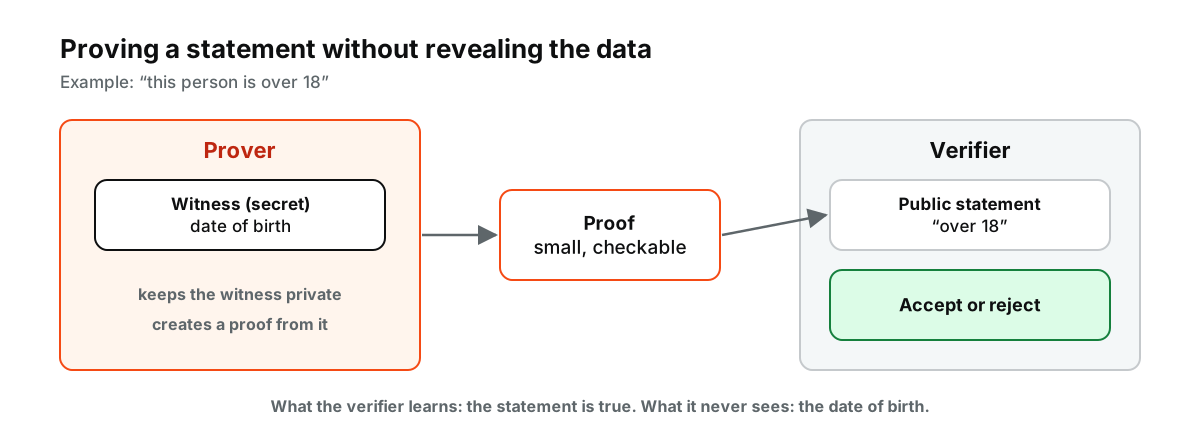
Figure: The three parts of a zero-knowledge proof, using the article’s over-18 example. The secret data never leaves the prover.
The verifier checks that proof against the public statement. If the proof is valid, the verifier can accept the claim without receiving the witness itself.
Consider a simplified blockchain example. A user wants to prove that a transfer is valid. The private witness might include the exact balances and transaction path. The public statement might be that the transaction obeys all protocol rules and does not create money from nowhere. A zero-knowledge proof can allow the network to verify the public statement without exposing every private detail used to produce it.
That distinction matters because blockchains are naturally good at verification but poor at privacy. Public networks are designed so independent participants can check the same state. Zero-knowledge techniques add a way to preserve verifiability while disclosing less data.
Why ZK-SNARKs and ZK-STARKs come up so often
“Zero-knowledge proof” describes a broad family of techniques. Two names appear frequently in blockchain systems:
| Proving system | What the name emphasizes | Practical trade-off |
|---|---|---|
| ZK-SNARK | Succinct, non-interactive argument of knowledge | Very small proofs and fast verification; some constructions require a trusted setup |
| ZK-STARK | Scalable, transparent argument of knowledge | No trusted setup in common designs; proofs can be larger |
The acronyms are useful, but they are not competing cryptocurrencies or separate networks. They are different ways to construct proofs. Specific implementations make different choices around proof size, proving time, verification cost, cryptographic assumptions and setup requirements.
For a user, the important question is usually not “SNARK or STARK?” It is what the proof is being used to verify and what information remains public.
Zero-knowledge proofs can scale a blockchain as well as protect privacy
Privacy is the intuitive use case, but scaling is one of the most important reasons zero-knowledge proofs are used in crypto infrastructure.
A zero-knowledge rollup can execute many transactions away from the base layer, then submit a proof showing that the resulting state transition is valid. The base blockchain verifies the proof instead of recomputing every transaction from scratch. The result is a different division of labor: heavy computation happens elsewhere, while the base chain checks a compact cryptographic claim.
This is why “ZK” appears in discussions about Ethereum layer-2 systems even when transactions are not fully private. A zero-knowledge proof can prove computational correctness without necessarily hiding all transaction data.
Privacy and scaling overlap, but they are not the same feature.
A concrete example: proving membership without revealing identity
Suppose 10,000 addresses are registered for a private onchain vote. The goal is to let each eligible participant vote once without publishing which registered address cast which vote.
A participant can generate a proof that says, in effect:
I know a secret corresponding to one member of this approved set, and I have not used this voting credential before.
The verifier checks the proof and the public anti-double-voting condition. The voter does not need to reveal which member of the set they are. Ethereum’s privacy documentation describes this type of anonymous membership pattern as one practical use of zero-knowledge technology.
The same pattern can be adapted for credentials, access control, compliance checks and selective disclosure.
Zero-knowledge does not make a system automatically private
This is an easy point to miss. A protocol can use zero-knowledge proofs while still exposing useful metadata: wallet addresses, timestamps, transaction sizes, contract interactions or deposit and withdrawal points.
Privacy depends on the full system design, not on the presence of a ZK acronym. A user who enters a private system from a publicly identified address and exits immediately to another known address can still create a link that analysis tools may infer.
The proof protects what it was designed to hide. It does not erase every other piece of information around the transaction.
Zero-knowledge also does not prove that the application is safe
A mathematically valid proof can show that a program followed its encoded rules. That does not guarantee those rules are economically sensible, bug-free or safe for users.
Smart-contract risk still exists. So do key-management risk, bridge risk, governance risk and flaws in the circuits or software used to generate proofs. Some systems also depend on setup ceremonies, specialized hardware or complex cryptographic libraries.
In other words, a proof can establish “this computation was performed according to the circuit.” It cannot establish “this product is a good idea.”
The cost of producing a proof
Verifying a zero-knowledge proof is fast and cheap, but producing one can take substantial computing power. That imbalance shapes how ZK systems are built: specialized operators, sometimes called provers, run powerful hardware to generate proofs, while ordinary nodes only check them.
Where zero-knowledge proofs matter most
The technology is most useful when a system needs verification and limited disclosure at the same time. Common examples include private credentials, anonymous membership, privacy-preserving voting, transaction validity proofs and blockchain scaling.
It matters less when all inputs are already public and the computation is cheap enough for everyone to verify directly. In that case, adding a proving system can create complexity without solving a real problem.
The useful question is therefore not whether zero-knowledge proofs are advanced cryptography. They are. The better question is whether a specific application needs to prove something without revealing, or recomputing, everything behind it.