
Bitcoin vs Ethereum
Bitcoin is built to be scarce digital money; Ethereum is a platform for running applications. Compare their supply, security model, speed and uses.
The most important difference in bitcoin vs ethereum is purpose. Bitcoin is designed to be scarce digital money with rules that almost never change. Ethereum is designed to be a platform where anyone can run programs, called smart contracts, and its native coin, ether, pays for that computing. Their supply rules, security and upgrade pace all follow from that split.
Two networks, two jobs
Bitcoin launched in January 2009 as a peer-to-peer cash system. Its scripting language is deliberately limited, and changes to its rules are rare and slow. That conservatism is the point: holders value predictability over new features.
Ethereum launched in July 2015 with a general-purpose programming environment. Tokens, stablecoins, lending markets, exchanges and NFTs all run as smart contracts on it. Ether is needed to pay for every one of those operations, which ties its demand to how much the network is used. See what a smart contract is.
Side by side
| Bitcoin | Ethereum | |
|---|---|---|
| Main purpose | Store of value and payments | Platform for applications |
| Launched | January 2009 | July 2015 |
| Consensus | Proof of work (mining) | Proof of stake since September 15, 2022 |
| Supply | Capped just under 21 million BTC | No fixed cap; issuance minus fees burned |
| New block | About every 10 minutes | Every 12 seconds |
| Programmability | Limited scripts | Full smart contracts |
| Pace of change | Slow and conservative | Regular planned upgrades |
Supply: a fixed schedule vs a moving balance
Bitcoin’s issuance halves every 210,000 blocks, roughly every four years, and stops just short of 21 million coins. Anyone can predict roughly how many bitcoin will exist in any future year.
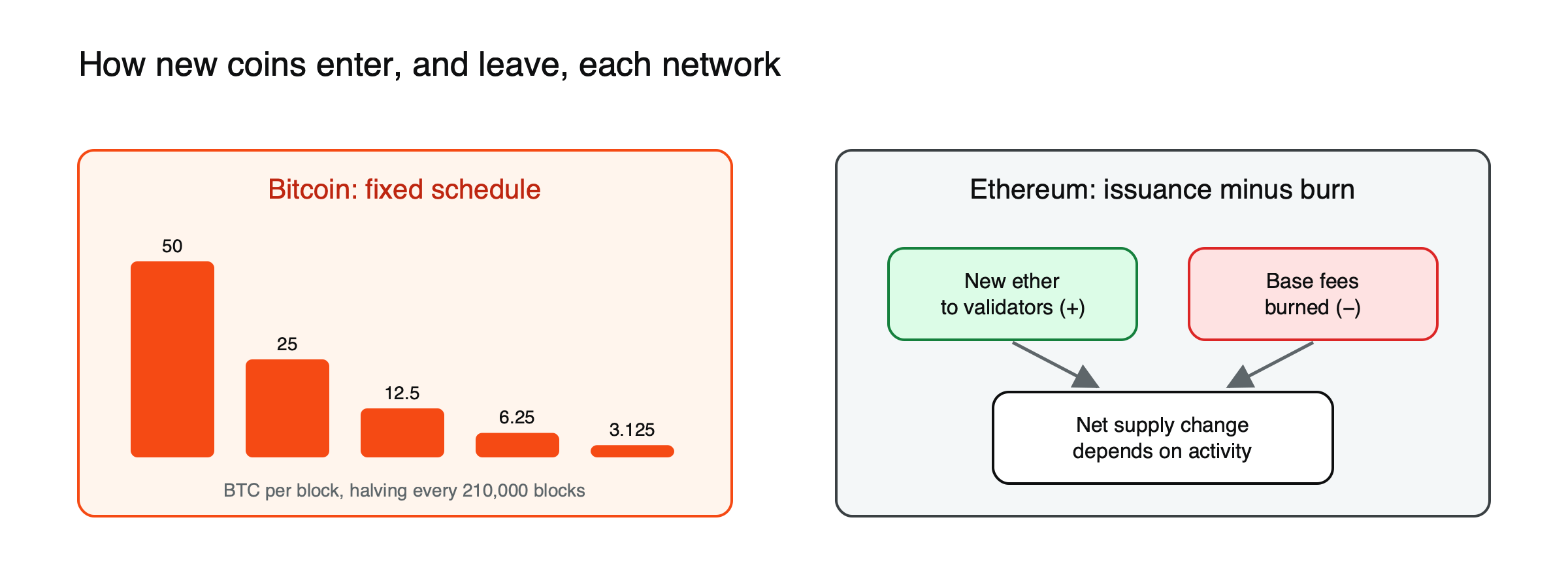
Figure: Two supply models. Bitcoin’s is fixed in advance; ether’s moves with how much the network is used.
Ether has no hard cap. New ether is issued to validators, while the base fee of every transaction is burned and removed from supply. When network activity is high, more ether can be burned than issued and total supply shrinks; when activity is low, supply grows. Ether’s supply therefore depends on how much the network is used, not on a fixed timetable. See how the ETH burn works.
Fees and what they pay for
On Bitcoin, users pay fees to get their transactions into a block, and those fees go to miners alongside the block reward. Fees rise when blocks are full and many people want to transact at once.
On Ethereum, every operation, from a simple transfer to a complex trade, consumes “gas.” Users pay a base fee, which is burned, plus an optional tip to validators. Because smart contracts can be computationally heavy, Ethereum fees depend on what you are doing as well as on how busy the network is. Much everyday activity has moved to layer 2 networks that bundle transactions and settle them on Ethereum, lowering costs. See what Ethereum rollups are.
Security comes from different places
Bitcoin is secured by miners spending electricity and hardware; rewriting its history would require outspending them. Ethereum switched to proof of stake in the Merge on September 15, 2022, cutting its energy use by an estimated 99.95%. Its validators lock up ether as collateral, and attacking the chain would put that collateral at risk. See proof of work vs proof of stake.
Wallets and addresses work differently
Bitcoin tracks coins as separate pieces of value, called unspent outputs, that are spent whole and return change, a bit like notes and coins in a purse. Ethereum tracks accounts with balances, more like a bank account. For users, the practical difference is what an address can do. An Ethereum address holds ether and any tokens issued on the network, and it can grant smart contracts permission to move those tokens. That flexibility is what makes decentralized apps possible, and it is also why approval scams and wallet drainers are mostly an Ethereum-style problem. A Bitcoin address, by contrast, simply holds bitcoin. It cannot grant spending permissions to a contract, so the most common Ethereum-style theft, tricking a user into signing an approval, has no direct equivalent there; Bitcoin thefts usually come from stolen keys or seed phrases instead, usually obtained through phishing sites or malware on the owner’s device. See what a wallet drainer is.
How each one changes
Bitcoin’s rare upgrades, such as SegWit and Taproot, followed years of debate, and many proposals never get adopted. New capabilities tend to be built on top rather than in the base layer, as with the Lightning Network for fast payments.
Ethereum changes on a planned roadmap. The London upgrade of August 2021 introduced the fee burn, the Merge moved the network to proof of stake, and later upgrades enabled staking withdrawals and cheaper data for layer 2 networks. Each change adds capability and also adds complexity that must be tested and secured.
How they behave as assets
Both are among the most traded cryptocurrencies and usually move in the same direction, but not always by the same amount. Ether has tended to swing more than bitcoin, and the correlation between them dips when their stories diverge. In May 2023, for example, the 30-day correlation fell to 0.78, its lowest in 18 months, as bitcoin rose during US banking stress while ether lagged. See why most cryptocurrencies move together.
Which one carries more risk?
The common view is that bitcoin is the safer of the two, and on track record and simplicity that is fair. But Ethereum’s flexibility gives ether a source of demand bitcoin lacks: every application built on it needs ether for fees, and ether can be staked for rewards. The risks are different in kind. Bitcoin depends heavily on one use case, being held as a store of value. Ethereum depends on staying the platform developers choose in the face of competing networks. See Ethereum vs Solana.
Which one fits which goal
People who want a simple, fixed-supply asset tend to focus on bitcoin. People who want exposure to the growth of decentralized applications, tokenization and stablecoin settlement tend to focus on ether. Because both move together much of the time, holding both diversifies less than it seems in a broad sell-off.
For more on each network, read what Bitcoin is and what Ethereum is.
This article is educational content and does not constitute financial, investment, legal or tax advice. Digital assets are volatile and you may lose the amount you invest.
Sources
- Bitcoin: A Peer-to-Peer Electronic Cash System — Satoshi Nakamoto, 2008
- The Merge (September 15, 2022; ~99.95% energy reduction) — ethereum.org
- Gas and fees (base fee burned) — ethereum.org
- Blocks (12-second slots) — ethereum.org
- Ethereum history (July 2015 launch) — ethereum.org
- Ethereum timeline (London upgrade August 5, 2021) — Blockchain.com Explorer
- Bitcoin and Ethereum rolling correlation below 80% for the first time in 18 months (30-day, May 2023) — FXStreet