
What Is a Central Bank Digital Currency?
A CBDC is a digital form of a country's currency issued by its central bank. Learn how it differs from stablecoins and crypto, and where CBDCs stand today.
A central bank digital currency, or CBDC, is digital money issued by a country’s central bank and denominated in its national currency. Unlike money in a commercial bank account, a CBDC is a direct liability of the central bank. Unlike bitcoin, it is centrally controlled, and unlike a stablecoin, it is issued by the state rather than a company.
How a CBDC differs from money you already use
Most money people hold today is already digital: a bank balance is a number in a bank’s ledger and a claim on that bank. Cash is the only form of central bank money most people can hold directly. A retail CBDC would add a digital version of that direct claim.
| Who issues it | Whose liability | Price | |
|---|---|---|---|
| Cash | Central bank | Central bank | Fixed to the national currency |
| Bank deposit | Commercial bank | Commercial bank | Fixed, protected up to deposit-insurance limits |
| CBDC | Central bank | Central bank | Fixed to the national currency |
| Stablecoin | Private company | The issuing company | Aims to hold a peg; can slip |
| Bitcoin | No issuer | No one | Set by the market |
The distinction matters most in a crisis. A bank deposit is only as safe as the bank and the deposit-insurance scheme behind it; central bank money carries no such risk in its own currency.
Retail and wholesale CBDCs
A retail CBDC is meant for households and businesses, as a digital alternative to cash. A wholesale CBDC is used only between banks and financial institutions to settle large payments, including across borders and, increasingly, trades in tokenized assets. Wholesale projects have tended to move faster, partly because they raise fewer privacy concerns.
How most designs work
Most retail designs use a two-tier, or intermediated, model. The central bank issues the currency and keeps the core ledger, while banks and payment companies open wallets, check identities and handle customer service. Users would deal with their bank or payment app, not with the central bank directly.
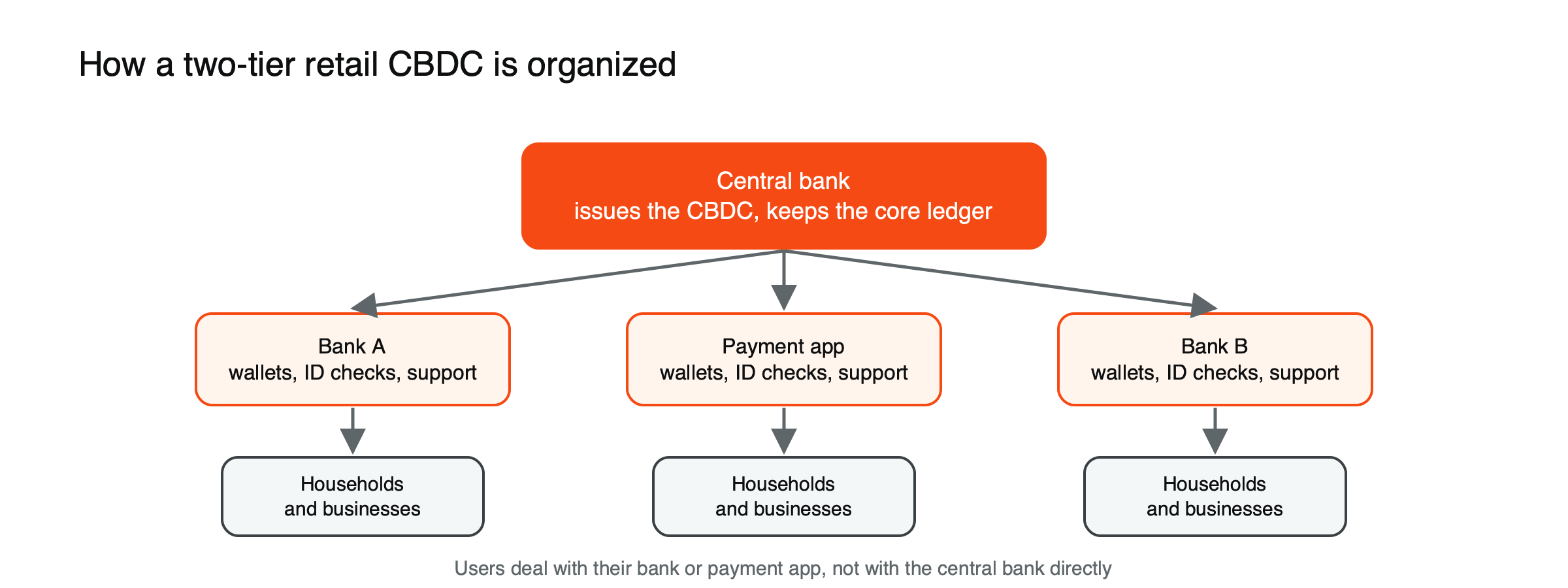
Figure: The intermediated, or two-tier, model used in most retail CBDC designs.
What paying with a CBDC would look like
In most proposals, using a retail CBDC would feel much like using a banking or payment app today. You would open a digital currency wallet through your bank or an authorized payment provider, which would check your identity. To pay a shop, you would scan a code or tap your phone, and the payment would settle almost instantly in central bank money rather than as a transfer between commercial banks. Some designs add an offline mode, in which value stored on a phone or card can be passed between devices without a connection, usually with low limits to contain the risk of loss or fraud.
The design choices that decide what a CBDC is like
Two CBDCs can share a name and be very different in practice. The questions that matter most are:
- Accounts or tokens? An account-based design ties every unit to an identified holder; a token-based design works more like digital cash, with transfers that can carry less identifying information.
- How private? Designs range from full visibility for intermediaries to tiered systems in which small payments carry fewer data.
- Holding limits. Caps on how much one person can hold reduce the risk of people moving their savings out of commercial banks in a panic.
- Offline payments. The ability to pay without an internet connection makes a CBDC usable during outages, but is technically harder.
- Interest. Most proposals pay none, so that a CBDC does not compete directly with bank deposits for savings.
The digital euro: a test case in progress
The euro area offers the clearest view of how a large economy approaches the question. After a two-year preparation phase that ended in October 2025, the European Central Bank moved to the next phase of the project. Its design focuses on distribution through banks and on offline functionality. The ECB has said it will decide whether and when to issue only after EU legislation is adopted; if that happens during 2026, a pilot could start as early as mid-2027, with a possible first issuance in 2029.
Part of the motivation is strategic. The ECB has pointed out that nearly two-thirds of card transactions in the euro area are processed by non-European companies, and that 13 member states rely entirely on international networks for in-store payments.
Where CBDCs stand worldwide
According to the Atlantic Council’s tracker update in July 2025, a record 49 countries were running CBDC pilots. China’s digital yuan was by far the largest pilot, with India’s digital rupee the other major one. Only three countries had fully launched a retail CBDC: the Bahamas, Jamaica and Nigeria. In those that have launched, adoption has often been slow, because people already have convenient ways to pay.
Why the US has ruled out a CBDC
The United States has moved the other way. An executive order signed on January 23, 2025, prohibits federal agencies from establishing, issuing, circulating or promoting a CBDC within US jurisdiction, citing risks to financial stability, privacy and national sovereignty. The same order revoked the previous administration’s 2022 order on digital assets and promoted privately issued, dollar-backed stablecoins instead.
The main arguments for and against
Supporters argue that a CBDC could make payments cheaper and faster, give people without bank accounts access to digital money, keep a public option alongside private stablecoins and card networks, and preserve central bank money as cash use declines.
Critics argue that a CBDC could give the state a detailed view of every payment, make spending controls possible, and pull deposits out of commercial banks in a crisis, weakening the banks that lend to the economy.
What CBDCs mean for crypto holders
A CBDC is not an investment. It is worth exactly one unit of the national currency and does not rise or fall against it. It competes most directly with stablecoins as a way to hold and move digital dollars, euros or yuan, and its design choices, especially on privacy and holding limits, decide how much it overlaps with private stablecoins and crypto.
For how private digital dollars work, read what a stablecoin is and how stablecoins are used in payments. For the experiments that came before Bitcoin, see the history of digital cash, and for how cryptocurrencies differ from state money, what cryptocurrency is.
This article is educational content and does not constitute financial, investment, legal or tax advice. Digital assets are volatile and you may lose the amount you invest.
Sources
- CBDC pilots in 49 countries (Atlantic Council tracker; Bahamas, Jamaica, Nigeria launched; China and India pilots) — Axios, July 2025
- President Trump issues executive order on digital financial technology (revokes EO 14067; promotes dollar-backed stablecoins) — Orrick InfoBytes, January 2025
- Executive Order 14178: Strengthening American Leadership in Digital Financial Technology (CBDC prohibition; definition) — The American Presidency Project, January 2025
- ECB moves to next phase of digital euro project (preparation phase completed; decision after legislation expected by 2026; pilot as early as mid-2027; first issuance by 2029) — A&O Shearman, October 2025
- ECB moves to next phase of digital euro project as preparation phase concludes (offline functionality; nearly two-thirds of card transactions processed by non-European companies; 13 member states) — BusinessNow, October 2025