
What Is a Bull Market and a Bear Market in Crypto?
A crypto bull market is a sustained rise; a bear market is a sustained fall. Learn how to tell them apart and how deep past bitcoin bear markets went.

Crypto bull and bear market phases are opposite trends: a bull market is a sustained rise in prices and optimism; a bear market is a sustained fall in prices and activity. Stock investors often use a 20% move as the dividing line, but crypto swings so far that the trend, its depth and its length matter more.
Why the 20% rule fits crypto badly
In stock markets, a 20% fall from a recent high is the common definition of a bear market. Bitcoin can move that much within a few weeks in the middle of a bull market. The 2020–2021 run, for example, included three corrections of more than 40% before the final peak. Applying the stock-market rule would have declared several bear markets that turned out to be pauses.
A more useful test looks at the trend over months: whether prices keep making higher highs and higher lows, or lower highs and lower lows, and whether a long-term average price, such as the 200-day moving average, is rising or falling. See the difference between simple and exponential moving averages.
How deep crypto bear markets have gone
Bitcoin’s bear markets have been far deeper than typical stock market declines:
- 2018: bitcoin fell about 84%, from roughly $20,000 to near $3,200, over about a year.
- 2022: after peaking near $69,000 in November 2021, it fell about 77% to roughly $15,500 in November 2022.
- 2025–2026: after a high of about $126,000 in October 2025, it fell roughly 47% to near $60,000 by early 2026.
Smaller coins usually fall further than bitcoin in the same downturn, and many never return to their previous highs.
The math of recovery shows why these declines matter so much. A 47% fall needs a gain of about 89% just to get back to the old high. A 77% fall needs about 335%, and an 84% fall needs about 525%. Losses and gains are not symmetrical, which is why avoiding the deepest part of a bear market matters more than catching every rally.
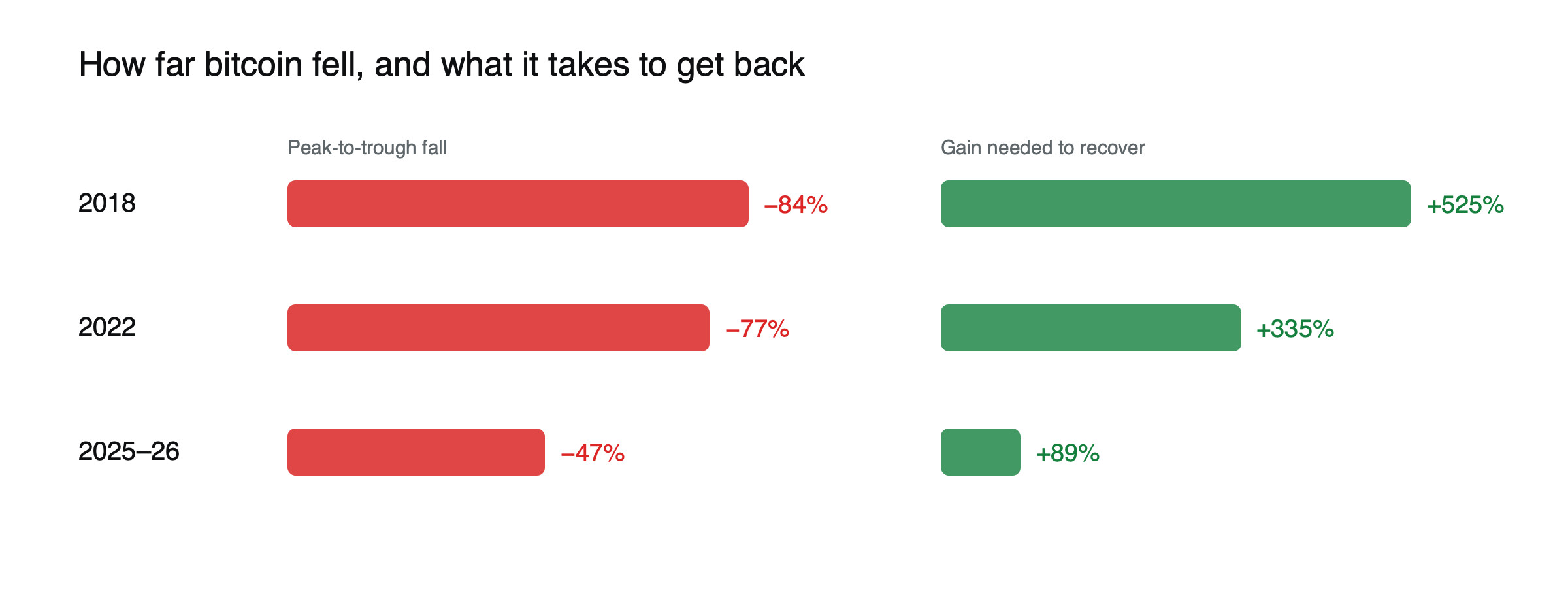
Figure: Bitcoin drawdowns and the rise needed to get back to the prior high. Drawdowns: Coin Metrics data via Analytics Insight; recovery math: 1 ÷ (1 − loss) − 1.
How crypto bear markets compare with stock bear markets
Stock market bear markets have usually ended with declines of a few tens of percent, and broad indices contain hundreds of companies that keep earning profits through the downturn. Crypto bear markets have repeatedly run to 75% or more for bitcoin and further for smaller coins, partly because there are no earnings to anchor prices and partly because leverage is widespread. Recoveries have also been sharper. The practical result is that risk limits borrowed from stock investing tend to be too loose for crypto.
What a crypto winter looks like
The long, quiet stretch after a deep decline is often called a crypto winter. It is defined less by price than by activity. Trading volumes shrink, new token launches dry up, venture funding slows, and companies that grew during the boom cut staff or close. Projects that relied on rising prices to attract users or pay for development fail in large numbers. Media coverage drops to occasional “crypto is dead” headlines.
Prices in a winter tend to move sideways in a range for months. For long-term builders and investors, these are often the periods when the groundwork for the next cycle is laid, though no one can know in advance how long a winter will last.
Telling the phases apart
Rather than a single signal, traders look for several pointing the same way:
- Price structure: higher highs and higher lows in a bull market; lower highs and lower lows in a bear market.
- Volume: rising on up-moves in a bull market; fading, apart from panic spikes, in a bear market.
- Leverage: building up in a bull market, often with positive funding rates on perpetual futures; flushed out by liquidations in a bear market. See what the funding rate is.
- Breadth: smaller coins tend to outperform late in a bull market and fall hardest in a bear market.
- Attention: search interest and media coverage climb in a bull market and fade in a bear market.
Why the turns are hard to call
Bull markets end at the point of greatest optimism, when most people expect more gains, and bear markets end when most people have given up. That is why the turning points are obvious in hindsight and hard to spot in real time. Prices also tend to recover before the news improves, because buyers act on expectations rather than on the latest headline.
Each phase also contains moves that look like the other. Bear markets often include sharp relief rallies that feel like a new bull market for a few weeks before prices roll over again, while bull markets include deep corrections that feel like the end. Both are reasons the labels tend to be applied with a lag, once the trend has lasted long enough to be clear.
Mistakes each phase invites
In a bull market: adding leverage after a long run of gains, treating every dip as a buying opportunity, and moving into ever smaller and riskier coins because the large ones “already went up.”
In a bear market: selling everything in panic near the lows, buying rallies that turn out to be brief, and holding failing projects in the hope they return to their old highs.
What helps in both is the same: decide position sizes and risk limits in advance, and review them when conditions change rather than in the middle of a sharp move.
What changes for traders
In a bull market, dips tend to be bought quickly and leverage builds up, which makes sudden, sharp corrections more likely. In a bear market, rallies tend to fade, liquidity thins and the cost of trading, such as the bid-ask spread, can widen. Position sizes that feel comfortable in one environment can be too large for the other.
For how these phases fit into a repeating pattern, read what a crypto market cycle is. For Bitcoin’s history around its supply cuts, see the Bitcoin halving history, and if you are just getting started, read what cryptocurrency is first.
This article is educational content and does not constitute financial, investment, legal or tax advice. Digital assets are volatile and you may lose the amount you invest.