
Why Is the Same Coin Priced Differently on Different Exchanges?
The same coin can cost more on one exchange than another. See why: capital controls, liquidity, quote currencies, fees and trust in the venue.
Each exchange runs its own order book, so its price is set by its own buyers and sellers. Crypto price differences between exchanges stay small when traders can move money and coins quickly. They grow when something blocks that movement, such as capital controls, slow transfers, thin liquidity or doubts about whether an exchange can pay out.
Where “the bitcoin price” comes from
The bitcoin price on a news site or chart is usually an index: an average of trades across several large exchanges, often weighted by volume. On any single exchange, the price is simply where the last buyer and seller met in that venue’s order book.
Two venues with different users, different local currencies and different amounts of liquidity will rarely print exactly the same number at the same moment. Most of the time the difference is a fraction of a percent and disappears within seconds, because arbitrage traders buy where the coin is cheap and sell where it is expensive. The interesting question is what stops them when gaps last.
What keeps prices apart
Barriers to moving money
Capital controls and banking rules can stop traders from moving cash into or out of a country. The coin itself can travel across borders in minutes; the profit, in local currency, often cannot. This is behind the largest and longest-lasting gaps on record.
Liquidity
A small exchange with a thin order book moves further on each large trade. Its price can drift away from the big venues for minutes or hours before anyone bothers to close the gap.
The quote currency
A price in Korean won, a price in US dollars and a price in the USDT stablecoin are three different things. Exchange rates, bank spreads and a stablecoin trading slightly above or below $1 all show up as apparent price differences, even when the coin itself is fairly valued everywhere.
Fees, limits and transfer time
Withdrawal fees, daily limits and network confirmation times eat into any gap. A 1% difference is not worth chasing if moving the coin costs half of that and the price can change before it arrives.
Trust in the venue
When traders doubt that an exchange can process withdrawals, coins held there can trade at a discount, because getting them out is uncertain. A widening gap on one venue is sometimes the first public sign of trouble.
Why your exchange may not match the chart
Price aggregators decide which venues to include in their index. Many weight each exchange by trading volume, and some leave out venues with suspicious volume or prices far from the rest. Your own exchange may not be in the index at all, or it may carry very little weight. That is why the price you see on a news site and the price you can actually trade at can differ, especially on smaller exchanges and in fast markets. When accuracy matters, the price that counts is the bid or ask in the order book where you will trade, not the headline number.
The kimchi premium
South Korea has produced the most persistent gap. Researchers at the University of Calgary found that bitcoin traded on South Korean exchanges at an average premium of 4.73% to US prices between January 2016 and February 2018, peaking at 54.48% in January 2018. Traders named it the kimchi premium.
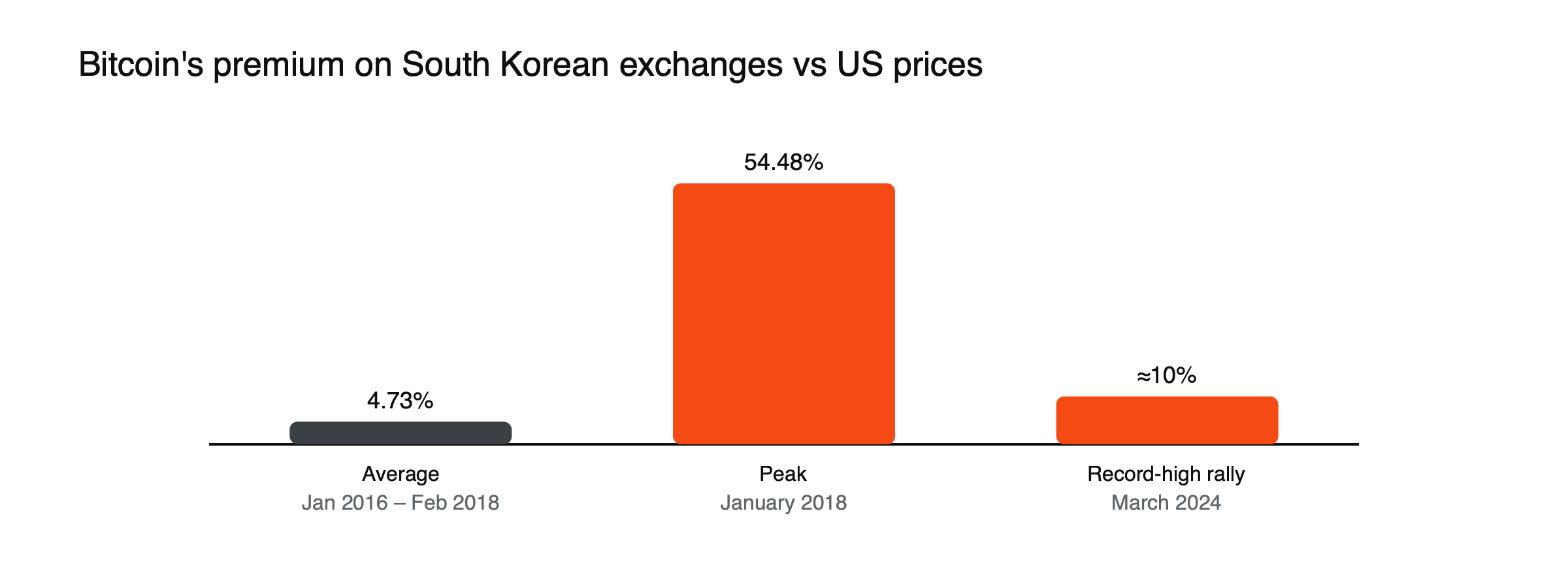
Figure: The kimchi premium at three points. Sources: University of Calgary research (2019) via CNBC; March 2024 figure from CNBC.
The researchers described the gap as largely structural. Korea’s controls on moving capital abroad meant an arbitrage trader could sell bitcoin for won at a high price but could not easily convert the won and move it out of the country. The premium faded by early February 2018 and has returned in later rallies, including a gap of roughly 10% when bitcoin set a record high in March 2024.
A worked arbitrage, with the costs left in
Suppose bitcoin trades at $100,000 on Exchange A and $101,000 on Exchange B, a 1% gap. You buy one bitcoin on A and send it to B to sell. (Example values.)
| Item | Amount |
|---|---|
| Gross gap | +$1,000 |
| Trading fees, 0.1% on each side | −$201 |
| Withdrawal fee, 0.0002 BTC | −$20 |
| Result before price risk | +$779 |
| If bitcoin drops 0.5% while the transfer confirms | −$505 |
| Result after that move | +$274 |
Two-thirds of the apparent profit can disappear in one ordinary price swing during the transfer. Professional arbitrage firms avoid the transfer altogether by holding balances on both exchanges in advance, buying on one and selling on the other at the same moment. That requires capital parked on every venue, which brings its own risk if an exchange fails.
Stablecoins: the gap hidden inside the quote
Many exchanges quote coins in stablecoins rather than dollars. If the stablecoin itself slips, every price quoted in it shifts. In March 2023, after Circle disclosed that part of USDC’s reserves were held at the failed Silicon Valley Bank, USDC fell as low as about $0.87. For a few days, bitcoin priced in USDC looked more expensive than bitcoin priced in dollars, even though nothing had changed about bitcoin. See what happened when USDC lost its peg.
Why the gap is not free money
On paper, buying at $100,000 abroad and selling at $105,000 in a premium market is a 5% profit. In practice:
- The coin takes time to arrive, and the premium can close while it travels.
- The exchange may require local identity verification and a local bank account.
- Getting the proceeds back into dollars can be slow, capped or blocked.
- Fees on both ends, plus the currency conversion, come off the top.
Persistent gaps exist precisely because the easy version of the trade does not work.
Spot prices vs futures prices
Another source of confusing gaps is the type of market. Futures and perpetual contracts on the same coin often trade above or below the spot price. On perpetuals, the gap is kept in check by funding payments between buyers and sellers; on dated futures, it reflects time to expiry and demand for leverage. A chart that switches between spot and derivatives prices can show jumps that have nothing to do with the coin itself. See what the funding rate is and how the crypto futures basis works.
What a lasting gap tells you
A small, short-lived gap is normal. A gap that is large and lasting usually points to one of three things: money cannot flow freely into or out of that market, local demand is unusually strong, or traders are pricing in risk at a specific exchange. Watching premiums on regional exchanges and the price of major stablecoins against $1 gives an early read on all three.
Before trading on any venue, it helps to know how crypto exchanges work and how liquidity affects the price you get. For what supports prices in the first place, see what gives cryptocurrency its value or start with what cryptocurrency is.
This article is educational content and does not constitute financial, investment, legal or tax advice. Digital assets are volatile and you may lose the amount you invest.
Sources
- In the wake of bitcoin’s new highs, South Korea’s kimchi premium is in the spotlight again (4.73% average, 54.48% peak; ~10% in March 2024) — CNBC, April 2024
- Bitcoin’s ‘Kimchi Premium’ Vanishes Again as Trading Range Tightens (University of Calgary paper, April 2019; structural causes) — CoinDesk, August 2019
- Bitcoin’s “Kimchi Premium” Has Vanished — Bloomberg, February 2018
- USDC regained its dollar peg (low of $0.87, March 2023) — FXStreet
- USDC and DAI remain at about $0.90 following Circle’s disclosure of funds at SVB — The Block, March 2023