
What Gives Cryptocurrency Its Value?
Crypto has value when people need what the network does. See the drivers ranked: real use, supply rules, security, liquidity and speculation.

What gives crypto value is the expectation that enough people will use or hold it, backed by a network that makes that expectation believable. The strongest support is demand for what the network does, such as settling payments or running applications. Supply rules, security and liquidity add to it; speculation can push prices far beyond all of them.
Why the question is hard to answer
A share has a claim on a company’s profits. A bond pays interest. A barrel of oil can be burned. Most cryptocurrencies offer none of these. There are no earnings to discount and no physical use, so the usual valuation tools do not apply cleanly.
That does not mean crypto prices are random. It means value has to come from somewhere else: from people needing the coin to do something, from people choosing to hold it as a store of value, or from people expecting someone else to pay more later. Every serious answer to “what gives crypto value” is some mix of those three, and the mix differs a great deal from one coin to the next.
Demand for the network itself
Start with the most durable source. Someone who wants to send a payment on Bitcoin, run a smart contract on Ethereum or move stablecoins on a fast network has to pay a fee in that network’s native coin, or at least use its block space. That creates a buyer who is not betting on the price at all.
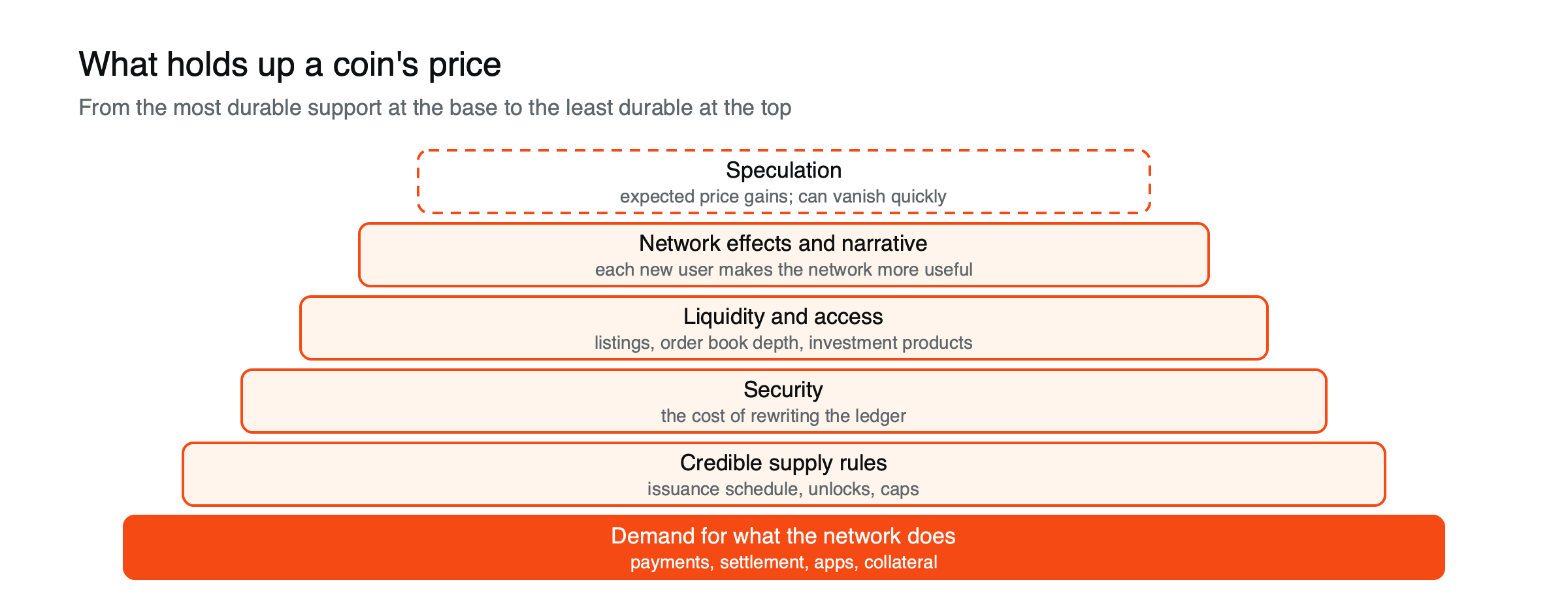
Figure: What supports a cryptocurrency’s value, from daily demand for the network at the base to speculation on top. The lower layers repeat every day; the top can leave all at once.
Fees paid, the number of active addresses and the value settled each day are rough measures of this demand. None is a perfect price model. But a network that people pay to use has something to fall back on when speculative interest fades, and a token with no use has nothing.
Some coins add a second job. Ether is also staked to secure the network and locked as collateral in lending markets. Every unit locked in that way is a unit that is not for sale, which tightens the available supply.
Holding demand: the store-of-value argument
Bitcoin’s case rests less on fees and more on people choosing to hold it as a scarce, hard-to-confiscate asset. Its supply is fixed by code: new issuance halves roughly every four years and stops just short of 21 million coins. See what the Bitcoin halving is.
Scarcity on its own is not value. Plenty of tokens have fixed supplies and no buyers. Scarcity matters when there is lasting demand to hold the asset, because then a growing base of holders competes for a supply that cannot expand to meet them. The store-of-value argument therefore depends on trust built over time: a long record of the network working, of the rules not changing, and of the coin remaining easy to buy and sell.
Supply rules that help, and ones that hurt
Supply works in both directions. Credible limits, such as Bitcoin’s schedule, or mechanisms that remove coins from circulation, such as Ethereum’s fee burn, can support value when demand is steady. See how the ETH burn works.
Large allocations to founders and early investors work the other way. When those holdings unlock on a schedule, new supply can arrive faster than the market can absorb it. A token can have a growing user base and a falling price at the same time if insiders sell more than new users buy. See how token unlocks affect price.
Security: what makes the ledger worth trusting
A ledger is only useful if rewriting it is too expensive. On Bitcoin, that cost is hardware and electricity; on proof-of-stake networks, it is the coins validators lock up and stand to lose if they cheat. More security does not raise the price by itself, but weak security can erase value quickly, as projects hit by attacks or bridge hacks have found.
Three coins, three different value stories
| Bitcoin | Ether | A dollar stablecoin | |
|---|---|---|---|
| Main source of value | Holding demand for a scarce asset | Fees and collateral on a busy network | Reserves backing a $1 claim |
| Supply | Fixed schedule, capped near 21 million | Issuance minus fee burn | Expands and shrinks with redemptions |
| What would break it | Loss of trust in the network or its rules | Users moving to other networks | Reserves proving insufficient |
The table shows why one valuation story cannot fit all of crypto. A stablecoin should trade near $1 because it can be redeemed for dollars; its value has nothing to do with scarcity. A meme token has neither use nor reserves; its price is entirely what the next buyer will pay.
Speculation is real demand, but borrowed
Buyers who expect a higher price are demand like any other, and in crypto they often dominate. The difference is that speculative demand can leave all at once. When it does, prices fall back toward whatever support comes from real use, and for many tokens that support is close to zero.
The record of failed tokens shows how often this happens. CoinGecko counted 20.2 million projects on its GeckoTerminal tracker by the end of 2025 and classed 53.2% as failed, meaning they had stopped trading entirely. Most never had a network anyone needed. See why most cryptocurrencies fail.
The first well-known purchase with bitcoin is a reminder that value builds slowly. In May 2010, a programmer paid 10,000 BTC for two pizzas. The coins had almost no market value then, because almost no one needed or wanted them. What changed over the next decade was the size of the network, its track record and the number of people willing to hold it. See the story of Bitcoin Pizza Day.
Attempts to put a number on it
Analysts have tried to build valuation tools for crypto, each with clear limits:
- Network value to transactions: compares a network’s market value with the value it settles. A very high ratio can mean the price has run ahead of use, but transaction counts are easy to inflate.
- Network-effect models: link value to the number of users, on the idea that each new user makes the network more useful to the rest. They describe growth well and turning points badly.
- Supply-based models: relate price to scarcity, such as the ratio of existing supply to new issuance. They ignore demand, which is the part that actually moves.
Used together, these can flag when a price looks stretched or cheap relative to activity. None of them can tell you what a coin is “worth” with any precision.
Signals worth tracking beyond the price
- Usage: fees paid, active addresses and stablecoin volume on the network.
- Supply: the issuance schedule and any upcoming token unlocks.
- Security: hash rate on proof-of-work chains, total stake on proof-of-stake chains.
- Liquidity: order book depth on major exchanges and whether listings are growing or shrinking.
- Concentration: how much of the supply sits with insiders or a handful of wallets.
A coin that scores well on these can still fall sharply, because speculation swings both ways. A coin that scores badly on all of them depends entirely on the next buyer.
For the basics of how these assets work, start with what cryptocurrency is, and for a practical checklist see how to research a crypto asset.
This article is educational content and does not constitute financial, investment, legal or tax advice. Digital assets are volatile and you may lose the amount you invest.