
What Is Staking in Crypto?
Staking locks crypto to help run a proof-of-stake network in return for rewards. Learn the main ways to stake, where rewards come from and what can go wrong.
Staking in crypto means locking up coins on a proof-of-stake network so they can be used to validate transactions and secure the chain. In return, the network pays rewards from new issuance and transaction fees. Rewards vary and are never guaranteed, and the staked coins stay exposed to price swings, lockup periods and penalties.
Where staking fits
Proof-of-stake networks replace mining with collateral. Instead of spending electricity to compete for the right to add blocks, validators lock the network’s coins as a security deposit, propose and check new blocks, and earn rewards for doing it honestly. If they cheat, they can lose part of that deposit.
Staking is how ordinary holders take part. They can run a validator themselves, or assign their coins to someone who does. Either way, the coins they stake help make attacks on the network expensive. Our guide to proof of stake covers the consensus side in detail.
How staking works, step by step
- Coins are committed to the protocol. On Ethereum, activating a validator requires a minimum of 32 ETH. Other networks set their own minimums, and many allow smaller amounts through delegation.
- A validator does the work. It runs software that proposes blocks and votes on blocks proposed by others, and it needs to stay online and up to date.
- The protocol pays rewards. Rewards come from newly issued coins and transaction fees. They depend on how many coins are staked across the network, how well the validator performs and how busy the network is.
- Unstaking takes time. Getting coins back usually means waiting in an exit queue or an unbonding period that can last from days to weeks.
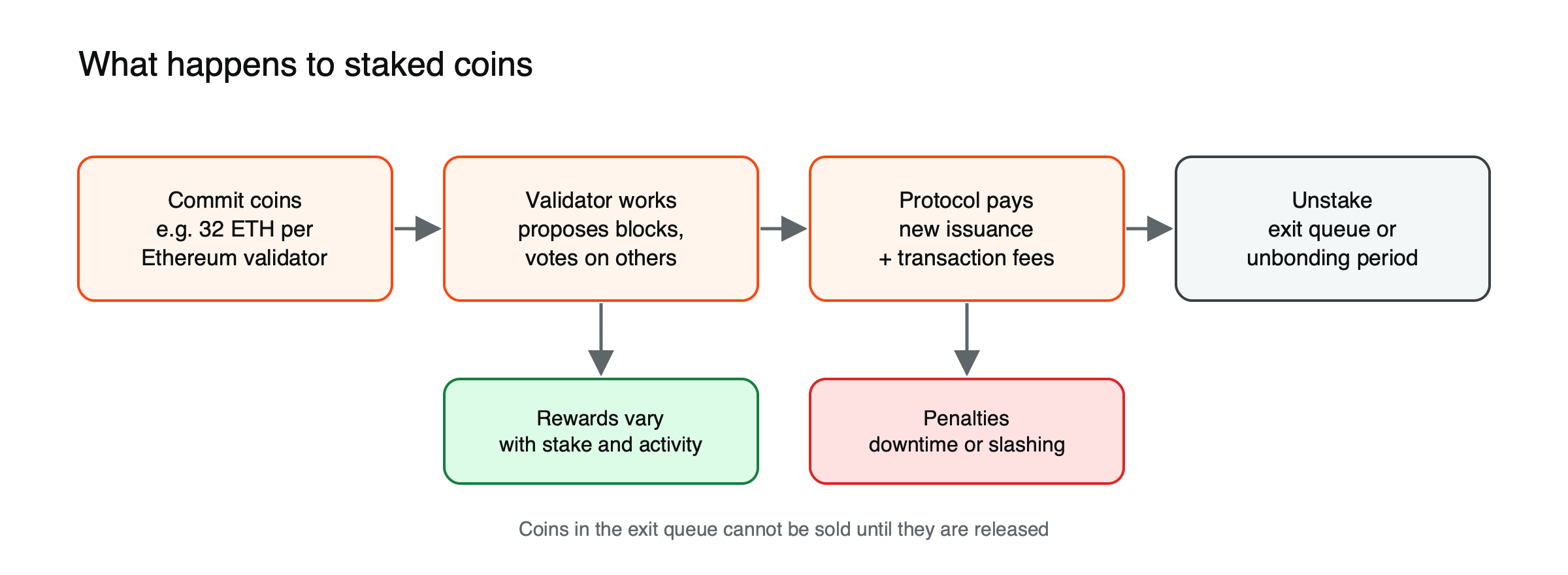
Figure: The staking cycle. Rewards are variable; penalties and exit waits are part of the same system.
Staking rewards in numbers
Suppose you stake 10 ETH when ether trades at $3,000, so the position is worth $30,000, and the network pays an annual reward of 3%. (Example values; real rates change.)
- After a year you hold about 10.3 ETH: the protocol added 0.3 ETH.
- If ether’s price is unchanged, you are up about $900.
- If ether falls 20% to $2,400, your 10.3 ETH are worth about $24,720, a loss of roughly $5,280 despite the reward.
The reward is paid in the same coin you staked. It increases the number of coins you hold, not their dollar value, which is why staking does not protect against a falling market.
Three ways to stake
| Who runs the validator | Who holds the keys | Main extra risk | |
|---|---|---|---|
| Solo staking | You | You | Running the setup correctly and keeping it online |
| Delegated or self-custodial staking | A third-party operator | You | The operator’s performance and penalties |
| Custodial staking | A service provider, such as an exchange | The provider | The provider’s solvency, terms and access to your coins |
A fourth route, liquid staking, gives you a token representing your staked coins, which you can trade or use elsewhere while the originals stay staked. It adds smart-contract risk and the chance that the token trades below the value of what it represents. See what liquid staking is.
What can go wrong
- Price risk. As the example shows, a few percent of rewards rarely offsets a fall in the coin’s price.
- Slashing. Validators that break the rules, for example by signing two conflicting blocks, can lose part of their stake, and delegators can share that loss. See how slashing works on Ethereum.
- Lockups. Coins waiting in an exit queue cannot be sold during a market crash.
- Counterparty risk. With custodial staking, your coins are only as safe as the company holding them.
- Variable rewards. Advertised rates are estimates. They fall as more coins are staked and change with network activity.
- Tax. Many countries treat staking rewards as income when received, separately from any gain when the coins are sold. Rules differ by jurisdiction.
Why reward rates fall as more coins are staked
Staking rewards are shared among everyone who stakes. On Ethereum, total new issuance rises as more ether is staked, but more slowly than the stake itself, so the reward rate for each staked coin falls as participation grows. Other networks use different formulas, but the principle is similar: a high advertised rate often reflects low participation and may not last. Checking the current participation rate gives a better guide than a headline figure. When comparing rates across networks, it also helps to ask how much new supply the rewards create, since rewards paid by issuing new coins dilute holders who do not stake.
Staking is not lending
Staking rewards come from the protocol for helping to run the network. Crypto lending products pay interest because someone borrowed your coins, which adds credit risk: the borrower may not pay them back. Some services label lending as “earn” or “yield” without making the difference clear, so it is worth checking where the return actually comes from.
How regulators have treated it in the US
On May 29, 2025, staff in the SEC’s Division of Corporation Finance stated their view that certain protocol staking activities, namely solo staking, self-custodial staking with a third party and custodial staking, do not involve the offer and sale of securities. The statement does not cover liquid staking or restaking, does not have the force of law, and other countries apply their own rules.
Questions to ask before staking
- Where do the rewards come from? Protocol issuance and fees, or a company lending your coins?
- Who holds the keys? You, an operator acting on your instructions, or a custodian?
- How long does it take to get out? Check the exit queue or unbonding period before you need the money.
- What happens if the validator is penalized? Find out whether losses are passed on to you.
- How is it taxed where you live? Rewards may be taxable when received.
Staking and proof of stake are not the same thing
Proof of stake is the consensus method a blockchain uses. Staking is what participants do within it. A network can use proof of stake without most holders ever staking, and a holder can stake without running any infrastructure. The comparison with mining is covered in proof of work vs proof of stake, and the practical side in how to stake ETH.
For how custody choices change your risk, read custodial vs non-custodial wallets, and for the basics, what cryptocurrency is.
This article is educational content and does not constitute financial, investment, legal or tax advice. Digital assets are volatile and you may lose the amount you invest.
Sources
- Ethereum consensus specifications, Electra beacon chain (32 ETH minimum activation balance) — Ethereum, GitHub
- Statement on Certain Protocol Staking Activities — US SEC Division of Corporation Finance, May 2025
- SEC Staff Declares Certain Protocol Staking Not A Security Transaction (excludes liquid staking and restaking; no legal force) — Mondaq, June 2025