
DeFi Mistakes That Lead to Lost Funds
Fake sites, unlimited approvals, copycat tokens, wrong networks, unexplained yields and risky borrowing: where each DeFi mistake happens and how to stop it.
Most DeFi losses come from a short list of DeFi mistakes: signing on fake sites, leaving unlimited token approvals, buying copycat tokens, sending to the wrong network, chasing yields without a source and borrowing too close to liquidation. Each happens at a predictable moment, so each can be caught with a quick check.
Mistakes happen at moments
A DeFi transaction passes through a series of moments: finding the app, connecting a wallet, approving tokens, choosing what to buy or where to send, leaving money in a position and finally walking away. Almost every common loss happens at one of these points. Knowing which moment you are in, and what usually goes wrong there, is more useful than memorizing a list.
Before you connect
The most expensive mistakes start before any transaction. A search advert, a reply on social media or a message in a chat group leads to a copy of a real app, built to look identical. Connecting to it is harmless on its own, but everything you sign afterwards goes to the attacker.
The habit: reach DeFi apps only through bookmarks you saved yourself or links in the protocol’s official documentation. If you arrived some other way, close the tab and start again from a bookmark. See how to spot fake crypto exchange websites.
When your wallet asks for something
Your wallet’s pop-up is the last moment you can stop a bad transaction, and the moment most people rush. Approvals are the main danger. Many apps ask for permission to move an unlimited amount of a token, and approvals do not expire. If that contract is later exploited, or if you approved a malicious one by mistake, the token can be drained long after you have forgotten the app.
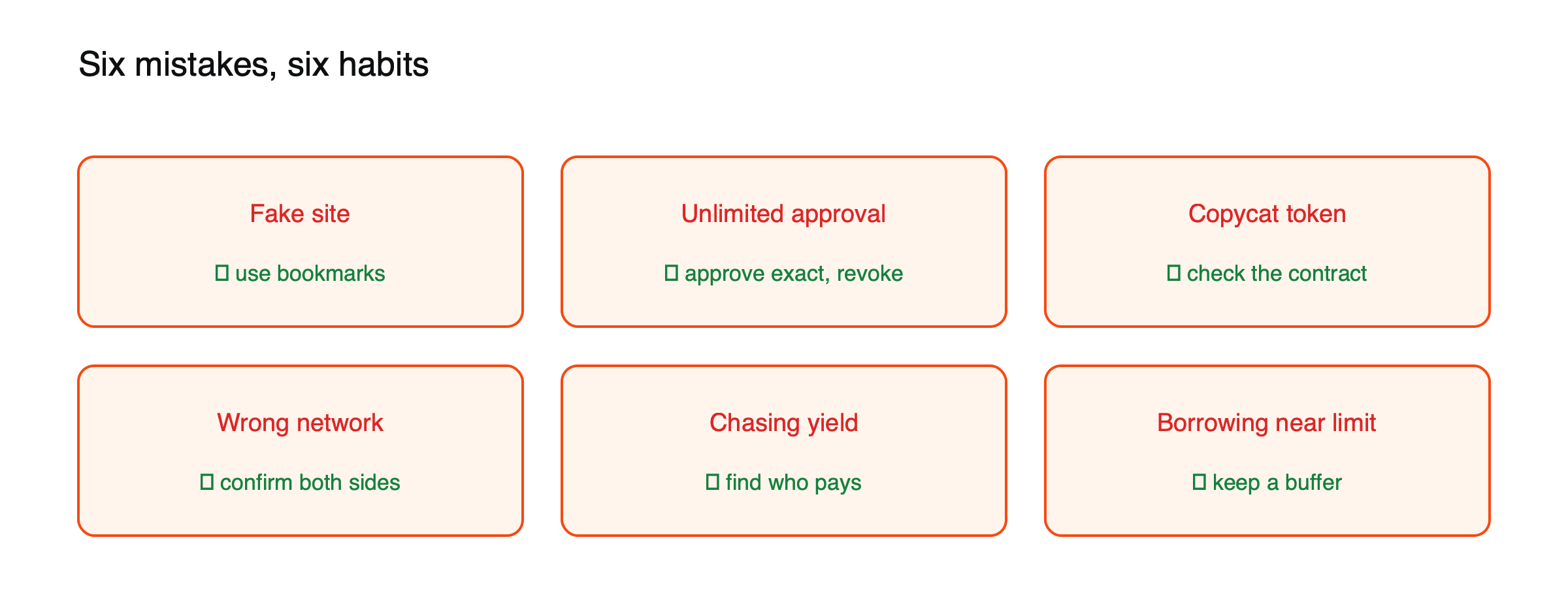
Figure: Six common mistakes and the habit that prevents each.
| What the wallet shows | What it means | What to check |
|---|---|---|
| Connect | Shares your address | That you are on the real site |
| Approve or set allowance | Lets a contract move a token | The spender and the amount |
| Permit or sign message | Can authorize spending without a transaction | Whether it names a spender and token |
| Set approval for all | Lets an operator move all items in a collection | Whether you recognize the operator |
| Swap or deposit | Moves your tokens now | Amount received, fee, slippage |
The habit: approve only the amount you need, read who the spender is, and treat any signature request you did not expect as hostile. See what a wallet drainer is.
When choosing what to buy or where to send
Two mistakes cluster here. The first is buying a copycat token: anyone can create a token with the same name, ticker and logo as a real one, and swap apps will list it if someone creates a pool. The second is sending on the wrong network: the same token exists on many blockchains, and an address that works on one may not be supported on another by the receiving platform. Unknown bridges add the risk of losing funds in transit.
The habit: copy contract addresses only from the project’s official sources, confirm the network on both sides of every transfer and use well-known bridges with a small test amount first. See what a rug pull is and how to choose the correct blockchain network.
While your money is working
Once funds are deposited, the risks change. Very high advertised yields attract money into protocols that are untested, paid in reward tokens that are falling, or designed to collapse. Borrowing near the maximum, or using borrowed funds to deposit more, leaves almost no room for prices to move before liquidation and its penalty.
The habit: find out who pays the yield before depositing, borrow well below the limit and set alerts so you hear about price moves before liquidators do. See where DeFi yield comes from and how health factor and liquidation price work.
When you are done
The last moment is the one most people skip. Approvals granted months ago stay active after you stop using an app. Small balances left in forgotten protocols remain exposed to future exploits. And many swaps, rewards and withdrawals create tax records that are painful to rebuild later.
The habit: after leaving a protocol, revoke its approvals with an approval checker on a block explorer, withdraw dust balances you no longer need and export your transaction history. See how to keep records of your crypto transactions.
The common thread: speed
Look across these moments and one pattern stands out: almost every costly mistake is made in a hurry. A countdown on a mint page, a yield that might disappear tomorrow, a message warning that your wallet will be locked, a token that is rising while you read about it. Urgency is the attacker’s most reliable tool, because it pushes people past the checks they would normally make. Treating any sense of rush as a warning sign, and stepping away for a few minutes before signing, prevents more losses than any single technical precaution. Over time, these checks become as automatic as looking both ways before crossing a road, and they cost mere seconds rather than savings each and every time.
One setup that prevents most of these
Many experienced users keep two wallets: a main wallet that holds most of their funds and rarely signs anything, and a separate wallet with a small balance for connecting to new apps, claiming airdrops and experimenting. A mistake in the second wallet costs only what it holds. Combined with bookmarks, careful reading of wallet prompts and regular approval reviews, this arrangement removes most of the routes by which DeFi users lose money.
If something goes wrong
Move any remaining funds from the affected wallet to a new one, revoke approvals that might still be used and record what happened, including transaction hashes and the site involved. Report the incident to the protocol and to the platforms where stolen funds may arrive. Be wary of anyone offering to recover funds for a fee. See how to recover a hacked crypto account.
For a full pre-deposit checklist, read how to check a DeFi protocol before depositing. For the basics, see what DeFi is.
This article is educational content and does not constitute financial, investment, legal or tax advice. Digital assets are volatile and you may lose the amount you invest.