
What Was DeFi Summer?
DeFi Summer was the 2020 boom when token rewards pulled billions into DeFi. The timeline from COMP to UNI, what it built and what it left behind.
DeFi Summer was the period from June to September 2020 when token rewards pulled billions of dollars into decentralized finance. It began when Compound started handing out its COMP token on June 15, 2020, and peaked around Uniswap’s UNI airdrop in mid-September. Total value locked in DeFi grew from under $1 billion to over $10 billion in about three months.
The numbers behind the summer
Before June 2020, decentralized finance was a niche with under $1 billion deposited. Within about three months it held more than $10 billion. Much of that growth came from users chasing token rewards rather than from new demand for lending or trading, which is why the figures were so volatile. But the rise also brought in developers, investors and users who stayed after the rewards ended.
Timeline
- June 15: Compound begins distributing COMP to lenders and borrowers. Within days it becomes the largest DeFi protocol by deposits.
- July 17: Yearn Finance launches its YFI token with a fixed supply of 30,000, no pre-mine and no allocation for its team or investors, distributed only to users.
- August: a wave of copycat “food” tokens launches; one, YAM, discovers a critical bug a day after launch with about half a billion dollars deposited.
- Late August: SushiSwap, a copy of Uniswap, offers SUSHI rewards to lure Uniswap’s liquidity providers, a tactic called a vampire attack. It draws in around $1 billion of liquidity.
- September 16–17: Uniswap launches its UNI governance token and gives 400 UNI to every address that had used it. DeFi token market value peaks shortly afterward.
- September: DeFi tokens fall back as the market cools.
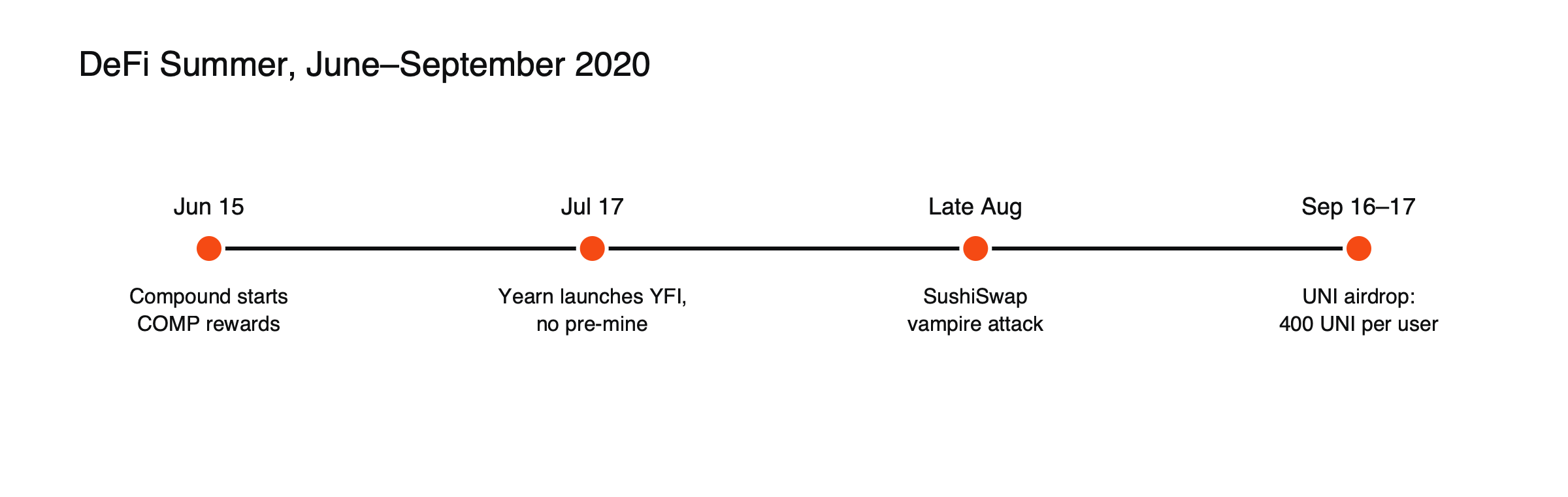
Figure: Four launches that defined DeFi Summer.
What liquidity mining looked like for a user
Suppose a user deposited $10,000 of a stablecoin into a lending protocol in mid-2020. They earned ordinary interest from borrowers, plus a stream of the protocol’s governance token as a reward. If the token was trading at a high price, the combined return could look like 20%, 50% or more a year. (Illustrative figures.) Many users then borrowed against their deposit, redeposited the borrowed funds and repeated the loop to earn more tokens, increasing both rewards and risk. Most sold the reward tokens quickly, which is part of why many token prices fell once the initial excitement faded. The real return depended on when those tokens were sold, not on the yield displayed when the deposit was first made.
Compound’s COMP: where it started
Compound already ran a lending market in which users could deposit tokens to earn interest or borrow against collateral. On June 15, 2020, it began distributing its new COMP governance token to both lenders and borrowers each day. Because the rewards could be worth more than the interest paid, borrowing itself became profitable for some users. Deposits and borrowing jumped, other protocols copied the model within weeks, and the term “yield farming” entered everyday crypto vocabulary.
Yearn and the “fair launch”
Yearn Finance, which automatically moved deposits between lending protocols to chase the best yields, launched its YFI token on July 17 with a fixed supply of 30,000 and no allocation for the team or investors. Tokens went only to users who provided liquidity. The approach was called a fair launch, and it became a model that many later projects claimed to follow, though few matched it in practice. Its price rose steeply in the following weeks, showing how much enthusiasm the summer generated.
The YAM episode
YAM, one of the “food” tokens that launched in August, attracted about half a billion dollars of deposits within a day or two, without an audit. Then a bug was found in the contract that controlled its supply, which meant the protocol could not reach the governance votes needed to function properly. The price collapsed and depositors rushed to withdraw. YAM became a symbol of the summer’s excesses: enormous sums moving into untested code because rewards were high and everyone else was doing the same.
SushiSwap’s vampire attack
SushiSwap copied Uniswap’s code and offered its SUSHI token to anyone who deposited Uniswap liquidity tokens into its contracts. After a set period, it moved that liquidity from Uniswap to its own exchange. The tactic drew in around $1 billion and showed how easily liquidity could be lured away when code is open source and loyalty is bought with token rewards. Uniswap’s own token launch weeks later was partly read as a response to that pressure.
Why it happened
Liquidity mining. Paying users in governance tokens made using a protocol profitable on its own, and protocols copied each other within days. See what yield farming is.
Composability. Tokens from one protocol could be deposited in another, so rewards stacked.
Low barriers. Anyone could launch a token and a pool on Uniswap and attract liquidity immediately. See what an automated market maker is.
What it built
DeFi Summer established governance tokens, retroactive airdrops and liquidity mining as standard tools. Protocols such as Uniswap, Aave, Compound, Curve and Yearn grew into core DeFi infrastructure, and total value locked kept rising into 2021, peaking near $178 billion in November 2021.
Why the UNI airdrop mattered
Uniswap’s decision on September 17 to give 400 UNI to every address that had used the exchange turned past users into token holders overnight. It set the template for retroactive airdrops that projects have used ever since, and it showed that a protocol could distribute ownership widely rather than selling tokens to investors first. It also taught users to farm future airdrops by using new protocols, which shaped behavior for years. See what a crypto airdrop is.
After September
The excitement cooled quickly after Uniswap’s token launch. Prices of many DeFi tokens fell sharply in the autumn of 2020 as farmers sold rewards and attention moved on. But deposits did not disappear. As crypto prices rose through 2021, DeFi grew far beyond its summer levels, with total value locked peaking near $178 billion in November 2021, before the 2022 bear market reversed much of that growth.
What it left behind
Many farm tokens lost most of their value once rewards slowed and farmers sold. Unaudited forks lost user funds to bugs and exploits. The pattern of high, emission-funded yields followed by sharp declines has repeated in later cycles. Our guide to where DeFi yield comes from explains why.
Lessons that held up
Several lessons from that summer proved durable. Token rewards can attract capital quickly, but much of it leaves as soon as rewards fall, so incentives alone do not build lasting usage. Unaudited code holding large sums is a disaster waiting to happen, however popular it looks. Open-source protocols can be copied overnight, so a protocol’s real advantages are its users, liquidity and trust rather than its code. And rewards paid in a protocol’s own token are only worth what someone will pay for that token, which can be far less than the advertised yield implies.
For airdrops more generally, read what a crypto airdrop is. For the bigger picture, see what DeFi is.
This article is educational content and does not constitute financial, investment, legal or tax advice. Digital assets are volatile and you may lose the amount you invest.
Sources
- Here are some of the biggest DeFi events of 2020 (Yearn July 17; SushiSwap August; UNI September 16) — The Block, December 2020
- History of DeFi (TVL from under $1 billion to over $10 billion in three months; COMP June 15; 30,000 YFI; 400 UNI on September 17; $178 billion peak) — CoinLaw
- DeFi: from inception to 2021 (YAM bug with half a billion dollars locked; SushiSwap) — ethereum.org
- The State of DeFi Tokens (DeFi market cap peaked September 18 after UNI) — Coin Metrics
- DeFi history (SushiSwap drew about $1 billion of liquidity) — ethereum.org (Chinese edition)