
What Is TVL in DeFi?
TVL is the dollar value of crypto deposited in DeFi protocols. How it is calculated, what it tells you, and why price moves and double counting can mislead.
TVL, or total value locked, is the dollar value of all crypto deposited in a DeFi protocol’s smart contracts at a given moment, and the most quoted measure of DeFi’s size. It fell from about $115 billion in January 2026 to around $70 billion by June. TVL moves with token prices and can count the same money twice.
How TVL is calculated
Data providers such as DefiLlama read the balances held in each protocol’s contracts, multiply each token by its current market price and add them up. They then total protocols by category, by blockchain and across all of DeFi. A lending protocol’s TVL is mostly deposits; a decentralized exchange’s TVL is the tokens in its liquidity pools.
What TVL tells you
- Rough size and trust: a protocol holding billions has attracted more users and capital than one holding thousands.
- Where activity sits: by chain and by category, such as lending, liquid staking or exchanges.
- Trends: sustained growth over months says more than a sudden spike.
Why TVL can mislead
It moves with prices. If ether’s price doubles, the dollar value of ether in protocols doubles too, even if nobody deposits anything new.
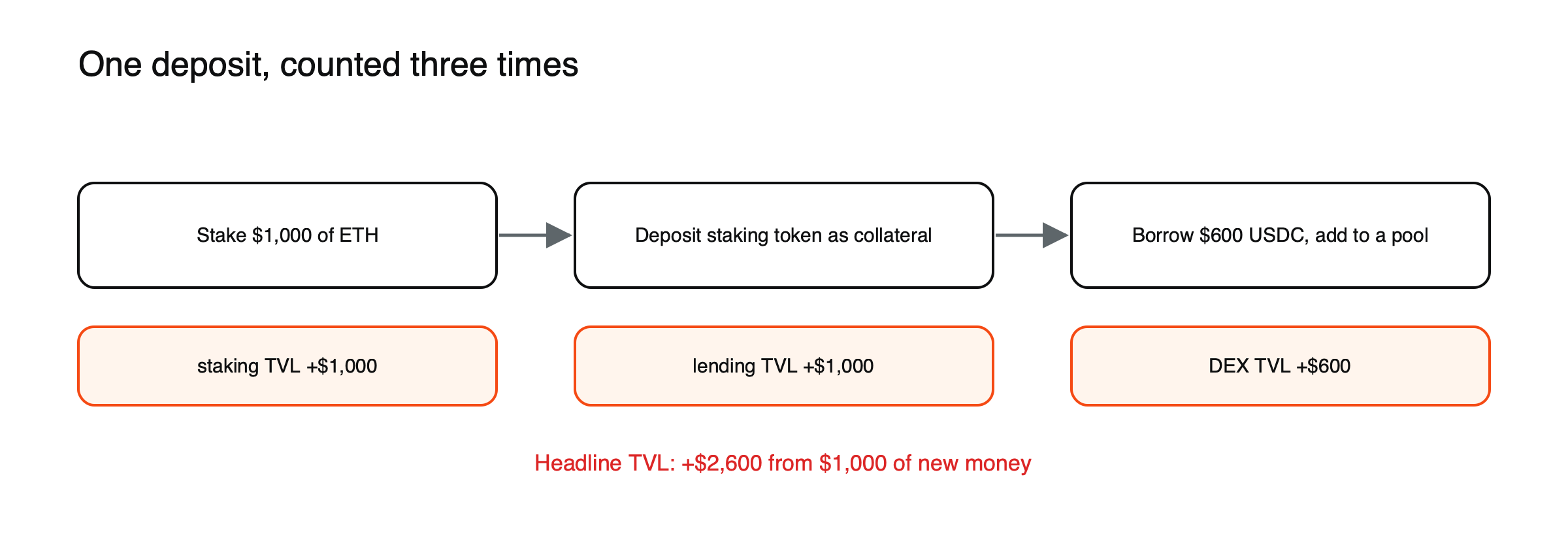
Figure: How the same money can appear in several protocols’ TVL (illustrative).
It can count the same money twice. A user can stake ETH for a liquid staking token, deposit that token as collateral in a lending protocol, borrow stablecoins and add them to a pool. Each step can appear in a different protocol’s TVL. DefiLlama offers a setting to adjust for this, but most headline figures include some double counting.
Incentives can inflate it. Token rewards can attract deposits that leave as soon as rewards end.
It is not revenue. A protocol can hold a lot of value and earn little from it.
A price move, with no one moving funds
Suppose a protocol holds 100,000 ETH and nothing else. At $3,000 per ETH, its TVL is $300 million. If ETH falls to $2,000 and not a single user withdraws, TVL drops to $200 million, a one-third fall that says nothing about users leaving. (Illustrative figures.) Many headlines about DeFi “losing billions” describe price moves of this kind. Checking TVL measured in tokens, or the number of active depositors, separates real outflows from price effects.
Double counting, worked through
Take one user with 10 ETH worth $30,000. They stake it with a liquid staking protocol and receive a staking token worth $30,000, counted in that protocol’s TVL. They deposit the staking token as collateral in a lending protocol, counted again: another $30,000. They borrow $15,000 of stablecoins and add them to a trading pool, counted a third time. The user’s original $30,000 now appears as about $75,000 of TVL across three protocols. (Illustrative figures.) Data providers offer settings to reduce this effect, but headline totals often include it.
Better companion measures
- Fees and revenue: what users actually pay to use the protocol, and how much the protocol keeps.
- Active users: the number of distinct addresses using it over a week or month.
- TVL against market value: some analysts compare a protocol token’s market value with its TVL, though the ratio is crude.
- Stablecoin deposits: less affected by crypto price swings than volatile assets.
- Concentration: how much of the TVL comes from a few large depositors who could leave at once.
A short history in TVL
DeFi’s total value locked peaked near $177 billion in late 2021, then fell more than 70% by July 2022 as prices collapsed and several large failures shook confidence. In 2026, it slid from about $115 billion in January to just over $70 billion by late June. Each swing combined price moves with real withdrawals, which is why the headline number alone rarely tells the full story.
TVL by chain and by category
Data providers break TVL down by blockchain and by type of protocol. By chain, Ethereum has long held the largest share, with layer 2 networks and other chains such as Solana and BNB Chain holding much of the rest. By category, lending protocols, liquid staking and decentralized exchanges have usually been among the largest. These breakdowns show where users are actually putting money, which can differ from where attention on social media is focused.
Using TVL when choosing a protocol
For someone deciding where to deposit, TVL is useful mainly as a filter. A protocol holding very little may have thin liquidity and few users to notice problems. A protocol holding a great deal has at least passed the judgment of many depositors over time. Beyond that, the more important questions are how long the protocol has operated without major incidents, whether its code is audited, how concentrated its deposits are and how its TVL behaved during past market stress.
Finally, remember that TVL describes what is deposited, not what could be withdrawn quickly. Funds lent out to borrowers, locked for staking or committed to long positions may not be available in a crisis, so a protocol with large TVL can still struggle to meet withdrawals during a rush for the exits. Withdrawal queues and lock-up terms reveal this better than any headline totals.
How to read TVL sensibly
Compare TVL over time and against fees or revenue, check how much comes from the protocol’s own token, and look at whether deposits hold up when rewards change. For a protocol you plan to use, TVL is one input, not a safety rating: large protocols have been hacked too.
For the wider sector, read what DeFi is. For a related market measure, see what crypto market cap is.
This article is educational content and does not constitute financial, investment, legal or tax advice. Digital assets are volatile and you may lose the amount you invest.
Frequently asked questions
Is a higher TVL safer?
Not necessarily. A large TVL shows that many users trust a protocol, but it also makes the protocol a bigger target for attackers, and size does not guarantee that the code is sound or that the protocol could handle a rush of withdrawals.
Why do different websites show different TVL figures?
They track different protocols and chains, treat double counting differently, and may include or exclude a protocol’s own token. Comparing trends on one source is more reliable than comparing exact levels across sources.