
What Was the DAO Hack and Why Did Ethereum Split?
In June 2016 an attacker drained 3.6 million ETH from The DAO. A hard fork reversed it, and the original chain became Ethereum Classic. Here is what happened.
The DAO hack began on June 17, 2016, when an attacker exploited a flaw in The DAO, a smart-contract investment fund, and drained about 3.6 million ETH, roughly 28% of its funds. On July 20, 2016, Ethereum ran a hard fork to return the funds. The community split, and the unchanged original chain continued as Ethereum Classic.
What The DAO was
The DAO was an investment fund run entirely by smart contracts. Anyone could send ether and receive DAO tokens, which gave a vote on which projects the fund would back. Its token sale launched on April 30, 2016, and raised about 12.7 million ETH, worth around $150 million at the time, making it one of the largest crowdfunds of its day.
The DAO had no managers in the usual sense. Token holders voted on proposals, and a group of well-known community members acted as curators, checking the identity of anyone seeking funding and deciding which proposals could be put to a vote. That structure later mattered to regulators, because it suggested investors were relying on the efforts of a small group rather than running the fund themselves.
How the attack worked
The DAO let token holders split off into a “child DAO” and withdraw their share of ether. The withdrawal function sent the ether before updating the holder’s balance. The attacker’s contract used that gap to call the withdrawal again and again before the balance changed, a technique now known as a reentrancy attack. About 3.6 million ETH moved into a child DAO controlled by the attacker.
The bug in plain terms
Picture a bank teller who hands over cash before writing the withdrawal in the ledger, and who answers every new request from the same customer before finishing the previous one. A customer who keeps asking fast enough can withdraw the same balance again and again, because the ledger still shows the original amount each time. That is reentrancy. The DAO’s code sent ether to the caller and only then reduced the caller’s balance, and the attacker’s contract was written to ask for another withdrawal the moment it received each payment.
The fix is simple once it is understood: update the balance first, then send the money. Developers also began adding locks that block a function from being re-entered before it has finished running. That ordering, often summarized as “checks, effects, interactions,” became one of the first rules taught to every Ethereum developer.
The rules of The DAO helped buy time: funds in a new child DAO were locked for a waiting period before they could be moved, which gave the community weeks to decide what to do.
Timeline
- April 30, 2016: The DAO’s token sale launches.
- June 17, 2016: the attack drains about 3.6 million ETH into a child DAO.
- Late June 2016: a soft fork to freeze the funds is proposed, then abandoned after a flaw is found in it.
- July 15, 2016: a hard fork to return the funds is proposed.
- July 20, 2016: the hard fork activates at block 1,920,000. Ether from The DAO is moved to a contract where original investors can withdraw it.
- Days later: exchanges list both chains, ETH and Ethereum Classic (ETC).
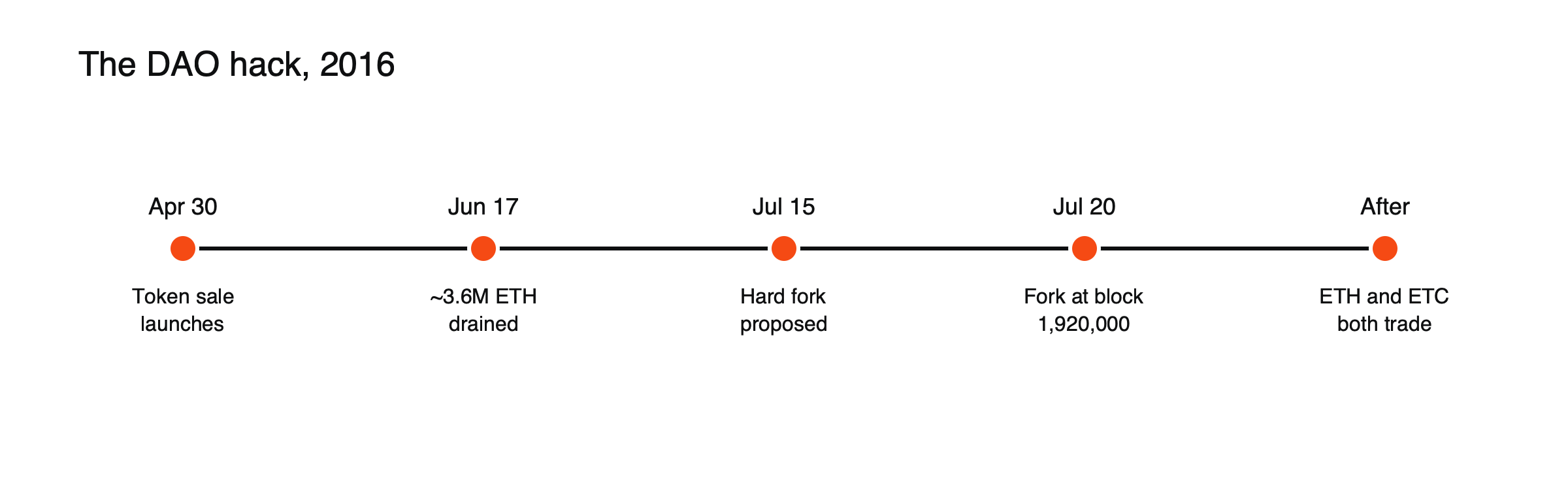
Figure: The DAO from launch to the chain split.
How the hard fork returned the funds
The fork did not undo the attack transaction by rewriting old blocks. Instead, at block 1,920,000, the new rules moved the ether held by The DAO and its child DAOs, including the attacker’s, into a single recovery contract. Original token holders could then exchange their DAO tokens for ether from that contract. On the forked chain, the attacker’s haul was gone; on the chain that refused the fork, it remained in the attacker’s control.
Why the decision split the community
Supporters of the fork argued that the attack exploited a bug, not the intended rules, and that returning the funds protected thousands of investors and Ethereum’s young ecosystem. Opponents argued that “code is law”: a blockchain’s value comes from history that cannot be rewritten, and reversing one theft set a precedent for reversing others.
Neither side could force the other. Nodes that upgraded followed the new rules; those that did not kept the original chain, which became Ethereum Classic. On that chain, the attacker kept the ether.
The regulator’s verdict
The DAO’s story did not end with the fork. On July 25, 2017, the US Securities and Exchange Commission published an investigative report concluding that DAO tokens were securities under US law, because investors put money into a common enterprise expecting profits from the efforts of others, in this case the project’s creators and curators. The SEC chose not to bring charges, but the report became an early landmark in how regulators view token sales, and it was cited for years afterward in debates over which tokens should be treated as investments.
What changed afterward
The DAO hack shaped Ethereum’s culture and practices:
- Smart-contract security became a discipline. Audits, standard patterns that update balances before sending funds, and formal tools to catch reentrancy became routine.
- Hard forks became a known option, and a contested one. Ethereum has not reversed a theft since, even after larger hacks.
- Two chains with shared history. Ethereum Classic still runs, kept its proof-of-work design, and later suffered 51% attacks.
“Code is law,” ten years on
The argument that split Ethereum in 2016 never fully went away; it simply settled into a practice. Ethereum has not reversed a theft or bug since, despite later losses that were larger in dollar terms and proposals to use a fork to recover frozen or stolen funds. The informal rule that emerged is that a network-wide intervention was a one-time response to an existential threat in Ethereum’s first year, not a tool for routine use.
That position puts the burden of safety on the applications rather than on the network. Protocols now plan for failure in advance, with insurance funds, emergency pauses and bug bounties, because they cannot count on the chain itself to rescue them.
Ethereum Classic today
The chain that refused the fork still runs. Ethereum Classic kept proof-of-work mining, including after Ethereum’s own move to proof of stake in 2022, and its supporters describe it as the version of Ethereum that never altered its history. Its smaller hash rate has made it a target: in 2020 it suffered repeated majority attacks in which attackers rewrote recent blocks and double-spent coins at exchanges. See what a 51% attack is.
Lessons for today’s DAOs
Decentralized autonomous organizations are now common, usually to govern protocols rather than to run investment funds, and they carry the DAO hack’s lessons in their design. Treasury contracts are audited and often kept simple. Changes to how funds can move usually pass through a timelock, a delay that gives members time to react before a decision takes effect. Many protocols keep an emergency pause that a trusted group can trigger if an exploit is detected, a deliberate trade of pure decentralization for safety. And large treasuries are increasingly split across several contracts so that one bug cannot drain everything at once. See what a DAO is.
For how chain splits work in general, read what a blockchain fork is. For the programs at the center of the story, see what a smart contract is, and for the network, what Ethereum is.
This article is educational content and does not constitute financial, investment, legal or tax advice. Digital assets are volatile and you may lose the amount you invest.
Sources
- Mastering Ethereum, Appendix: Ethereum fork history (DAO timeline; hard fork at block 1,920,000 on July 20, 2016) — Antonopoulos and Wood, GitHub
- Ethereum Classic and the DAO hack (12.7 million ETH raised, ~$150 million; 3.6 million ETH taken June 17, 2016; 28%) — SFOX
- The DAO Hack Explained (reentrancy; child DAO; Ethereum Classic) — Gemini Cryptopedia
- SEC issues investigative report concluding DAO tokens, a digital asset, were securities (July 25, 2017) — US Securities and Exchange Commission