
What Is MEV?
MEV is the profit made by choosing which transactions go into a block and in what order. How it works, what a sandwich attack is and how to protect trades.
MEV, or maximal extractable value, is the profit that can be made by deciding which transactions go into a block and in what order. Because pending transactions are visible before they confirm, specialized bots can trade ahead of them, behind them or both. Some MEV keeps markets efficient; some, like sandwich attacks, takes money directly from users.
Why ordering creates profit
Ethereum transactions wait in a public queue before they are included in a block. Anyone can see that a large swap is about to push a token’s price up. A bot that places its own buy just before that swap, and sells just after, captures part of the move. Whoever controls the order of transactions in a block can decide who gets that opportunity.
The term originally stood for “miner extractable value,” because miners chose the order. Under proof of stake, block builders and validators play that role.
The main types of MEV
- Arbitrage: buying a token where it is cheap and selling where it is expensive, across different exchanges, in the same block. It keeps prices aligned and does not directly harm a specific user.
- Liquidations: repaying undercollateralized loans on lending platforms to collect a bonus. It keeps lending markets solvent.
- Sandwich attacks: buying just before a user’s swap and selling just after, so the user gets a worse price and the bot keeps the difference.
How a sandwich attack works
- You submit a swap to buy a token, allowing some slippage.
- A bot sees it and buys first, pushing the price up.
- Your swap executes at the higher price, within your slippage limit.
- The bot sells right after, at the price your trade pushed even higher.
The cost to you is the extra price you paid. The wider your slippage tolerance and the larger your trade relative to the pool, the more there is to take. Our guide to slippage in crypto trading explains the setting that limits it.
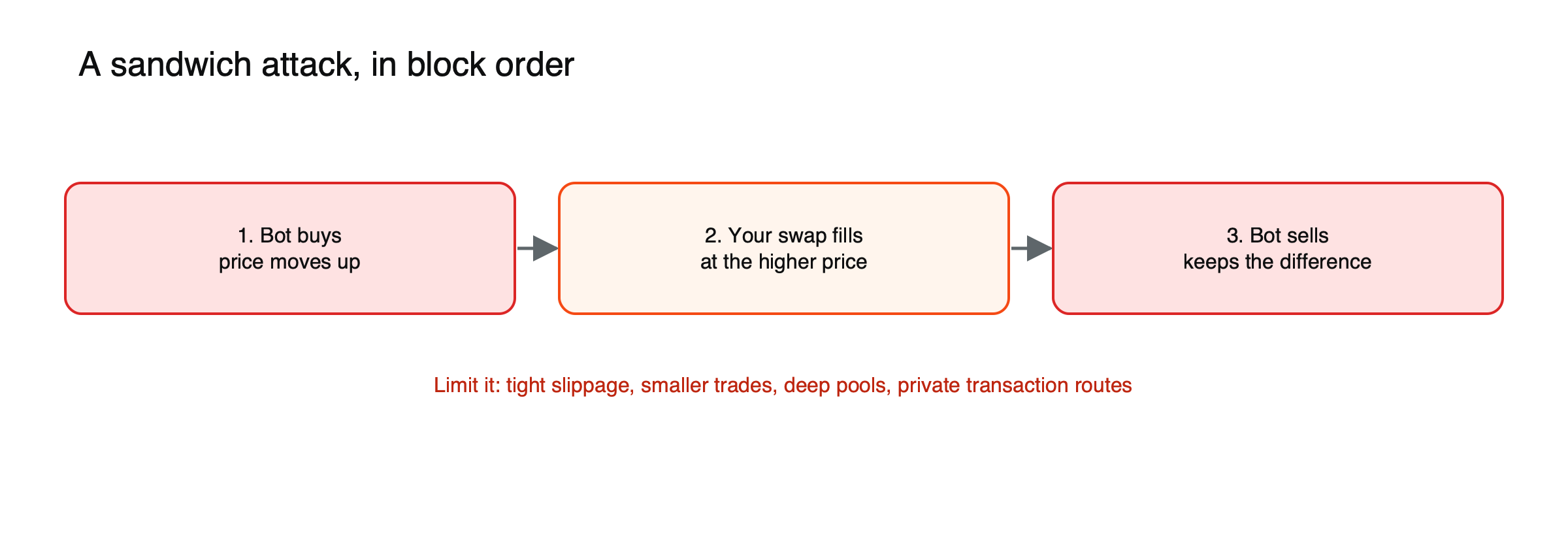
Figure: The three transactions of a sandwich attack, in the order they land in the block.
A sandwich in numbers
Suppose you buy $10,000 of a token in a modest liquidity pool, allowing 1% slippage. A bot sees the order, buys first and pushes the price up 0.6%. Your trade still executes, because it is within your 1% limit, but you pay about $60 more than you would have. The bot then sells into the higher price your purchase created and keeps the difference, minus its own fees and gas. (Illustrative figures.) Nothing failed and no rule was broken, yet $60 moved from you to the bot. Setting slippage to 0.3% in this example would have left the bot too little room to profit.
Good MEV and bad MEV
Not all MEV hurts users. Arbitrage keeps prices on different exchanges in line, so a trader on any of them gets a fair price. Liquidations keep lending markets solvent, so depositors can withdraw. These activities would happen in some form in any market. Sandwich attacks and similar tactics are different: they do not improve prices for anyone except the bot and depend entirely on seeing a user’s trade before it is confirmed. Much of the effort to reduce MEV focuses on this second kind, mainly by hiding transactions until they are included in a block.
Who captures MEV today
Most Ethereum blocks are not assembled by the validator that proposes them. Through an auction system called MEV-Boost, specialized builders compete to construct the most profitable block and pay the validator for the right to have it proposed. Around 90% of Ethereum blocks have been produced this way, and between October 2023 and March 2024 just three builders produced about 80% of MEV-Boost blocks. Ethereum developers plan to move this auction into the protocol itself in a future upgrade, known as enshrined proposer-builder separation.
Proposer-builder separation and what comes next
MEV-Boost splits block production into two roles: builders, who assemble blocks to capture as much value as possible, and proposers, the validators who choose the highest-paying block. The split lets ordinary validators earn MEV income without running sophisticated software. It relies on relays, intermediaries trusted to pass blocks between builders and validators fairly, and it has concentrated block building among a few large firms. Ethereum developers have proposed building the separation directly into the protocol, known as enshrined proposer-builder separation, to remove the need to trust relays.
MEV beyond Ethereum’s main chain
MEV exists wherever someone controls transaction ordering. On many layer 2 networks, a single sequencer orders transactions, often on a first-come, first-served basis, which limits sandwiching but concentrates ordering power in one operator. Other blockchains have their own versions of MEV markets and their own protections. The question to ask on any network is who decides the order of transactions, and whether that party can see them in advance.
How to reduce your exposure
- Set a tight slippage tolerance for swaps, especially in thin pools.
- Split large trades so each one moves the price less.
- Use private transaction routes offered by many wallets, which send transactions to builders without exposing them in the public queue.
- Prefer deep liquidity, where your trade moves the price less.
Sandwich extraction has fallen as these protections spread: one dataset of more than 95,000 attacks shows monthly extraction dropping from roughly $10 million in late 2024 to about $2.5 million in October 2025.
For how smart contracts process these trades, read what a smart contract is. For how fees decide which transactions get in, see what a gas limit is, and for the bigger picture, what Ethereum is.
This article is educational content and does not constitute financial, investment, legal or tax advice. Digital assets are volatile and you may lose the amount you invest.
Frequently asked questions
Can I tell whether my trade was sandwiched?
Often, yes. On a block explorer, look at the transactions immediately before and after yours in the same block. A buy of the same token just before your swap and a sell just after, from the same address, is the typical pattern. Several public dashboards track sandwich attacks and let you search by address.
Does using a private transaction route cost more?
Usually not. Many wallets and swap services route transactions privately to builders by default or as a free option. The trade-off is reliance on that route to forward your transaction honestly and promptly. If a private route is slow, your transaction may wait longer to be included, so it is worth watching the first few transactions you send this way.