
What Is Restaking?
Restaking reuses staked ETH to secure other services for extra rewards and extra slashing risk. How it works, what liquid restaking tokens are and the risks.
Restaking means taking ether that is already staked, or a liquid staking token, and committing it to secure additional services beyond Ethereum itself. Those services pay extra rewards, and in return they can slash the restaked funds if the operator misbehaves. Restaking adds a second layer of rewards and a second layer of risk on the same coins.
Why restaking exists
New networks and services, such as data availability layers, oracles and bridges, need economic security: collateral that can be taken away if their operators cheat. Building that from scratch is expensive. Restaking lets them borrow security from ether that is already staked, instead of convincing people to buy and stake a new token.
EigenLayer, launched in 2023, created this market. The services it secures are called actively validated services, or AVSs.
How it works
- You start with staked ETH, either from your own validator or as a liquid staking token such as stETH.
- You deposit it into a restaking protocol and delegate it to an operator.
- The operator runs software for one or more AVSs.
- The AVSs pay rewards for that work, on top of normal Ethereum staking rewards.
- If the operator breaks an AVS’s rules, that AVS can slash part of the restaked funds.
EigenLayer turned on slashing on its mainnet on April 17, 2025, with node operators and restakers opting in. Before that date, restaking carried rewards without the enforcement that gives it meaning.
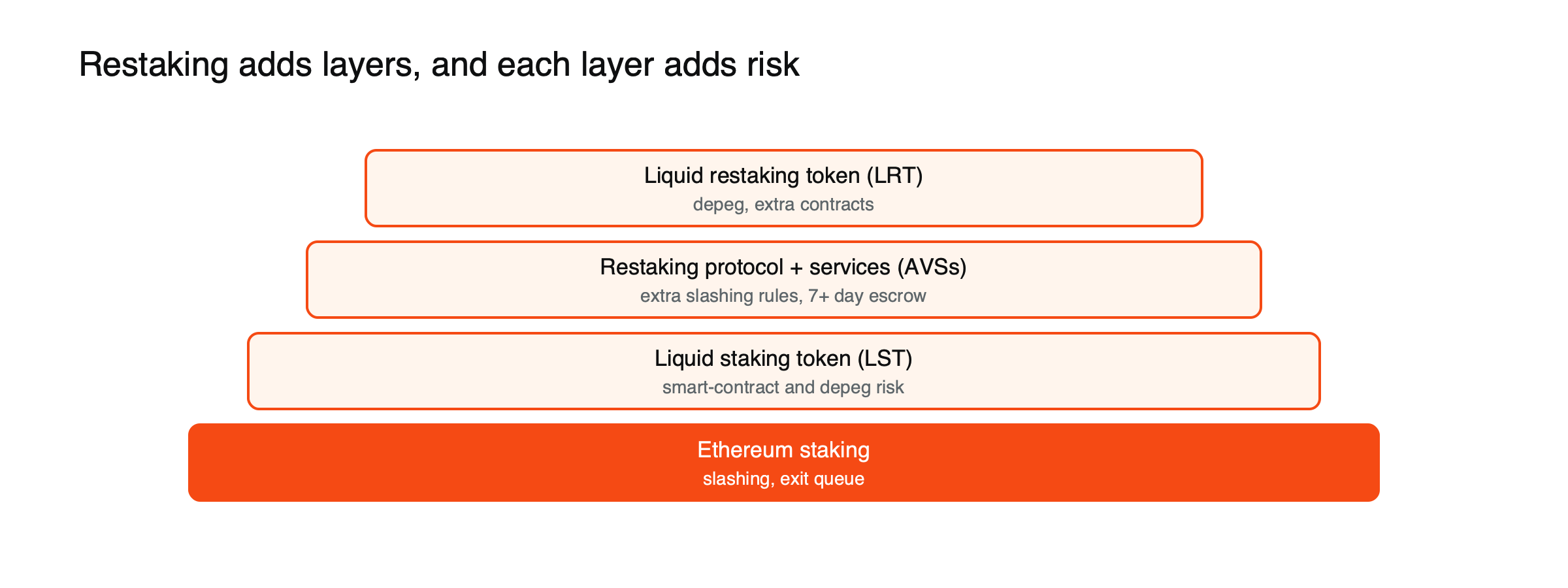
Figure: Each layer adds rewards and its own way to fail.
Restaking vs liquid staking
The two are often confused because they stack on top of each other. Liquid staking turns staked ether into a tradable token while it keeps securing Ethereum; the risks are Ethereum’s own slashing rules plus the staking protocol’s contracts. Restaking takes that staked ether, or the token representing it, and commits it to secure additional services as well. The coins are not doubled; the same ether is promised as collateral to more than one system, so any of those systems can now take part of it.
Where the extra rewards come from
AVSs pay operators and restakers for securing them, often in their own tokens rather than in ether. The value of that reward therefore depends on the AVS’s token price and on demand for its service, both of which can be volatile for young projects. In restaking’s early period, much of the advertised yield came from incentive programs and points that promised future tokens rather than from fees paid for real services. When comparing restaking yields, it helps to separate rewards paid in ether from rewards paid in newer tokens, and both from promotional incentives that may end.
What AVSs actually do
The services secured through restaking vary. Some are data availability networks that store and serve data for rollups. Others run oracles that bring prices on-chain, bridges that relay messages between chains, or networks that order transactions for rollups. What they share is a need for operators who can be penalized if they report false data or fail to do their job, which is the guarantee restaked ether provides.
Liquid restaking tokens
Protocols such as Renzo, ether.fi and Puffer accept deposits, restake them and issue a liquid restaking token (LRT) in return. That adds one more layer: Ethereum staking, then the liquid staking token, then restaking, then the LRT on top. Each layer has its own contracts and its own way to fail.
The risk is not theoretical. In April 2024, Renzo’s ezETH token lost its peg to ETH, triggering a cascade of liquidations among holders who had borrowed against it.
The layers in one example
Suppose you hold 10 ETH. (Illustrative figures.)
- You stake it through a liquid staking protocol and receive a liquid staking token. If staking pays 3% a year, that is about 0.3 ETH, minus the protocol’s fee.
- You deposit the token into a liquid restaking protocol and receive a liquid restaking token. If AVSs pay an extra 1%, that adds about 0.1 ETH a year.
- You use the restaking token as collateral to borrow more ETH and repeat the loop, increasing your exposure.
At each step, the extra yield is small and the new risks are real. A 5% slashing by one AVS would wipe out several years of that additional 1%. A depeg in the restaking token could trigger liquidation of the borrowed position in step 3, as happened to some ezETH holders in April 2024. The more layers and leverage, the more ways the position can fail at once.
The risks, layer by layer
- Extra slashing conditions: each AVS adds its own rules, and an operator mistake on one service can cost restakers.
- Stacked smart-contract risk: every protocol in the chain can contain a bug.
- Liquidity and depeg risk: restaking tokens can trade below the value of what they hold, especially when many holders exit at once.
- Longer exits: EigenLayer adds an escrow period of at least seven days on top of Ethereum’s own unstaking queue.
- Leverage: borrowing against restaking tokens to restake more magnifies every one of these risks.
- Variable rewards: AVS payments depend on demand for each service and are not guaranteed.
A debate about Ethereum’s own security
Restaking has also raised a question for Ethereum itself. If a large share of staked ether is also securing outside services, a major failure in one of them could put pressure on Ethereum’s validators, and there might even be calls to use Ethereum’s own social coordination to resolve problems in those services. In 2023, Ethereum co-founder Vitalik Buterin warned against “overloading” Ethereum’s consensus in this way, arguing that applications should not rely on Ethereum’s community to step in if their own systems break. Restaking protocols generally accept that view, but how well it holds in a crisis has yet to be tested.
Questions to ask before restaking
- Which AVSs will my funds secure, and what are their slashing conditions?
- Who is the operator, and what is its track record?
- How long would it take to get back to plain ETH, counting every layer’s exit period?
- Is the restaking token liquid enough to sell in a hurry, and at what discount?
- Are the rewards paid in ether, or in a newer token whose price could fall?
Who restaking is for. Restaking suits holders who understand Ethereum staking well and want to take on more risk for possible extra rewards. It is a poor fit for anyone who needs to exit quickly or who would struggle to monitor several protocols at once.
For the layer underneath, read what liquid staking is and what slashing is. For the network itself, see what Ethereum is.
This article is educational content and does not constitute financial, investment, legal or tax advice. Digital assets are volatile and you may lose the amount you invest.
Sources
- EigenLayer to begin ‘slashing’ restakers in April (launched 2023; mainnet slashing April 17, 2025; opt-in) — Cointelegraph, April 2025
- How EigenLayer + Liquid Restaking Are Re-pricing DeFi Yields in 2025 (ezETH depeg April 2024) — BlockEden, September 2025
- EigenLayer restaking cascade risks (minimum seven-day EigenLayer escrow; LRT protocols Renzo, ether.fi, Puffer) — BlockEden, February 2026
- Don’t overload Ethereum’s consensus — Vitalik Buterin, May 2023