
What Is Tokenized Gold?
Tokenized gold is a token backed by physical gold in a vault, usually one troy ounce per token. How XAUT and PAXG work, redemption limits and the risks.
Tokenized gold is a blockchain token backed by physical gold in a vault, typically one token per troy ounce of London Good Delivery bullion. It lets people hold and move gold in small amounts at any hour. Tether Gold (XAUT) and Pax Gold (PAXG) hold about 96% to 97% of the market. Owning the token is not holding gold yourself.
How it works
An issuer buys gold bars meeting the London Bullion Market Association’s Good Delivery standard, stores them with a custodian and issues one token per ounce. Holders can often check which bars back their tokens. Tokens track the gold price, so they rose as gold set a record near $5,600 an ounce in January 2026, and fell when gold dropped about 14% in the second quarter.
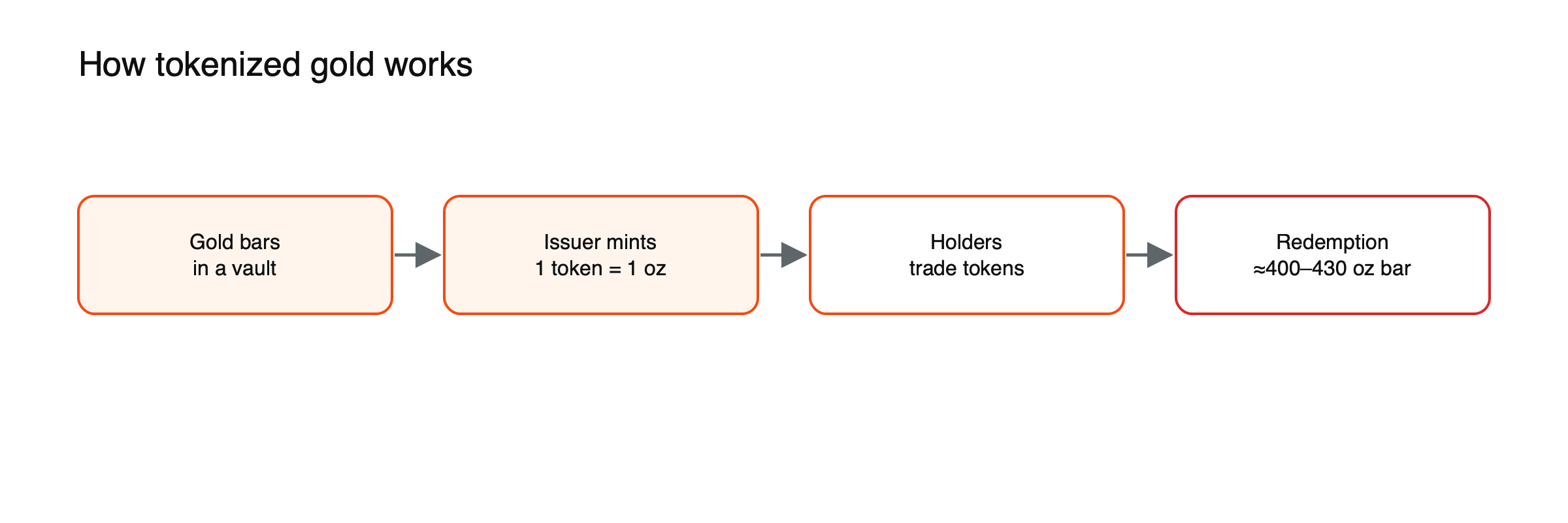
Figure: From vaulted bars to tokens, and why most holders exit by selling.
The two largest tokens
| Tether Gold (XAUT) | Pax Gold (PAXG) | |
|---|---|---|
| Issuer | A Tether subsidiary | Paxos Trust Company |
| Oversight | Issuer’s own terms | New York State Department of Financial Services |
| Gold stored | Switzerland | London |
| Unit | 1 troy ounce | 1 troy ounce |
Redemption limits
Physical delivery usually requires a whole bar, about 400 to 430 ounces, worth well over $2 million at 2026 prices. Tether Gold also sets a 50-token minimum for direct purchases and a one-time verification fee. Most holders exit by selling on the market rather than redeeming gold.
Why put gold on a blockchain at all?
Gold is one of the oldest stores of value, but moving it is slow and costly. Selling physical gold means visiting a dealer, and moving gold-backed fund shares across borders or platforms runs through brokers and business hours. A gold token can be sent anywhere in minutes, split into tiny amounts and used alongside stablecoins and crypto on the same platforms. For people who already keep part of their wealth on-chain, that makes gold a practical option for diversification without leaving the blockchain.
Gold token, gold ETF or physical gold?
| Tokenized gold | Gold ETF | Physical bars and coins | |
|---|---|---|---|
| Smallest practical amount | A fraction of an ounce | One share | A small coin, at a premium |
| Trading hours | Any hour | Exchange hours | Dealer hours |
| What you own | A claim on gold held by the issuer | A fund share | The metal itself |
| Main extra risk | Issuer, custodian, smart contract | Fund and broker | Storage, theft, resale spreads |
| Taking delivery | Usually a whole bar or through a dealer | Rarely possible for individuals | Already in hand |
What it costs to hold
Tokenized gold avoids storage arrangements, but it is not free. Buying and selling involves a spread against the spot gold price, which can widen on smaller platforms or in fast markets, plus network fees for on-chain transfers. Some issuers charge fees for creation, redemption or verification. Compared with a large gold ETF, costs can be higher or lower depending on how often you trade and on which platform, so comparing the full cost, not just the token’s price against spot, gives a fairer picture.
Checking the gold behind the tokens
Major issuers publish regular reports on the gold they hold, and some let holders look up the specific bars, by serial number and refiner, allocated against their tokens. Comparing total tokens in circulation with the ounces reported in custody is a simple first check. A report from an independent firm, issued on a regular schedule, is more reassuring than the issuer’s own statements alone.
How the tokens behaved in 2026
Because each token tracks an ounce of gold, holders experienced gold’s full swings. Gold set a record near $5,600 an ounce in January 2026 and then fell 14.1% in the second quarter, and token prices followed. Tokenized gold changes how gold is held and moved, not how much its price moves. Anyone buying it as a safe asset should expect the same drawdowns that gold itself delivers, which in some quarters have rivaled those of stock markets.
Choosing between gold tokens
The largest tokens dominate liquidity, which matters when selling. Beyond size, the main differences are oversight, with PAXG supervised by a US state regulator and XAUT governed by its issuer’s own terms; vault location, London or Switzerland; the blockchains each token runs on; and redemption rules. A token with deep markets on the platforms you use, regular independent reports and clear redemption terms is usually a better choice than a smaller one offering a slightly better price.
One practical point is the network. The same gold token can exist on more than one blockchain, and moving it between them usually means using a bridge or the issuer’s own conversion service. Before buying, check which network your wallet or exchange supports for that token, because sending it on the wrong one can delay access or lose it. Most of the trading volume tends to sit on one main network, which is usually the safest choice for long-term holding.
Gold tokens as collateral
Some lending platforms and exchanges accept gold tokens as collateral, letting holders borrow stablecoins against gold without selling it. That adds liquidation risk: if gold falls sharply, as it did in mid-2026, the position can be closed automatically. Borrowing against gold tokens should be sized with gold’s own volatility in mind.
Why people use it
- Fractional gold ownership with no storage arrangement.
- Moving gold value across platforms and borders quickly.
- Pairing gold with crypto and stablecoin holdings.
Risks to know
- Issuer and custodian risk: your claim depends on the company and the vault.
- Redemption barriers for small holders.
- Smart contract and platform risk.
- Gold price risk: the token falls when gold falls.
For the wider category, read what RWA tokenization is and how to check what backs a tokenized asset. For gold’s behavior in stress, see gold vs stocks in a crash.
This article is educational content and does not constitute financial, investment, legal or tax advice. Digital assets are volatile and you may lose the amount you invest.
Frequently asked questions
Is tokenized gold safer than holding gold myself?
It removes the risks of storing metal at home but adds the risk that the issuer or vault fails or that the token cannot be redeemed as expected. Which is safer depends on the amount and on how much you trust the issuer’s structure and oversight.
Do I pay tax on tokenized gold like on physical gold?
Rules vary by country. In some, tokenized gold is taxed like a crypto asset; in others like a commodity or a collectible. Keeping records of purchase prices and dates makes any later calculation easier.
Sources
- Tokenized Gold in 2026 (XAUT and PAXG about 96%–97% of the market; one LBMA bar of about 430 ounces for delivery) — Tangem
- Gold-backed crypto tokens (PAXG regulated by NYDFS; London Good Delivery gold) — Matcha
- XAUt (Swiss vaults; 50-token minimum; verification fee; whole-bar redemption) — 1inch
- PAXG: Gold’s onchain boom is starting to cool (record near $5,600 in January 2026; gold fell 14.1% in Q2 2026) — Kaiko via Brainsum, 2026