
What Are Tokenized Treasuries?
Tokenized treasuries are tokens backed by US government debt, usually via a fund. How they work, the largest products, who can buy them and the risks.
Tokenized treasuries are blockchain tokens that represent shares in funds or notes holding short-term US government debt. They pass Treasury interest to holders and can be transferred on-chain at any hour. The category reached about $15.7 billion by mid-September 2026, making it the largest group of tokenized real-world assets. Most products limit who can buy them.
How they work
A fund or issuer buys Treasury bills or similar assets and issues tokens representing a share of them. The token’s value grows with the interest earned, or the issuer pays income as new tokens. A transfer agent or tokenization platform keeps the official record in line with the blockchain. See what RWA tokenization is.
The largest products
On rwa.xyz data for September 15, 2026, the largest were:
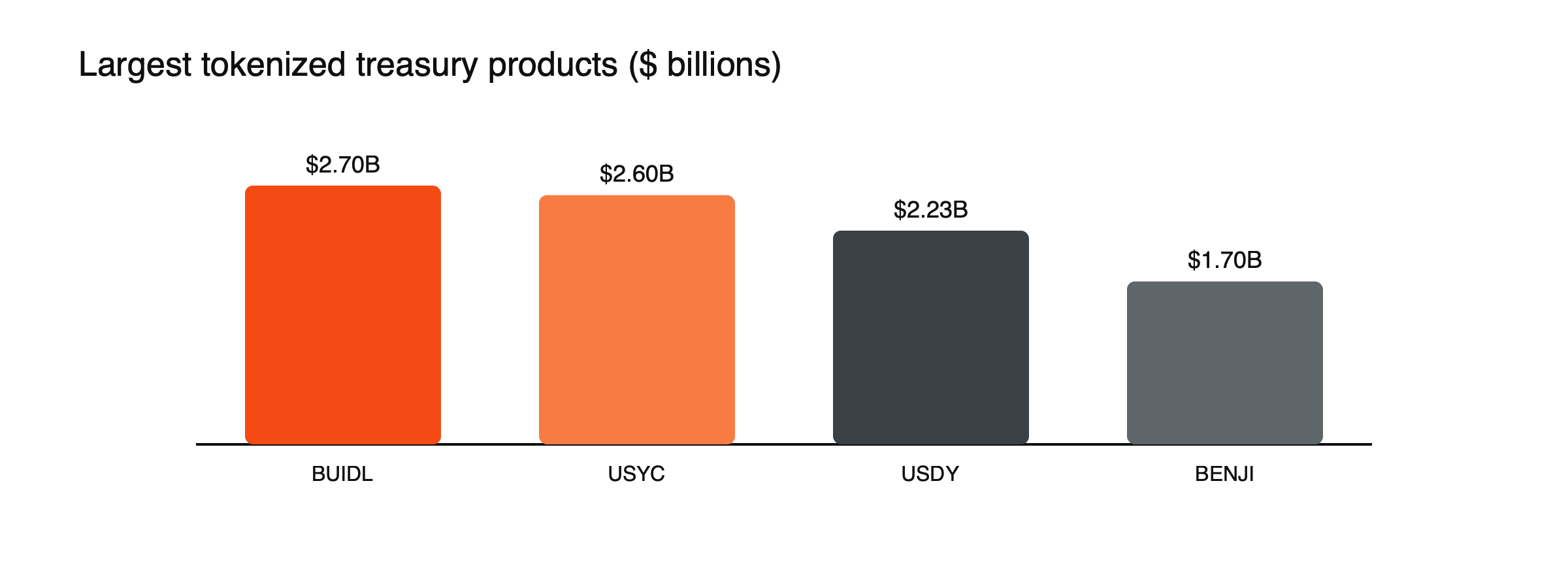
Figure: Largest tokenized treasury products. Source: rwa.xyz via Eco, September 15, 2026.
- BUIDL (BlackRock, via Securitize): about $2.70 billion.
- USYC (Circle): about $2.60 billion.
- USDY (Ondo): about $2.23 billion.
- BENJI (Franklin Templeton): about $1.70 billion.
The category grew from about $380 million in early 2023.
Why the category grew so fast
The category went from about $380 million in early 2023 to about $15.7 billion by September 2026, roughly a fortyfold increase. Interest rates explain much of it. Once short-term US rates rose above 4% in 2023, holding billions of dollars on-chain in stablecoins that pay nothing became expensive for funds, trading firms and DAOs. Large asset managers then brought familiar brands and legal structures on-chain, which made the products acceptable to institutions, and some stablecoin and crypto-native issuers began holding them as reserves. Lower rates would reduce the yield advantage, which is one reason the category’s growth is not guaranteed to continue at the same pace.
Reading a product page
Before buying, look for these details on the issuer’s page or documents:
- Structure: a registered fund, an offshore fund or a note issued by a company.
- Fees: the management fee and any subscription or redemption charges.
- Eligibility: which investors and countries are allowed, and the minimum.
- Networks: which blockchains the token runs on, and whether transfers are limited to approved wallets.
- Redemption: how quickly tokens can be turned into dollars or stablecoins, and any limits.
- Service providers: the custodian, transfer agent and auditor.
If any of these details are missing or hard to find, treat that as a reason for caution. Established products publish them clearly, along with regular reports on the assets held. For investors used to bank deposits, the closest comparison is a money market fund that settles on a blockchain, with the same need to read the fund documents carefully before buying anything.
Who can buy
Access varies widely. BUIDL targets qualified purchasers with a $5 million minimum, Ondo’s OUSG starts at $5,000, and Franklin Templeton’s BENJI can start at $20 for eligible users. Many products exclude US retail investors or require identity checks. See who can buy tokenized assets.
Income in numbers
Suppose you hold $10,000 in a tokenized Treasury product while short-term Treasury bills yield 4% a year, and the product charges a management fee of 0.15% to 0.50%. (Illustrative figures; check each product’s actual fee.) Over a year you would earn roughly $350 to $385 after fees. Holding the same $10,000 in a payment stablecoin would earn nothing, because the issuer keeps the reserve income. For balances held on-chain for months, that difference is the main reason these products exist.
Comparing the alternatives
| Tokenized Treasury product | Money market fund | Payment stablecoin | |
|---|---|---|---|
| Pays interest to holders | Yes | Yes | No |
| Transfers | On-chain, any hour, often only between approved wallets | Through brokers in business hours | On-chain, any hour, to anyone |
| Typical access | Verified investors; often non-US or qualified only | Broad retail access | Very broad |
| Main extra risk | Smart contracts, issuer and transfer agent | Fund management | Issuer and reserves |
Why people use them
- Treasury income on-chain, without moving money back to a bank.
- Collateral and treasury management for crypto firms and DAOs.
- Fast settlement compared with traditional fund subscriptions.
Unlike payment stablecoins, which may not pay interest under US and EU rules, these products are securities that pass income through. See what yield-bearing stablecoins are.
Where they are used
Beyond individual holdings, tokenized Treasury products have become building blocks. Crypto firms and DAOs park reserves in them so idle funds earn interest without leaving the blockchain. Some exchanges and trading venues accept them as collateral, so traders can earn Treasury income on assets posted as margin. Some stablecoin and synthetic-dollar issuers hold them as part of their reserves. Each use depends on the token being transferable to the platform in question, which is why transfer restrictions matter so much.
Subscriptions, redemptions and timing
Moving tokens between approved wallets can happen at any hour, but buying new tokens or redeeming them for cash usually follows the issuer’s process. Some products settle subscriptions and redemptions almost instantly in stablecoins; others process them only on business days or with cut-off times, like a traditional fund. Large redemptions may be subject to limits or delays. Checking how quickly you can actually turn the token back into dollars is as important as the yield.
Risks to know
- Interest-rate risk: income falls when rates fall.
- Issuer, custody and smart contract risk on top of the underlying debt.
- Redemption terms and transfer limits set by the issuer.
- Regulation that differs by country.
To check a product, read how to check what backs a tokenized asset.
This article is educational content and does not constitute financial, investment, legal or tax advice. Digital assets are volatile and you may lose the amount you invest.
Frequently asked questions
Are tokenized Treasuries the same as owning Treasury bills?
Not exactly. You usually own a share in a fund or a note issued by a company that holds the bills. The economic exposure is similar, but your claim runs through the issuer, its custodian and its legal structure.
Can I use them in decentralized finance?
Sometimes. Some products allow transfers only between whitelisted wallets, which limits their use in open applications, while others are designed to work with specific lending or trading protocols. The product’s documentation lists where it can be used.
Sources
- Tokenized RWA Market Size 2026 (rwa.xyz data for September 15, 2026: Treasuries $15.65 billion; BUIDL $2.70B, USYC $2.60B, USDY $2.23B, iBENJI $1.70B) — Eco
- Tokenized US Treasuries near $14 billion (BUIDL $5 million minimum for qualified purchasers; BENJI $20 minimum) — Yahoo Finance, April 2026
- RWA tokenization record Q1 2026 (Treasuries from $380 million in Q1 2023; OUSG $5,000 minimum) — BlockEden