
How Much a Stablecoin Issuer Earns on Its Reserves
Stablecoin issuers earn interest on the reserves behind their tokens while holders earn nothing. The formula, worked examples and Tether's 2024 figures.
Stablecoin issuer revenue comes mainly from one simple calculation: reserve income ≈ reserves invested × yield on those reserves. Holders give the issuer dollars and receive tokens that usually pay no interest, while the issuer invests the dollars in short-term government debt and keeps the interest. When interest rates are high and supply is large, that business is very profitable.
The formula
Annual reserve income = reserves invested in interest-bearing assets × average yield
Profit ≈ reserve income + other gains − operating costs − any revenue shared with partners
Reserves usually sit in short-term US Treasury bills, repurchase agreements and bank deposits. Treasury bills pay interest close to the central bank’s policy rate.
Worked example 1: high rates
An issuer has $100 billion of tokens in circulation and holds $100 billion of reserves. It keeps $10 billion in cash for redemptions and invests $90 billion in Treasury bills yielding 4% a year (illustrative).
- Reserve income = $90 billion × 4% = $3.6 billion a year
- If operating costs are $0.4 billion, profit ≈ $3.2 billion a year
Holders of the $100 billion in tokens receive nothing from this, because the tokens pay no interest.
Worked example 2: rates fall
Same issuer, same reserves, but yields fall to 2% (illustrative).
- Reserve income = $90 billion × 2% = $1.8 billion a year
- Profit ≈ $1.8 billion − $0.4 billion = $1.4 billion a year
Halving the interest rate more than halved the profit, because costs stay roughly fixed. Stablecoin issuers are, in effect, highly sensitive to interest rates.
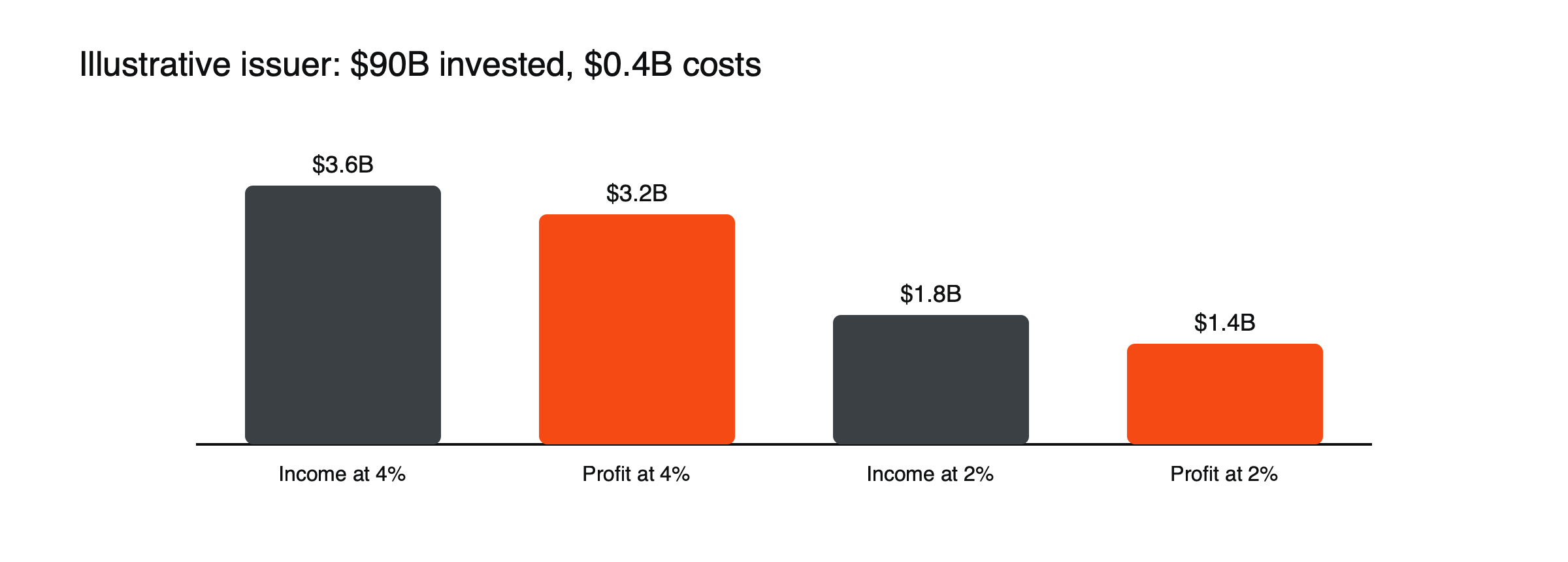
Figure: Same reserves, different interest rates (illustrative numbers from the worked examples).
How sensitive income is to rates
Keeping the same $90 billion invested and changing only the yield shows how directly the business tracks interest rates:
| Average yield | Annual reserve income |
|---|---|
| 1% | $0.9 billion |
| 2% | $1.8 billion |
| 3% | $2.7 billion |
| 4% | $3.6 billion |
| 5% | $4.5 billion |
Each percentage point of rates adds or removes $0.9 billion a year, before any change in costs or in the number of tokens outstanding.
Worked example 3: sharing the income
Many issuers pay part of their reserve income to partners that distribute their tokens, such as exchanges and payment firms. Suppose an issuer with $40 billion of tokens invests 90% of reserves at 4.5%, earning about $1.62 billion a year, and its distribution agreements pass 40% of that to partners. The partners receive about $0.65 billion and the issuer keeps about $0.97 billion before its own costs. (Illustrative figures.) Arrangements like this explain why the largest exchanges care so much about which stablecoins their customers use: a stablecoin’s float can be a revenue stream for its distributors as well as its issuer.
Real numbers: Tether in 2024
Tether, the issuer of USDT, reported net profit of more than $13 billion for 2024 in an attestation reviewed by the accounting firm BDO. About $7 billion came from US Treasuries and repurchase agreements, and about $5 billion from unrealized gains on its gold and bitcoin holdings. At the end of 2024 it held about $113 billion in direct and indirect US Treasury exposure, reserves of about $143.7 billion, and an excess over its liabilities of about $7.1 billion. Its 2023 profit had been about $6.2 billion.
The split matters: the Treasury income behaves like the formula above, while the gold and bitcoin gains depend on market prices and can reverse.
What drives the result
- Size of the float: more tokens outstanding means more reserves to invest.
- Interest rates: the single biggest lever on income.
- Reserve mix: cash held for redemptions earns little; riskier assets earn more but weaken the peg’s safety.
- Costs and partnerships: compliance, banking and distribution deals reduce what the issuer keeps.
Where the rest of the money goes
Reserve income is not all profit. Issuers pay for compliance teams that verify customers and monitor transactions, banking and custody relationships, regular reserve attestations, legal and licensing work in each jurisdiction, and the technology that mints, burns and supports the token on many blockchains. These costs grow with regulation and with the number of networks supported, but much less than reserve income grows with the float, which is why scale matters so much in this business.
What holders give up
The issuer’s income is the holder’s opportunity cost. Someone keeping $10,000 in a non-interest-bearing stablecoin for a year while Treasury bills yield 4% forgoes about $400 that a money market fund or bank deposit could have paid. For short holding periods, such as moving money between exchanges, the cost is negligible. For balances parked for months, it adds up, which is why yield-bearing alternatives exist. See what yield-bearing stablecoins are.
Safety costs money
An issuer could earn more by holding longer-dated bonds or riskier assets, but that would make it harder to pay out quickly in a rush of redemptions. Keeping a larger share in cash and very short-term Treasury bills sacrifices some income in exchange for liquidity. New rules in the US and EU push issuers toward the safer end, which caps how much reserve income can grow through risk-taking. For a large issuer, even a small change in the share of reserves held as cash can shift annual income by a noticeable margin overall. Retained profits can also serve as a cushion: at the end of 2024, Tether reported reserves exceeding its tokens in circulation by about $7.09 billion.
Why it matters to holders
The holder bears the risk that reserves are mismanaged, while the issuer keeps the income. That is why reserve quality, attestations and redemption rights matter more than the size of the issuer’s profits.
For how reserves are checked, read what proof of reserves is and what USDT is. For the basics, see what a stablecoin is.
This article is educational content and does not constitute financial, investment, legal or tax advice. Digital assets are volatile and you may lose the amount you invest.
Frequently asked questions
Why don’t payment stablecoins pay holders interest?
Partly business model and partly law. Keeping reserve income is how issuers fund their operations, and US and EU rules now bar regulated payment stablecoin issuers from paying interest simply for holding the coin. Products that do pass on income are structured differently. See what yield-bearing stablecoins are.
Do issuers profit when a stablecoin loses its peg?
Not directly. A depeg usually triggers redemptions, which shrink the float and therefore future income, and it damages the trust the business depends on. The issuer’s income comes from reserves staying invested, which requires holders to stay.
Sources
- Tether reports $13 billion in net profits for 2024 ($113 billion Treasury exposure; BDO review) — The Block, January 2025
- $USDT Issuer Tether Records $13B Profit in 2024 ($7 billion from Treasuries and repo; $5 billion gold and bitcoin; reserves $143.7 billion; excess $7.09 billion) — BitPinas, 2025
- Tether’s record-shattering profits (2023 profit $6.2 billion) — Decrypt, January 2025
- SVB collapse could materially impact Coinbase’s revenue (USDC income-sharing costs between Circle and Coinbase) — Benzinga, March 2023