
How Bitcoin’s Realized Price Is Calculated
Bitcoin's realized price is the average price at which all coins last moved on-chain, a rough cost basis. The formula, worked examples and how traders read it.

The bitcoin realized price is the average price at which all coins last moved on-chain, a rough cost basis for the market: realized price = realized cap ÷ circulating supply. When the market price falls below it, the average holder is at a loss, as near past bear-market bottoms. It is an estimate, not a record of purchases.
The formulas
Realized cap = sum of (each coin × price when that coin last moved)
Realized price = realized cap ÷ circulating supply
Ordinary market cap values every coin at today’s price. Realized cap values each coin at the price of its last on-chain movement, so coins that have not moved for years count at their old, low value.
Worked example: a tiny network
A network has three coins:
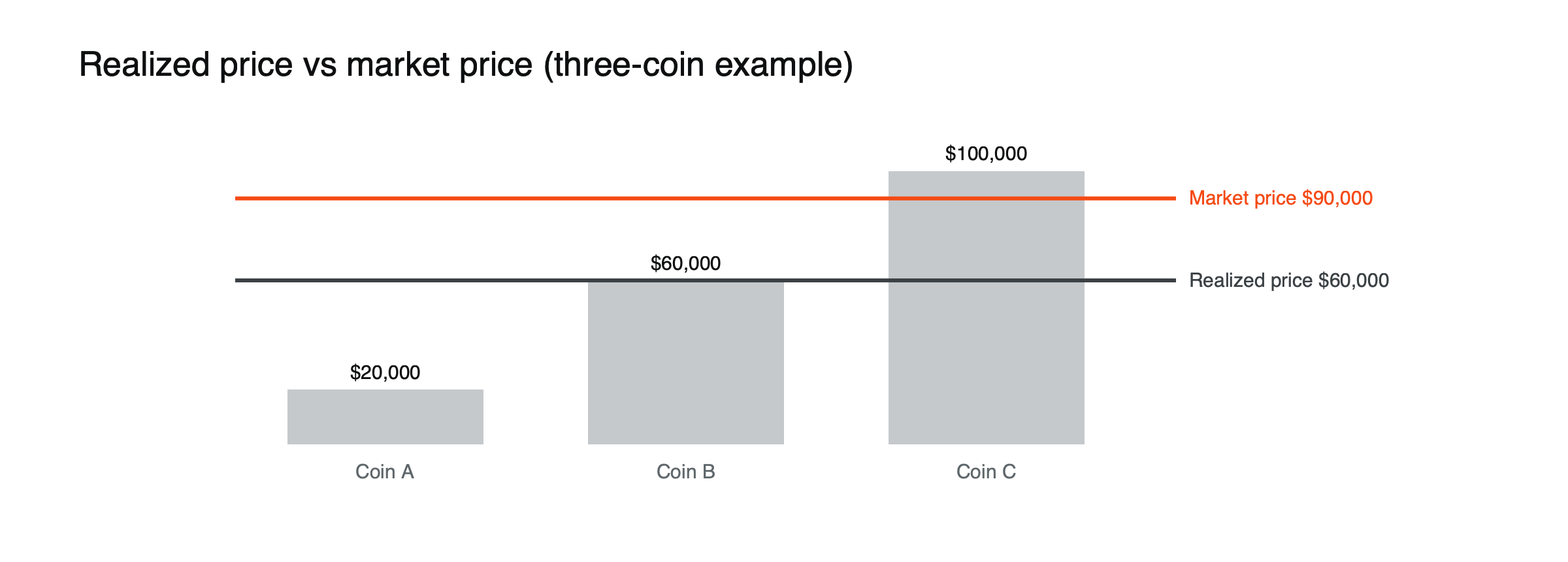
Figure: Realized price is the average of last-moved prices; market price sits above or below it.
- Coin A last moved at $20,000
- Coin B last moved at $60,000
- Coin C last moved at $100,000
Realized cap = $20,000 + $60,000 + $100,000 = $180,000. Realized price = $180,000 ÷ 3 = $60,000.
If the market price is $90,000, coins A and B are in profit and coin C is at a loss. MVRV = $90,000 ÷ $60,000 = 1.5. See how MVRV is calculated.
Worked example: what one transfer does
Now suppose coin A, last moved at $20,000, is sold and moves on-chain while the market price is $90,000. Its realized value resets from $20,000 to $90,000.
- New realized cap = $90,000 + $60,000 + $100,000 = $250,000
- New realized price = $250,000 ÷ 3 ≈ $83,333
- MVRV falls from 1.5 to about 1.08
Nothing about the market price changed, but the average cost basis jumped because an old, cheap coin changed hands at today’s price. This is why realized price tends to rise during bull markets, when long-held coins are sold to new buyers, and why it moves much more slowly than the market price.
Worked example: bitcoin scale
With a realized cap of $900 billion and 19.9 million coins (illustrative), realized price ≈ $45,226.
How traders use it
- Price below realized price: the average holder is underwater, which has coincided with past cycle lows.
- Price far above: large unrealized profits, which can encourage selling.
- Group versions: analysts also calculate realized prices for short-term and long-term holders separately.
Realized cap as a measure of money in the network
Because realized cap records each coin at the price it last changed hands, its growth roughly tracks how much capital has flowed into bitcoin at successively higher prices. A rising realized cap means coins are being bought, or at least moved, at prices above their previous cost. A flat or falling realized cap during a rally can suggest that price is rising on thin activity rather than broad buying.
Short-term and long-term holder cost bases
Analysts often split the supply by how long coins have been held. Recently moved coins, held for roughly the last five months by a common definition, form the short-term holder group, and their realized price is the average cost of recent buyers. Coins held longer form the long-term group, with a much lower average cost. When the market price falls below the short-term holders’ realized price, recent buyers are at a loss, which has often coincided with sharp sell-offs and capitulation among newer participants. The long-term holders’ cost basis usually sits far lower and is breached only in deep bear markets.
Reading it step by step
- Compare the market price with the overall realized price to see whether the average holder is in profit.
- Check whether realized price itself is rising, flat or falling over recent months.
- Look at the short-term holder realized price to judge how recent buyers are positioned.
- Use MVRV to express the distance as a ratio comparable across time.
Realized price across past cycles
Over bitcoin’s history, the market price has spent most of the time above the realized price, dipping below it mainly in the deepest parts of bear markets. Those dips have tended to be short compared with the time spent above, which is why analysts treat a fall below realized price as a sign of unusual stress rather than a normal condition. Each cycle, the realized price itself has ended higher than in the previous one, reflecting coins changing hands at higher prices over time.
Why it is an estimate, not a purchase record
Realized price uses the price at which a coin last moved on the blockchain, not what its owner paid. Someone who bought bitcoin on an exchange years ago and never withdrew it may still show up at a much older price, because the exchange’s wallet never moved that coin. Conversely, a holder who reorganizes wallets resets coins to today’s price without buying anything. Spot ETFs add another gap: shares change hands every day on stock exchanges while the underlying coins sit still in custody. The metric captures on-chain behavior well and investor cost basis only approximately. Data providers also revise historical realized values as their address labels improve, so a chart viewed today can differ slightly from the same chart viewed even a year ago.
Limits
- Lost coins remain at their old value and pull realized price down.
- Exchange and ETF trades that happen off-chain do not reset a coin’s price.
- Moving coins between your own wallets resets their value without any purchase.
For the wider toolkit, read what on-chain analysis is and on-chain metrics traders misread.
This article is educational content and does not constitute financial, investment, legal or tax advice. Digital assets are volatile and you may lose the amount you invest.
Frequently asked questions
Is realized price a support level?
Some traders treat it as one, because the price has spent relatively little time below it historically. But it is an average, not a barrier: the price has fallen below it in past bear markets and can stay there for months.
Does realized price exist for other coins?
It can be calculated for any blockchain with public transaction history, but it is most reliable for bitcoin, where the data is long and well studied. On networks with heavy use of smart contracts and frequent internal transfers, the calculation becomes noisier.
Why does realized price change when the market price does not?
Because it depends on which coins move. If long-held coins bought at low prices change hands, realized price rises even on a quiet day; if recently bought coins move at a loss, it can fall. The metric reflects activity on the blockchain, not the price chart alone.
Sources
- Mastering the MVRV Ratio (MVRV as price over realized price; below 1 means the average holder is underwater) — Glassnode Insights
- MVRV (realized cap reprices each coin at its last move; lost coins stay at old values; Coin Metrics origin) — LuxAlgo
- Using MVRV to estimate tops and bottoms (realized value as the network’s cost basis) — K33 Research