
Inflationary vs Deflationary Tokens
Inflationary tokens add supply over time; deflationary tokens remove it through burns or caps. How each works, with BTC, DOGE, ETH and BNB examples.
The difference between inflationary vs deflationary tokens is the direction of supply. Inflationary tokens keep adding new units, for example as mining or staking rewards. Deflationary tokens shrink supply over time by burning units through fees or buybacks. Many tokens mix both. Supply direction matters, but demand decides price: a shrinking supply of a token nobody wants still falls.
How inflation works in crypto
New tokens are created to pay for security or growth: miners, validators or users who provide liquidity. Inflation can be fixed in amount, falling over time or open-ended.
- Dogecoin adds about 5 billion coins a year forever. Because the amount is fixed, the percentage rate slowly falls as supply grows.
- Bitcoin issues new coins on a schedule that halves about every four years, stopping near 21 million.
How deflation works
Tokens are destroyed, usually by sending them to an address nobody controls.
- Ether burns part of every transaction fee. When activity is high, more is burned than issued. See what the ETH burn is.
- BNB burns tokens quarterly and from gas fees, aiming to reduce supply from 200 million to 100 million.
Side by side
| Inflationary | Deflationary | |
|---|---|---|
| Supply over time | Grows | Shrinks or is capped |
| Typical purpose | Pay validators, miners or users | Return value to holders, offset issuance |
| Examples | Dogecoin, many staking tokens | BNB burns; ETH at high activity |
| Risk for holders | Dilution if demand does not keep up | Burns may depend on activity that can fade |
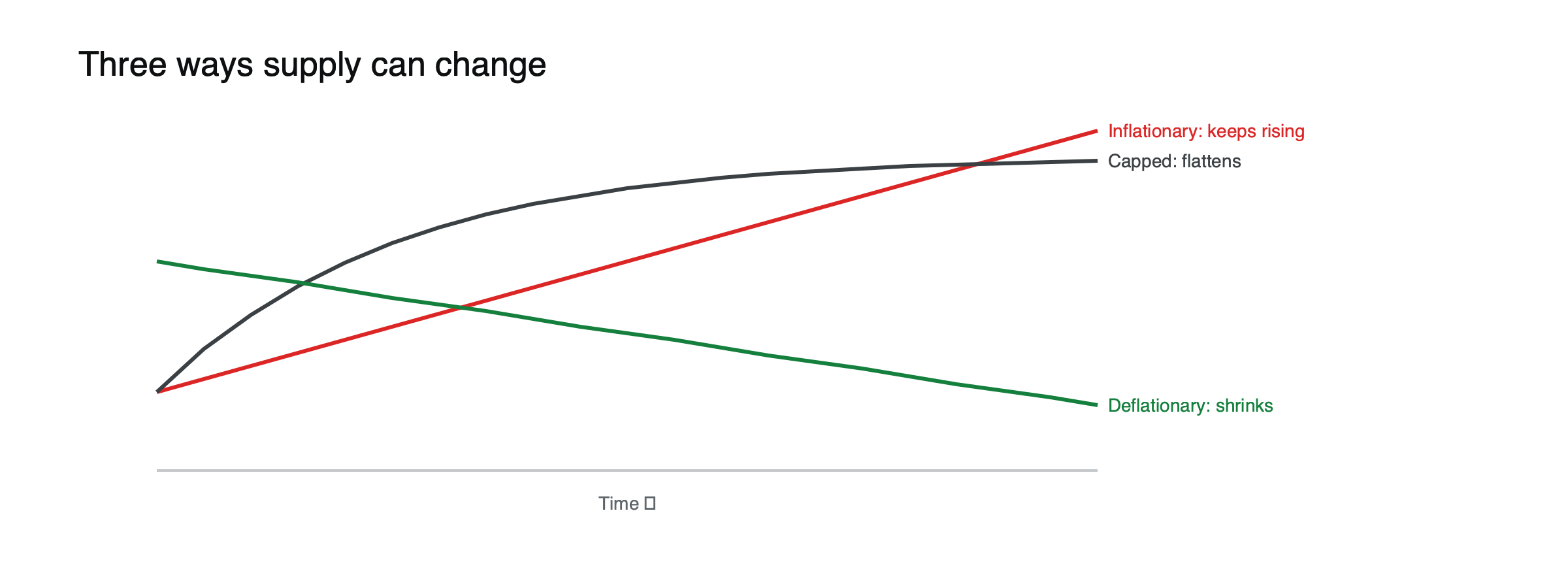
Figure: Three supply paths (schematic, not to scale).
Why “deflationary” is not automatically better
“Deflationary is better” ignores what the supply pays for. Inflation that pays validators to secure a network can be a reasonable cost. Burns funded by trading fees shrink in quiet markets. And capped supply does not create demand: plenty of fixed-supply tokens have gone to zero.
Inflation and staking: who actually pays
On many proof-of-stake networks, new tokens go to those who stake. That changes who bears the cost of inflation. Suppose a network issues new tokens equal to 4% of supply a year and stakers earn 5%. (Illustrative.) A holder who stakes ends the year with 5% more tokens while total supply grew 4%, so their share of the network rises slightly; their “real” yield is about 1%. A holder who does not stake keeps the same number of tokens and sees their share fall by about 4%. Inflation here works less like a tax on everyone and more like a transfer from non-stakers to stakers.
Net issuance over a year
The number that matters is net issuance: tokens created minus tokens destroyed, as a share of supply. Suppose a token starts the year with 1 billion units, issues 60 million as rewards and burns 25 million through fees. Net supply growth is 35 million, or 3.5%. (Illustrative.) Calling it “deflationary” because it burns tokens would be misleading; it is inflationary, just less so than its gross issuance suggests. The reverse can happen too: a token with modest issuance can shrink in busy periods when burns exceed it, as ether’s supply did after the Merge.
Common supply designs
| Design | How supply changes | Example |
|---|---|---|
| Fixed cap, falling issuance | Grows ever more slowly, then stops | Bitcoin |
| Fixed amount per year | Grows forever, at a slowly falling rate | Dogecoin |
| Issuance plus fee burn | Depends on activity; can shrink | Ether |
| Burn toward a target | Shrinks until a set supply is reached | BNB |
| Ongoing staking rewards | Grows; stakers keep their share | Many proof-of-stake tokens |
What inflation pays for
Issuance is not wasted if it buys something the network needs. On proof-of-work chains, it pays miners for the electricity and hardware that secure the ledger. On proof-of-stake chains, it rewards validators for locking capital and running infrastructure. On applications, it may pay users to provide liquidity or try a product. The first two buy ongoing security; the last often buys temporary activity that fades when rewards stop. Asking what a token’s inflation pays for is often more revealing than its rate. A network paying 3% a year for security that users clearly value is in a very different position from an application paying 3% a year to keep users who would otherwise leave, even though the headline numbers match.
Hybrid designs are common
Few large tokens are purely one or the other. Ether combines issuance to validators with a fee burn, so its supply direction depends on activity. BNB combines scheduled burns with a target supply. Many staking tokens pair inflation with fee-sharing or buybacks. The label matters less than the balance between what is created, what is destroyed and what drives each side.
Measuring it yourself
To estimate a token’s real supply direction, take the circulating supply a year ago and today from a reliable data source, adjust for any large unlocks that moved locked tokens into circulation, and calculate the percentage change. Then compare with the project’s stated issuance and burn figures. If the numbers disagree widely, find out why before trusting either. For tokens that already trade on many venues, that research takes only a few minutes and can prevent a very expensive misreading later.
Inflation also interacts with unlocks. A token can have modest protocol issuance and still see its circulating supply grow quickly as locked team and investor allocations are released. Supply growth from unlocks does not appear in issuance figures at all, which is why circulating supply over time is a better guide than the stated inflation rate on its own. Looking at both together shows the full dilution a holder faces over the coming year.
How to judge a token’s model
Look at net issuance, issuance minus burns, over a full year rather than a single busy week. Compare it with real usage. See what tokenomics is and what happens when all 21 million bitcoin are mined.
This article is educational content and does not constitute financial, investment, legal or tax advice. Digital assets are volatile and you may lose the amount you invest.
Frequently asked questions
Does a deflationary token always rise in price?
No. Shrinking supply helps only if demand holds up. If burns depend on activity that fades, or if large unlocks add tokens faster than burns remove them, the price can fall despite the token being labeled deflationary.
Is inflation always bad for holders?
Not necessarily. Issuance that pays for network security, received mostly by people who stake, can leave active participants roughly whole. It is most harmful when new tokens go mainly to insiders or to short-term incentive programs whose recipients sell immediately.