
How Crypto Options Work
Crypto options give the right, not the obligation, to buy or sell at a set price by a date. How calls and puts work, what drives premiums and a worked example.
Crypto options give the buyer the right, but not the obligation, to buy or sell a cryptocurrency at a set price by a set date. A call gains if the price rises above that level; a put gains if it falls below. The buyer’s premium is the most they can lose; the seller takes larger risk.
The key terms
- Call: the right to buy at the strike price.
- Put: the right to sell at the strike price.
- Strike price: the agreed price.
- Expiry: the date the option ends. Many crypto options are European-style, exercisable only at expiry.
- Premium: the price of the option.
Worked example: a call
Bitcoin trades at $65,000. You buy a call with a $70,000 strike for a $2,000 premium (illustrative, one BTC of exposure).
- At expiry, BTC = $75,000: the call is worth $5,000. Profit = $5,000 − $2,000 = $3,000.
- At expiry, BTC = $65,000: the call expires worthless. Loss = the $2,000 premium.
- Break-even: $70,000 + $2,000 = $72,000.
A put works the other way: it gains when the price falls below the strike minus the premium.
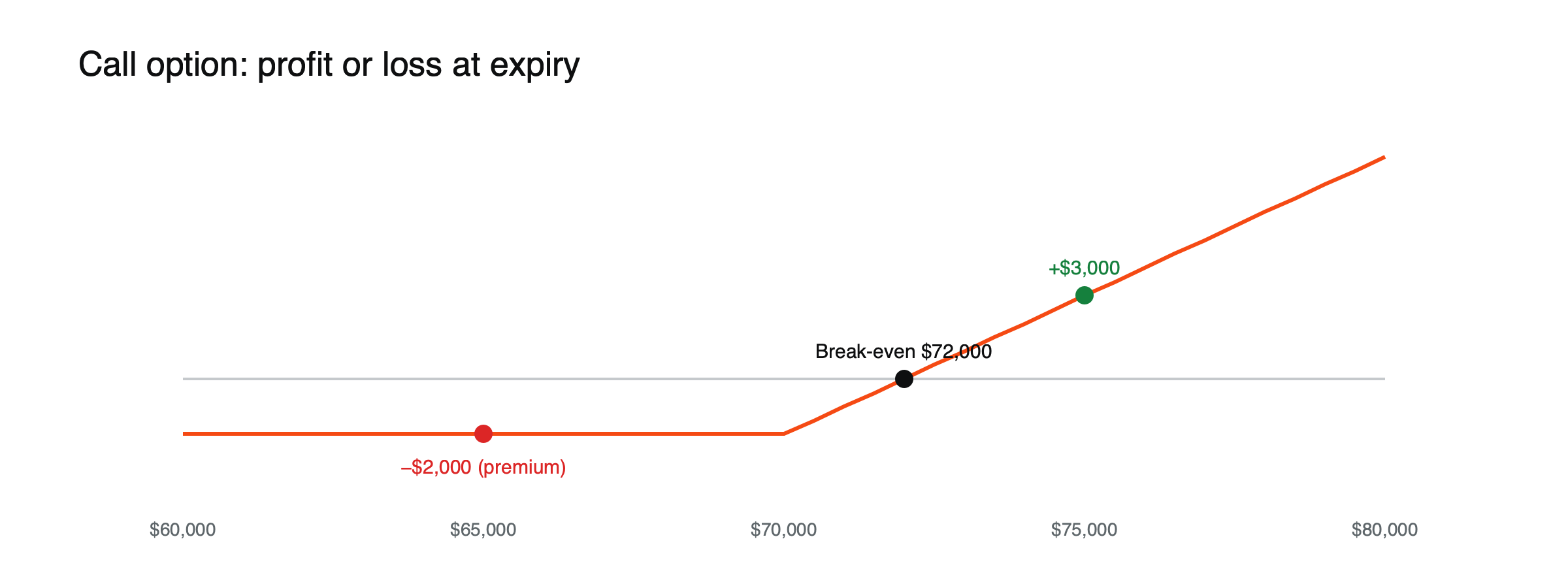
Figure: Profit or loss at expiry for the example call (illustrative).
Worked example: protecting a holding with a put
You hold 1 BTC at $65,000 and buy a put with a $60,000 strike for a $1,500 premium. (Illustrative figures.)
- If BTC falls to $50,000: the put is worth $10,000. Your bitcoin plus the put, minus the premium, is worth $50,000 + $10,000 − $1,500 = $58,500, instead of $50,000 unhedged.
- If BTC rises to $75,000: the put expires worthless. Your position is worth $75,000 − $1,500 = $73,500.
The put works like insurance: you pay a known cost to put a floor under your holding for a set period.
Worked example: a covered call
You hold 1 BTC at $65,000 and sell a call with a $75,000 strike for $1,200. If bitcoin stays below $75,000, you keep the premium as extra income. If it rises to $85,000, your upside above $75,000 belongs to the buyer: you end with $75,000 plus the $1,200 premium, rather than $85,000. (Illustrative figures.) Covered calls turn some potential upside into steady income, which suits sideways markets and disappoints in strong rallies.
What sets the premium
- Distance to the strike: options closer to paying off cost more.
- Time to expiry: more time means more chances to pay off.
- Implied volatility: the more the market expects prices to swing, the more options cost. Crypto’s high volatility makes its options relatively expensive.
Implied and realized volatility
Implied volatility is the swing the option price assumes; realized volatility is the swing that actually happens. When implied volatility is higher than what later materializes, option sellers tend to profit; when the market moves more than expected, buyers do. Implied volatility usually rises before big events and in sell-offs, which makes protection most expensive exactly when people want it most.
The Greeks in plain words
- Delta: how much the option’s price moves for a $1 move in the asset. A delta of 0.5 means about half as much.
- Theta: how much value the option loses each day as expiry approaches, all else equal.
- Vega: how much the option’s price changes when implied volatility changes.
- Gamma: how quickly delta itself changes as the price moves.
Buyers of options are usually fighting theta and hoping for movement; sellers collect theta and hope for calm.
Buying vs selling options
Buyers have limited risk, the premium, and potentially large gains. Sellers collect the premium but can face large losses if the price moves sharply, and usually must post margin. Selling options without holding the underlying asset is a high-risk strategy.
Beyond single options
Traders often combine options to shape their risk. A call spread buys one call and sells another at a higher strike, lowering the cost in exchange for capping the gain. A put spread does the same for falling prices. A straddle buys both a call and a put at the same strike, betting on a large move in either direction. Each combination trades one kind of risk or cost for another, and each adds fees and complexity.
Who options suit
Buying options suits people who want a defined maximum loss, whether to hedge a holding or to take a view without risking liquidation. Selling options suits experienced traders who understand the potential for large losses and can manage margin. For beginners, the combination of time decay, volatility pricing and many expiry dates makes options easy to misjudge, so starting small and with bought options is the cautious route.
Options compared with perpetual futures
Both let you profit from price moves without owning the asset, but their risks differ. A perpetual long can be liquidated by a sharp dip even if the price later recovers; a bought call cannot be liquidated, though it loses value with time and can expire worthless. Perps cost funding while open; options cost a premium up front. For a view that depends on a large move within a set period, options define the cost in advance. For short-term trading with tight risk control, perps are often simpler.
The market
Deribit has long dominated crypto options. In June 2025 it held nearly 90% of bitcoin options open interest, which exceeded $45 billion across venues. Coinbase agreed in May 2025 to buy Deribit for about $2.9 billion; the deal closed in August 2025. See what open interest is.
What people use options for:
- Hedging: a put can protect a holding against a fall.
- Speculation: calls or puts express a view with limited, known risk for buyers.
- Income: selling options collects premiums, with the risks above.
For other derivatives, read what perpetual futures are and how to calculate the annualized basis.
Trading with leverage magnifies losses as well as gains and can lead to the rapid loss of your entire margin.
This article is educational content and does not constitute financial, investment, legal or tax advice. Digital assets are volatile and you may lose the amount you invest.
Frequently asked questions
Can I lose more than I paid for an option?
Not as a buyer: the most you can lose is the premium. Sellers can lose much more, which is why exchanges require them to post margin.
What happens at expiry?
Most crypto options settle in cash. If an option finishes in the money, the holder receives the difference between the market price and the strike; if not, it expires worthless. Many are European-style and can only be exercised at expiry, though they can be sold before then.
Sources
- Deribit tops $40B in bitcoin options open interest (nearly 90% share; above $45 billion across venues) — The Block, June 2025
- Coinbase acquires options broker Deribit ($2.9 billion: $700 million cash plus 11 million shares) — FXStreet, May 2025
- Deribit Review 2026 (deal closed August 2025; European-style options; premium drivers) — Jean Galea