
What Causes Liquidation Cascades?
A liquidation cascade is a chain reaction where forced selling triggers more of it. What sets one off, why crypto is prone to them and what October 2025 showed.
A liquidation cascade happens when a price move forces leveraged positions to close, those forced trades push the price further, and that triggers the next group of liquidations. It needs three ingredients: lots of open leverage, positions crowded on one side and thin order books. The crash of October 10–11, 2025 wiped out more than $19 billion of leveraged positions.
The chain reaction
- A trigger moves the price: a headline, a large sale or a sudden shift in sentiment.
- The first liquidations hit: positions with the highest leverage reach their liquidation prices.
- Exchanges close them with market orders, selling for longs or buying for shorts.
- Those orders move the price further, especially if the order book is thin.
- More liquidation prices are hit, and the loop repeats until leverage is cleared or buyers step in.
When longs are forced out, it is a long squeeze; when shorts are, a short squeeze.
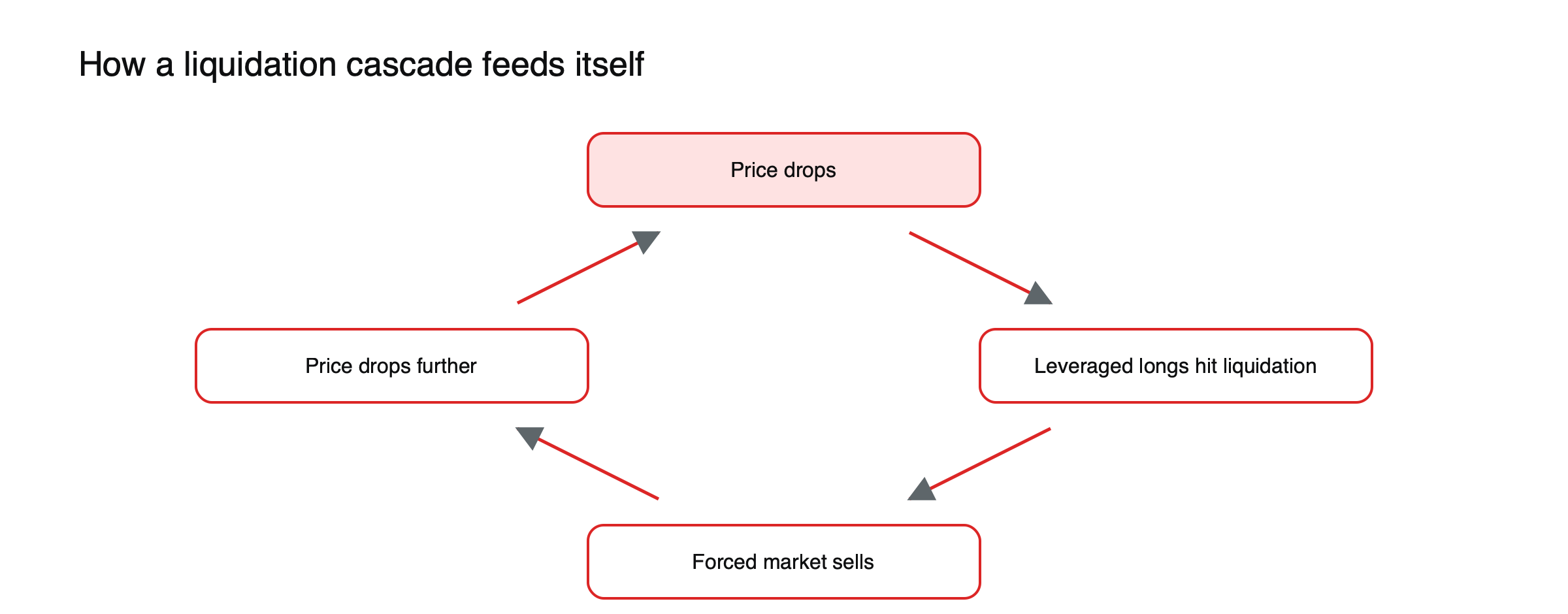
Figure: The feedback loop of a long squeeze.
A cascade, sketched in numbers
Imagine bitcoin at $60,000 with large groups of leveraged long positions set to be liquidated at about $58,000, $56,500 and $55,000. (Illustrative levels.) A sudden sale pushes the price to $58,000. The first group is liquidated, and exchanges sell those positions into a thin order book, dropping the price to $56,500 within minutes. That triggers the second group, whose forced sales push the price to $55,000, hitting the third. A fall that began with one large sale ends up about 8% lower, mostly driven by forced selling rather than new information. Once the clusters are cleared and buyers step in, the price often rebounds partway.
Why crypto is prone to cascades
High leverage is widely available. At 10x, a move of about 10% liquidates a position; at higher leverage, much less. See how to calculate a liquidation price.
Crowded positioning. High funding rates and rising open interest often mean many traders have made the same bet. See what open interest is.
Markets never close, so moves can happen when liquidity is thin, such as at night or on weekends.
Fragmented liquidity. The same asset trades on many venues; a sharp drop on one can feed into prices elsewhere.
October 2025
During the market crash of October 10–11, 2025, more than $19 billion of leveraged positions were liquidated. Prices on some venues diverged sharply: Ethena’s USDe briefly traded at $0.65 on Binance while staying much closer to $1 on decentralized exchanges. About $1.59 billion of USDe was redeemed over those two days. See what a synthetic dollar stablecoin is.
What October 2025 showed
The crash of October 10–11, 2025 illustrated how cascades interact with the structure of today’s market. More than $19 billion of leveraged positions were liquidated, and prices on some venues briefly detached from prices elsewhere: Ethena’s USDe traded as low as $0.65 on Binance while staying much closer to $1 on decentralized exchanges. Collateral that looked stable on one platform suddenly lost value there, triggering further liquidations of positions that used it. The lesson for traders was that cascades test not only their leverage but also what they post as margin and where. Collateral that depends on a single venue’s price, or on a token designed to hold a peg, can fail at exactly the moment it is needed most. Diversifying collateral across assets reduces that risk.
May 2021
On May 19, 2021, bitcoin fell about 30% at one point to around $30,000, ether lost about 40% and dogecoin about 45%, before partly recovering. Our account of the May 2021 crypto crash covers the timeline.
Short squeezes: the same mechanism upward
Cascades also run in reverse. When many traders are short with leverage and the price jumps, their positions are liquidated with market buy orders, which push the price higher and liquidate the next group of shorts. Short squeezes can produce sudden spikes that look like good news but are mainly forced buying, and they often fade once the squeeze is over.
Estimating where liquidations sit
Some data services publish liquidation heatmaps, estimating where clusters of liquidation prices might be based on open interest, leverage and recent entries. They can highlight levels where a cascade could accelerate, but they are estimates: exchanges do not publish every position’s liquidation price, and traders add margin, close positions or move stops at any time.
Nights, weekends and thin markets
Crypto trades around the clock, but liquidity does not. Order books are thinner overnight in the main trading regions and at weekends, when many market makers reduce activity. The same forced sale moves the price further in a thin market, so cascades that start at those times can run deeper before buyers arrive. Many traders reduce leverage before weekends for this reason.
After the cascade
Cascades tend to reset the market. Open interest drops sharply, funding rates fall back toward normal or turn negative, and the most crowded positions are gone. These conditions have often marked short-term lows or highs, though not always, since a cascade can also start a longer trend if the trigger reflects a real change in outlook.
Exchange safeguards
Exchanges use mark prices drawn from several markets to avoid liquidating positions on a single bad print, insurance funds to cover positions closed below their bankruptcy price and, in extreme cases, auto-deleveraging of profitable opposing positions. These measures limit the damage to the exchange, not to the traders being liquidated.
How traders reduce exposure
- Use low or no leverage, leaving room for large moves.
- Use isolated margin so one position cannot drain the whole account.
- Avoid adding to crowded trades when funding is extreme.
- Remember that stop orders can fill far from their trigger price in a cascade.
For the bigger picture, read what perpetual futures are.
Trading with leverage magnifies losses as well as gains and can lead to the rapid loss of your entire margin.
This article is educational content and does not constitute financial, investment, legal or tax advice. Digital assets are volatile and you may lose the amount you invest.
Frequently asked questions
Can liquidation cascades be predicted?
Not precisely. Crowded positioning, high funding and rising open interest show when the market is vulnerable, but the trigger and timing are usually impossible to forecast.
Do cascades affect people who do not use leverage?
Yes, through prices. Spot holders see the same sharp drop, and stop orders can fill far below their trigger prices in the rush.
Sources
- DeFi TVL drops 39% in 2026 (October 10, 2025 crash erased more than $19 billion in leveraged positions) — Cointelegraph, June 2026
- Ethena Under Pressure (USDe at $0.65 on Binance; $1.59 billion redeemed October 10–11) — Kaiko via Brainsum, December 2025
- Crypto in free fall (May 19, 2021: bitcoin −30% to $31,000, ether −40%, dogecoin −45%) — Business Today, May 2021
- Liquidation Price (10x ≈ 9.5% move) — Spark