
How Short Selling Works With CFDs
With a CFD you can sell first and profit if the price falls, without borrowing shares. How short positions work, what they cost and why losses are open-ended.
Short selling with CFDs means opening a sell position that profits if the price falls and loses if it rises. You do not borrow shares yourself: the contract gives short exposure directly. But losses on a short have no natural ceiling, because a price can keep rising, and short CFDs can carry financing and borrowing charges.
Why traders go short
Traders short for three main reasons. Some expect a price to fall and want to profit from it. Some hold assets they do not want to sell, perhaps for tax or long-term reasons, and use a short to protect against a temporary fall. Others pair a short in one asset with a long in a related one, betting on the gap between them rather than the direction of the whole market. CFDs make all three simple, because going short is as easy as going long.
How a short CFD trade works
- You sell a CFD on, say, 100 shares at $50.
- The price falls to $45: you buy back to close, making 100 × $5 = $500 before costs.
- If the price rises to $55 instead, you lose $500.
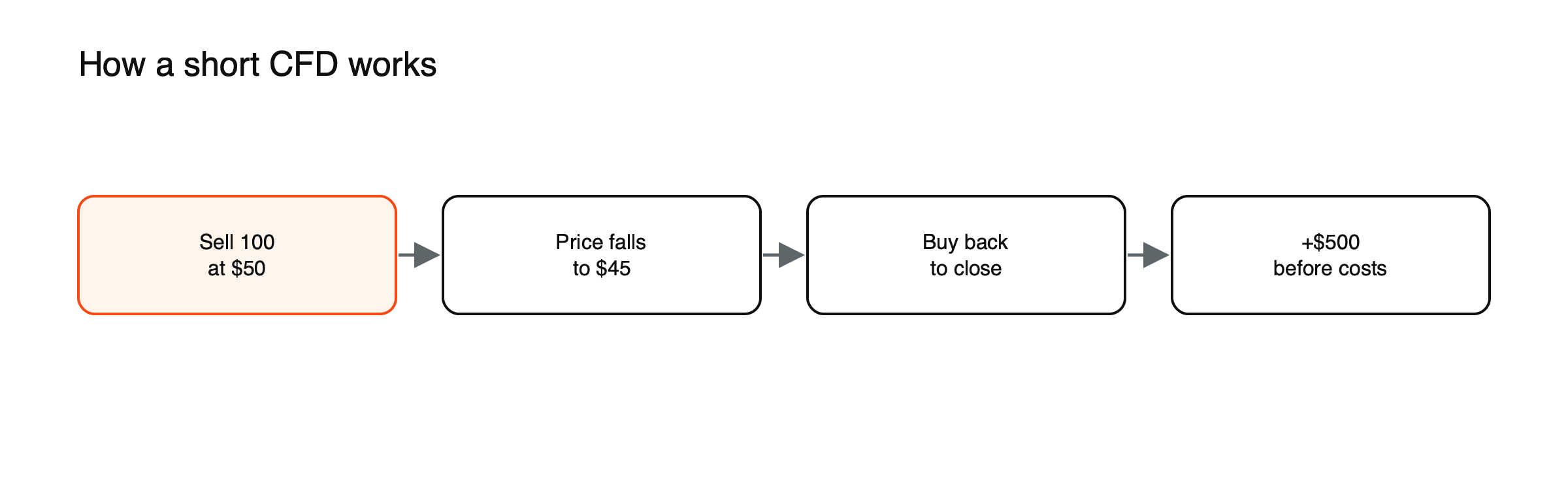
Figure: A short CFD profits when the price falls (example values).
Costs specific to shorts
- Financing: short positions usually receive the benchmark rate minus a fee; when rates are low, this becomes a charge. See how overnight financing works.
- Borrowing charges: some share CFDs add a fee for hard-to-borrow stocks, and providers can close or restrict shorts at short notice.
- Dividends: short share CFDs pay a cash adjustment equal to the dividend.
A short trade with costs included
You short 100 shares at $50, a $5,000 position, hold it for 10 nights and close at $46. (Example values.) The gross gain is $400. Along the way:
- The spread costs about $5.
- The benchmark minus the provider’s fee gives a 1.5% credit, but the stock carries a 2% borrowing charge, so the net rate is −0.5%: about $0.68 over ten nights.
- The company pays a $0.50 dividend while you are short, so you pay a $50 adjustment.
Net result: about $344. The dividend alone took an eighth of the profit, which is why short sellers check ex-dividend dates before holding through them.
Hedging a portfolio with an index short
Suppose you hold $50,000 of shares that broadly follow a major index, and you worry about a fall over the next month. Shorting an index CFD worth $25,000 hedges about half the exposure. If the market falls 10%, the shares lose about $5,000 and the short gains about $2,500, halving the loss. If the market rises instead, the short loses while the shares gain. (Illustrative figures; individual shares rarely track an index exactly.) The hedge costs financing and spreads, and it needs margin, so it is usually used for limited periods.
Risks of shorting
- Unlimited upside risk: prices can rise far more than they can fall.
- Short squeezes: forced buying by short sellers can drive prices sharply higher.
- Gaps: good news overnight can open the price well above your stop.
- Rules: regulators can restrict short selling in a crisis. See how short-selling rules work across markets.
Uses of short CFDs. Expressing a view that a price will fall, or hedging an existing long holding against a decline.
How short squeezes happen
When many traders are short a heavily shorted stock and its price starts to rise, some close their positions by buying, which pushes the price higher and forces others to buy too. Stops on short positions are buy orders, so a cluster of them can turn a rise into a spike. Squeezes can carry a price far beyond any reasonable valuation in days, which is why the size of a short position matters even more than the size of a long.
Where to put a stop on a short
The stop goes above the entry, at the level where the bearish idea is clearly wrong, often just above a resistance zone or a recent high. Because gaps are a particular danger for shorts in individual shares, around earnings or takeover news, many traders either avoid holding shorts through such events or use guaranteed stops. See how stop-loss orders work.
Shorting different markets
In currency pairs, every position is long one currency and short the other, so shorting a pair is routine. Index and commodity CFDs can be shorted easily and usually without borrowing charges. Share CFDs may carry borrowing fees and restrictions for some stocks. Crypto CFDs can be shorted but come with high volatility and financing costs. Each market’s specific costs and risks shape whether a short makes sense.
When a short can be closed for you
Providers can restrict new short positions or close existing ones in some stocks, for example if the shares become hard to borrow in the underlying market or regulators impose short-selling bans during a crisis. Checking the provider’s terms on short positions avoids being forced out at an inconvenient moment.
See what a CFD is and CFD trading vs owning the underlying asset.
Short positions and margin
Margin on a short works like margin on a long, but rising prices hit a short twice. The loss reduces your equity, and because margin is calculated on the position’s current value, a higher price also raises the margin the position requires. Together they push the margin level down faster than an equivalent fall would on a long. Keeping shorts smaller than longs of similar conviction, and watching margin level closely when a short moves against you, accounts for that asymmetry.
Shorting in a strong market
Markets tend to rise over long periods, so short positions work against that drift. Shorts are usually most effective as shorter-term trades or hedges, rather than as long-held bets against an asset, where financing, dividends and the general upward tendency of markets can erode results even when the original view proves partly right.
A short checklist
- Is there an earnings report, dividend or major announcement before you plan to close?
- What borrowing charge applies, and can the provider close the short?
- Where is the stop, and could a gap jump it?
- How heavily shorted is the stock already?
- Would you still take the trade without leverage?
Frequently asked questions
Can I lose more than my margin on a short?
Yes, losses on a short grow as the price rises, with no natural ceiling. Stop-loss orders, stop-outs and, for retail clients in some jurisdictions, negative balance protection limit how far that can go in practice.
Do I need to borrow shares to short a CFD?
No. The CFD gives short exposure directly. The provider may borrow or hedge in the underlying market, which is why some stocks carry borrowing charges or restrictions.
This article is educational content and does not constitute financial, investment, legal or tax advice. Digital assets are volatile and you may lose the amount you invest.