
Why Stocks Sometimes Fall After Beating Earnings
A stock can fall after beating estimates when expectations were higher, guidance disappoints, the beat is low quality or the stock had already rallied.
A stock can fall after an earnings beat when the beat does not improve expectations. Common reasons: investors expected more than published forecasts, guidance disappointed, the beat came from cost cuts or one-offs rather than revenue, the stock had already rallied, or key metrics such as margins weakened.
A beat that fell, illustrated
A company reports EPS of $1.26 against a consensus of $1.20, a 5% beat, and revenue slightly above forecasts. The shares had risen 15% in the month before the report. Gross margin slipped from 42% to 41%, and next quarter’s revenue guidance came in below consensus at its midpoint. On the call, management described demand as «softening» in one region. The shares fall 7% the next day. (Hypothetical figures.) Every reason in this article is present at once: high expectations, weak guidance, weaker margins and a share that had already rallied.
1. The bar was higher than the forecast
Published consensus estimates may lag what investors really expect, sometimes called the «whisper number.» A small beat against the published figure can be a miss against real expectations.
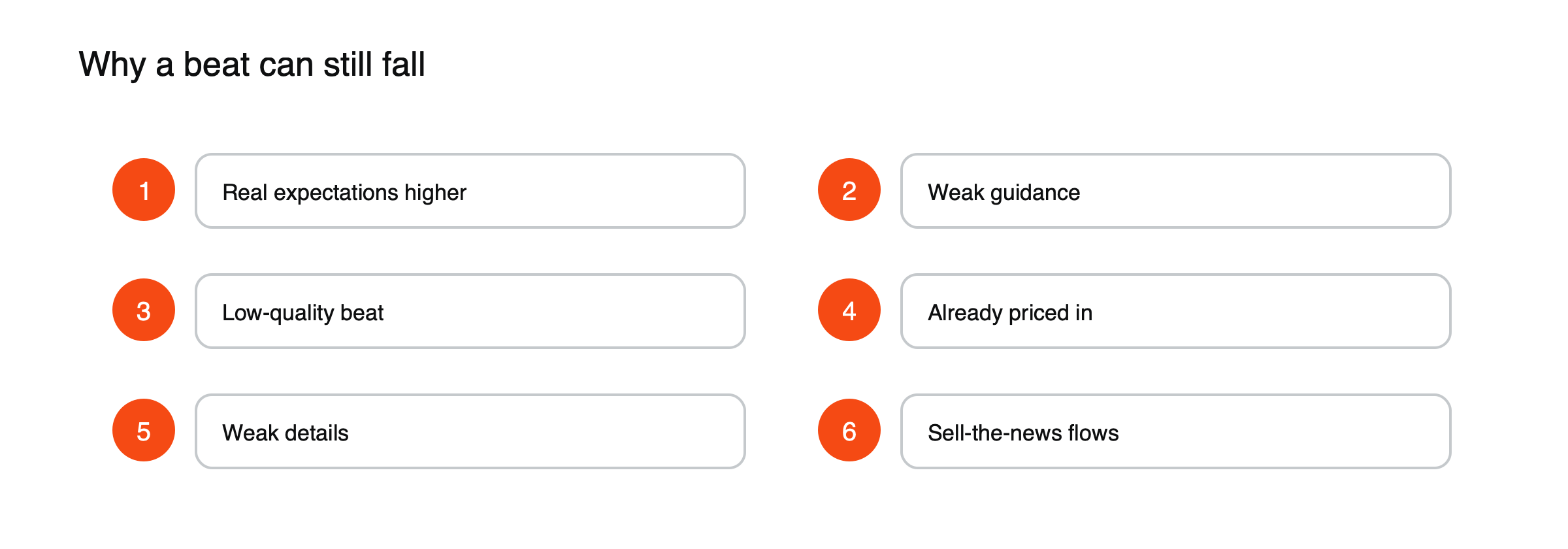
Figure: Why a beat can still disappoint.
2. Guidance outweighs the quarter
The last quarter is history; guidance shapes future value. Meta’s February 2022 plunge was driven by its weak forecast. See what company guidance is.
3. Low-quality beats
Earnings that beat because of lower taxes, buybacks or one-off gains, while revenue misses, rarely impress. See revenue vs earnings.
4. Priced in already
If the share price rose sharply before the report, a good result may already be reflected; investors «sell the news.»
5. Weak details
Falling margins, slowing growth in a key segment or cautious comments on the earnings call can outweigh the headline numbers.
Positioning
How investors are positioned before a report matters. If many funds already own the shares and options traders have bet heavily on a rise, there may be few new buyers left even after good news, while some holders take profits. Conversely, a heavily shorted share can jump on mediocre results as shorts cover. See what short interest is.
Buy the rumor, sell the news
The old saying describes a common pattern: prices rise in anticipation of good news and fall when it is confirmed, because the buying has already happened. The pattern is most visible when a share has rallied strongly into a widely anticipated report.
The reverse: rising on a miss
The same logic works the other way. A company can miss forecasts and still rise if the miss was smaller than feared, guidance was better than expected or the share had already fallen sharply. When Nvidia beat forecasts in May 2023, the 24% rise came mainly from its guidance, about $11 billion of next-quarter revenue against roughly $7.2 billion expected, showing again that the outlook usually decides the reaction.
What it means for traders
The direction after earnings is hard to predict even when results are known in advance. Size positions for a gap either way. See how earnings reports move share prices and what moves stock prices.
Judging the reaction
- Did the beat come from revenue or from costs, taxes and buybacks?
- How did guidance compare with consensus at its midpoint?
- Were margins and key metrics better or worse than expected?
- How much had the share moved before the report?
- How crowded was positioning?
Answering these after a report usually explains the reaction, even when it seems counterintuitive at first.
Revenue misses and earnings beats
Earnings can beat while revenue misses if a company cuts costs, benefits from a lower tax rate or reduces its share count. Investors generally value revenue growth more, because cost savings and buybacks have limits, so an earnings beat built on a revenue miss often draws a negative reaction. See revenue vs earnings.
How expectations get into the price
In the weeks before a report, investors form views from industry data, comments by management at conferences, results from peers and their own research. Those views are reflected in the share price long before the release. By the time results arrive, the question is not whether the company did well, but whether it did better or worse than what the price already assumed. A share that has risen sharply into results has, in effect, already been paid for good news.
The whisper number in practice
Companies with a record of beating forecasts often trade on expectations above the published consensus. If a company has beaten EPS estimates by 5% to 10% for several quarters, investors may expect a similar beat again, so a 2% beat looks like a disappointment. Watching how the share reacted to past beats of different sizes gives a sense of what the market really expects.
Analysts’ reactions
In the hours and days after a report, analysts revise their forecasts and price targets. If the revisions are small or downward despite a beat, perhaps because guidance or margins were weak, the share often keeps falling. Upward revisions can stabilize a share whose first reaction was negative. Following the direction of revisions is one of the best ways to judge whether a post-earnings move will last.
Sector context
A beat can also be swamped by news about the sector. If a peer reports the same day with a warning about demand, or if the whole sector is being sold on rising interest rates, even good results may not lift the share. Earnings reactions should always be read against what peers and the market did that day.
The quality of a beat, illustrated
Suppose a company was expected to report operating income of $150 million and earnings of $1.95 a share. It reports operating income of only $144 million, but a lower tax rate, 20% instead of the usual 25%, lifts EPS to about $1.98, a narrow beat. (Hypothetical figures.) The core business missed; only the tax line beat. Investors who notice will not reward the headline, and the share may fall. Checking where a beat came from, line by line down the income statement, explains many puzzling reactions. See how to read an income statement.
Volatility after the report
Before a report, options are expensive because of the uncertainty. Once results are out, that uncertainty disappears and option prices fall sharply, even if the share moves. Investors who bought options as a bet on good results can lose money on a beat if the share’s rise is smaller than the move the options had priced in. For share and CFD traders, the lesson is similar: being right about the direction is not enough if the move is smaller than expected or comes with costs that outweigh it.
A falling share is not always a verdict
A fall after good results does not necessarily mean the business is weakening. Sometimes it reflects profit-taking after a strong run, a rotation out of the sector or worries unrelated to the company. If guidance, margins and key metrics remain strong, the share may recover as the market digests the results. The reasons behind the move matter more than its direction on the first day. Watching analyst revisions and the next few sessions carefully separates temporary reactions from genuine changes in the outlook for the company.
Frequently asked questions
What is a whisper number?
An informal estimate of what investors really expect, often higher than the published consensus for companies with a record of beating forecasts.
Do falls after beats tend to last?
Sometimes they reverse within days as investors reassess; sometimes they mark a turning point, especially when guidance has weakened. Watching analyst revisions after the report helps tell which.
This article is educational content and does not constitute financial, investment, legal or tax advice. Digital assets are volatile and you may lose the amount you invest.
Sources
- Meta shares plummet on tepid forecast («it was the guidance that spooked people») — Reuters via Euronews, February 2022
- Wall Street ends winning run (earnings delivery rewarded or penalized) — The Jakarta Post / Reuters, February 2022
- Why Nvidia stock skyrocketed 239% in 2023 (Q2 revenue guidance of $11 billion vs $7.2 billion consensus; shares +24% on May 25, 2023) — The Motley Fool, January 2024
- Nvidia Q1 beat (EPS $1.09 vs $0.92 expected; revenue $7.19 billion vs $6.52 billion) — StreetBeat / Benzinga, May 2023