
What Moves Stock Prices?
Stock prices move on expected earnings, interest rates, company news, sector trends and sentiment. How each driver works and why surprises matter most.
Stock prices move mainly on what investors expect a company to earn and how much they will pay for those earnings today. Earnings, guidance, interest rates, sector news and market sentiment shift those expectations. Surprises matter most: in 2022, Meta fell 26% in a day after a weak forecast, losing over $200 billion.
A simple way to think about a share price
A useful starting point is to see a share price as two numbers multiplied together: the profit per share investors expect, and the multiple they are willing to pay for it, often the price-to-earnings ratio. If a company is expected to earn $5 a share and investors pay 20 times earnings, the share is worth about $100. If expected earnings rise 10% to $5.50 but the multiple falls to 18, the price barely moves, to about $99. (Illustrative figures.) Almost everything that moves stocks works through one of these two numbers. See how the P/E ratio works.
Earnings and expectations
Quarterly results and forecasts change expected profits. See how earnings reports move share prices and what company guidance is.
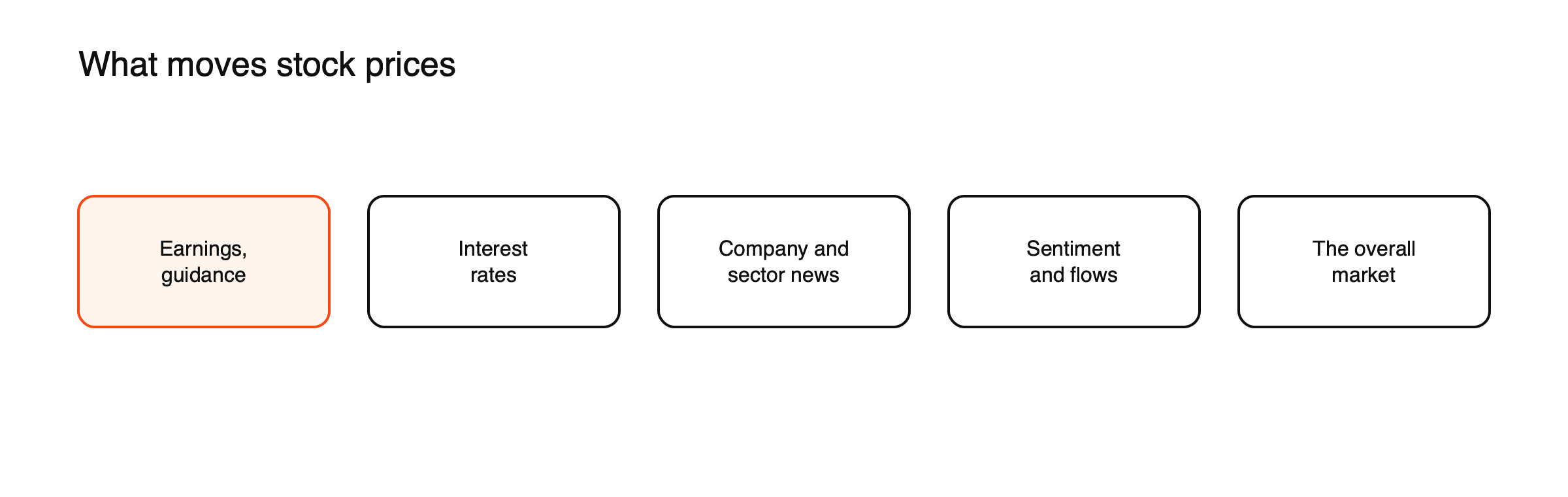
Figure: The main drivers, with expectations at the center.
An earnings surprise, illustrated
Suppose analysts expect a company to earn $1.20 a share in a quarter, and it reports $1.35, a beat of about 12%. (Illustrative figures.) If management also raises its forecast for the year, the share may rise sharply as investors lift their expectations for future earnings. If instead the beat came from a one-off gain and the forecast is cut, the share may fall despite the headline beat. Markets react to what results imply for the future, not to the past quarter alone. See why stocks sometimes fall after beating earnings.
Meta, February 2022
When Meta Platforms reported results in February 2022, its forecast for the coming quarter disappointed investors, and the shares fell 26% in a day, wiping out more than $200 billion of market value. The company was still highly profitable; what changed was the expected path of future growth. It remains one of the clearest examples of guidance moving a share more than the results themselves. See what company guidance is.
Interest rates
Higher rates raise the return investors demand and make future profits worth less today, hitting valuations, especially for growth stocks. In 2022, US equities fell about 18% as rates rose. See how interest rates affect stock prices.
Why rates matter, in numbers
A profit of $10 expected in ten years is worth about $6.76 today if investors discount it at 4% a year, but only about $5.58 at 6%, roughly 17% less. (Illustrative figures.) Companies whose profits lie mostly in the future, such as fast-growing technology firms, are hit hardest when rates rise, because more of their value comes from distant years. That is why technology shares often fall when bond yields jump. See why tech stocks react to bond yields.
Inflation
Moderate inflation can coexist with rising profits, as companies raise prices. High or rising inflation tends to hurt stocks overall, because it pushes up interest rates, squeezes profit margins when costs rise faster than prices and makes future profits less certain. Sectors that can pass on costs, such as energy or some consumer staples, often hold up better than those that cannot.
Company and sector news
Product launches, regulation, management changes and competitors’ results all move prices, often across a whole sector.
Sentiment and flows
Fear and greed, index inclusion, fund flows and short covering can move prices beyond fundamentals in the short run. See what a short squeeze is.
Buybacks and dividends
Companies that return cash to shareholders affect their share prices directly. Buybacks reduce the number of shares, lifting earnings per share and adding steady buying in the market. Dividend increases signal confidence in future cash flows, while cuts often trigger sharp falls. See how share buybacks affect stock prices.
Analysts and ratings
Analyst upgrades, downgrades and changes in price targets can move a share, especially when they come from widely followed analysts or contradict the consensus. Their effect is often short-lived unless they reflect new information. See why analyst upgrades and downgrades move stocks.
Index changes and fund flows
When a company is added to a major index, funds that track the index must buy its shares, which can lift the price around the change. Removal has the opposite effect. Large flows into or out of funds focused on particular sectors or styles can move whole groups of shares regardless of individual company news.
The overall market
Most stocks move with the broader market. A strong company can still fall in a sell-off.
The economy and the business cycle
Different kinds of companies respond differently to the economy. Cyclical businesses, such as carmakers, banks and industrial firms, tend to do well in expansions and badly in recessions; defensive businesses, such as utilities and food producers, are steadier. As expectations for the economy shift, investors rotate between them, moving prices across whole sectors. See cyclical vs defensive stocks and what sector rotation is.
Market-wide shocks
Some events move almost every share at once: the pandemic crash of 2020, the rate shock of 2022, when US equities fell about 18%, or sudden financial crises. In such moments, correlations between stocks rise, and even companies with strong results fall. Diversifying across shares offers less protection than usual when the whole market sells off.
Why surprises matter most
Prices already reflect what investors expect, so only new information moves them much. That is why a company can report record profits and still fall. See why stocks sometimes fall after beating earnings and how stock CFDs work.
Drivers by time horizon
| Horizon | Main drivers |
|---|---|
| Minutes to days | Earnings releases, guidance, news, analyst changes, market sentiment |
| Weeks to months | Interest rates, economic data, sector rotation, fund flows |
| Years | Long-term earnings growth, competitive position, valuation levels |
Over long periods, earnings growth explains most of a share’s return; over short periods, changes in expectations and sentiment dominate.
Long-run returns and earnings
Over many years, share prices tend to follow the growth of company profits and dividends, while the multiple investors pay rises and falls with interest rates and sentiment. A company that grows earnings steadily for a decade usually sees its share price rise too, even if the path is uneven. Short-term traders deal mostly with changes in the multiple and in expectations; long-term investors rely more on earnings growth.
A checklist before trading a share
- When are the next results, and what do analysts expect?
- How has the share reacted to past results?
- What are interest rates and bond yields doing?
- Is the share’s sector in favor or out of favor?
- How is the whole market trending, and how volatile is it?
Earnings and the multiple over five years, illustrated
Suppose a company earns $5 a share and trades at 20 times earnings, or $100. Over five years, earnings grow 8% a year to about $7.35, a rise of roughly 47%. If investors still pay 20 times, the share reaches about $147. But if rising interest rates push the multiple down to 16, the share ends near $118, only 18% higher despite much stronger profits. (Illustrative figures.) Over long periods, earnings growth drives most returns, but changes in the multiple can add or subtract a large share of them.
Sector-wide drivers
Many moves affect entire sectors rather than single companies: oil prices for energy producers, interest rates for banks and property companies, regulation for health care, chip demand for semiconductor makers. When one company in a sector reports, its peers often move in sympathy. Knowing a share’s sector drivers explains a large part of its day-to-day behavior.
Currency effects
Large companies earn money in many currencies. When the dollar strengthens, US multinationals’ foreign earnings are worth fewer dollars, which can weigh on reported profits; European exporters may benefit from a weaker euro. Currency moves therefore feed into earnings expectations and share prices, especially around results. See what moves currency prices.
How news reaches prices
Company news is usually released before markets open or after they close, and prices adjust within seconds in pre-market or after-hours trading, often driven by automated systems reading the headlines. By the time most individual traders react, much of the move has happened. What remains is the slower process of investors digesting details, which can extend or reverse the first move over the following days.
Common misreadings
- Assuming good news always lifts a share.
- Ignoring the overall market’s direction.
- Treating a low price per share as cheap.
Economic data days
Major economic releases, such as US jobs and inflation figures, move the whole stock market because they change expectations for interest rates and growth. A strong jobs report can lift cyclical shares while weighing on rate-sensitive ones; a hot inflation figure can hit almost everything at once. Traders holding individual shares often check the economic calendar as well as company calendars. See how to read an economic calendar.
Volatility and fear
Market-wide volatility, often measured by the VIX index of expected volatility in the S&P 500, rises when investors become fearful. High volatility usually comes with falling prices and higher correlations between shares, so diversification helps less. Calm periods with low volatility can encourage larger positions, which is why sudden jumps in volatility often hurt traders who had grown used to small daily moves. See what the VIX measures. Watching both the economic calendar and company results dates, and noticing how volatility changes, helps explain moves that often have nothing to do with the company itself. On many days, the market explains more of a share’s move than its own news does.
Frequently asked questions
Why can a stock fall when the company reports record profits?
Because the price already reflected high expectations. If results or guidance fall short of what investors hoped, or the outlook darkens, the share can fall despite record numbers.
Do interest rates affect all stocks equally?
No. Companies whose profits lie further in the future, such as fast-growing technology firms, are usually more sensitive to rates than mature companies with steady current profits.
How much do company fundamentals matter in the short term?
Less than over long periods. In days and weeks, sentiment, flows and market-wide moves often dominate; fundamentals tend to assert themselves over months and years.
This article is educational content and does not constitute financial, investment, legal or tax advice. Digital assets are volatile and you may lose the amount you invest.