
Why Prices Gap Over Weekends and What It Means for Open Positions
Markets close for the weekend but news does not, so prices can reopen far from Friday's close. Why gaps happen, how they hit stops and margin, how to manage.
Weekend gaps happen because most markets close on Friday while news keeps coming. When trading reopens, the first price reflects everything in between, so it can be far from Friday’s close. A gap can skip past your stop-loss and fill it at a worse price, and a large one can push an account straight to a stop-out.
Why gaps happen
- Political or economic events over the weekend, such as elections or policy announcements.
- Central bank or government moves outside market hours.
- Corporate news released when exchanges are closed.
- Thin liquidity at the open, when few orders are in the market.
Gaps also occur overnight for shares and indices, and for any market around unexpected news. The Swiss National Bank’s removal of its euro floor on January 15, 2015 caused a gap of about 30% within minutes on a weekday.
How gaps affect open positions
- Stop-losses fill at the first available price, not your level. See how stop-loss orders work and why they can slip.
- Margin: a large adverse gap can take the account below the stop-out level at the open. See what happens in a margin call and a stop-out.
- Negative balances: without negative balance protection, losses can exceed the account. See what negative balance protection is.
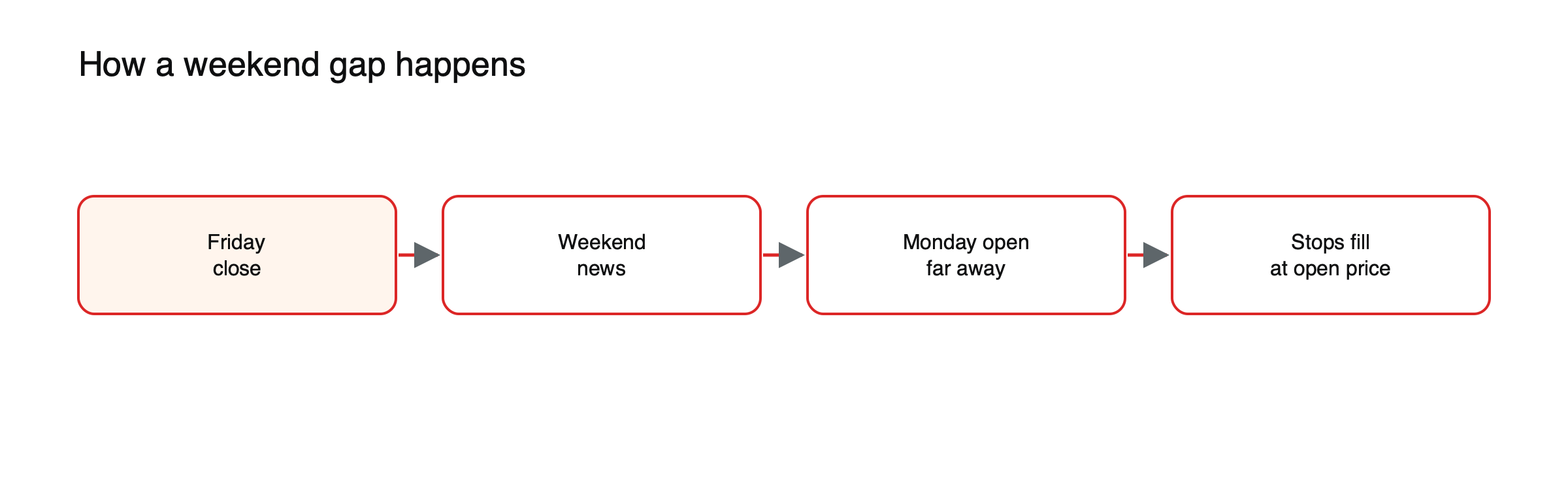
Figure: How weekend news turns into a price gap.
A Monday gap, worked through
You hold 3 index CFD contracts worth $10 a point, long from 5,000, with a stop at 4,950. Your planned maximum loss is 3 × $10 × 50 = $1,500. (Example values.) Over the weekend, bad news breaks, and the index opens on Monday at 4,880. The stop triggers at the open and fills near 4,880, so the loss is 3 × $10 × 120 = $3,600, well over twice the plan. If the account had been close to its margin limits, the gap could also have pushed it past the stop-out level before any order was filled.
Which markets gap most
| Market | When gaps usually happen |
|---|---|
| Major currency pairs | At the Sunday evening open, and around surprise central bank moves |
| Share CFDs | Every morning, after overnight news and earnings |
| Index CFDs | At the weekly open and after major overnight events |
| Commodity CFDs | After weekend supply news, such as producer decisions or conflicts |
| Crypto CFDs | Less at weekends, but provider pricing and thin liquidity can cause sudden jumps |
Gaps can help as well as hurt
A gap in your favor works the other way: a take-profit limit order usually fills at the better opening price, and an open position can show a larger gain than expected. The asymmetry is that a stop gives no protection in an adverse gap, while a favorable gap simply adds to a profit, so the risk management focus is on the downside.
Do gaps always fill?
A common saying holds that gaps tend to fill, with the price returning to the previous close. Some do, especially small gaps on low news, but many large gaps caused by real changes in information never close, or take months. Planning a trade on the assumption that a gap will fill is betting on a pattern that often fails when it matters most.
Margin over the weekend
Some providers raise margin requirements on Friday for positions held over the weekend, particularly before major events. That can push an account closer to a margin call before the market even reopens. Checking announcements on Friday, and keeping extra free margin, avoids being forced out at the Monday open. See what margin is in CFD trading.
Planning around known events
Many gaps follow events that are on the calendar: elections, central bank meetings, earnings dates and official data releases. Checking an economic calendar on Friday, and deciding in advance which positions to reduce or close, turns gap risk from a surprise into a choice. Unscheduled shocks will still happen, which is why position size matters even when nothing is planned. Even a simple rule, such as never holding more than half your usual position size over a weekend, removes much of the risk at little cost.
Crypto is different
Crypto trades seven days a week, so it does not gap over weekends in the same way, though thin weekend liquidity can produce sharp moves.
How traders manage gap risk
Reduce position size or close before weekends and major events, use guaranteed stops where offered, and keep extra free margin. See how to size a CFD position using risk per trade and what leverage is in CFD trading.
Overnight gaps in shares
For share CFDs, weekends are only the largest example of a daily pattern. Exchanges close every evening, and earnings reports, analyst changes and company announcements often arrive outside trading hours. A share can open 10% or more away from the previous close on results day, so holding share positions through scheduled earnings carries gap risk similar to a weekend.
A short weekend checklist
- Which open positions would hurt most if the market opened sharply against them?
- Is any major event scheduled before Monday’s open?
- Would the account survive a gap of two or three times the normal daily move?
- Has the provider announced margin changes for the weekend?
- Would a guaranteed stop, a smaller position or closing before Friday’s close be better?
Frequently asked questions
Why did my stop fill far from where I set it on Monday?
Because the market opened below your stop, and a stop becomes a market order once triggered, filling at the first available price. Only guaranteed stops fill at their exact level.
Do currency markets gap at weekends?
They can. Currency trading pauses from Friday evening to Sunday evening in most time zones, and prices can open at a different level if significant news arrives over the weekend.
This article is educational content and does not constitute financial, investment, legal or tax advice. Digital assets are volatile and you may lose the amount you invest.