
What Is an ETF and How Does It Work?
An ETF is a fund holding a basket of assets that trades on an exchange like a share. How ETFs work, why prices track their holdings' value and their costs.
An ETF, or exchange-traded fund, holds a basket of assets, such as the shares in an index, and trades on an exchange like a single share, giving broad exposure in one purchase, usually at low cost. Global ETF assets reached a record $23 trillion in 2026, and Vanguard’s S&P 500 ETF became the first to pass $1 trillion.
How an ETF works
- The fund holds assets according to its rules, such as tracking an index.
- Shares of the fund trade on an exchange throughout the day.
- Creation and redemption: large firms called authorized participants can swap baskets of the underlying assets for new ETF shares, or the reverse. This keeps the ETF’s price close to the value of its holdings.
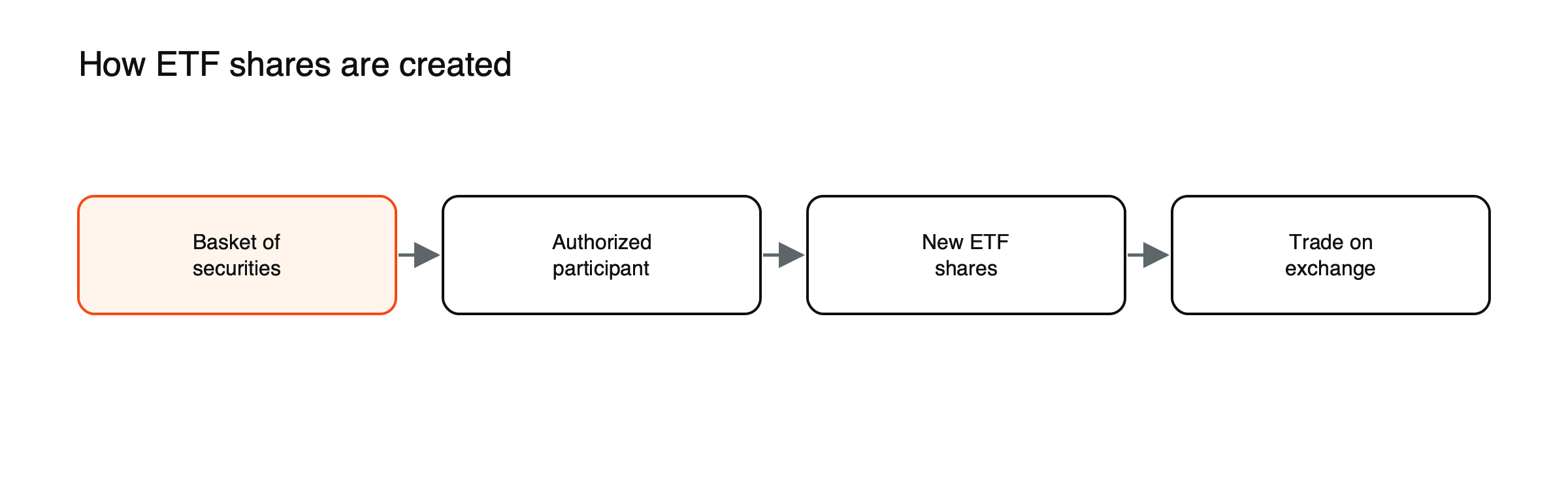
Figure: Creation and redemption keep prices close to NAV.
Creation and redemption, illustrated
Suppose heavy buying pushes an S&P 500 ETF’s share price slightly above the value of the shares it holds. An authorized participant can buy the underlying shares, deliver them to the fund in exchange for new ETF shares and sell those ETF shares at the higher price, earning a small profit. That extra supply pulls the ETF’s price back toward the value of its holdings. If the ETF trades below its value, the process runs in reverse. This arbitrage is why ETF prices usually stay very close to the value of their assets, even though the fund’s shares trade like a stock.
Buying an ETF
Investors buy ETF shares through a brokerage account, as they would any listed share, paying the ask price and any commission. The price moves throughout the trading day with the value of the holdings. Unlike traditional mutual funds, which are bought and sold once a day at a single price, ETFs can be traded at any time the exchange is open, and investors can use limit orders to control the price. See ETFs vs mutual funds.
Why ETFs are popular
- Low costs: S&P 500 ETFs charge as little as 0.03% a year.
- Diversification in a single trade.
- Trading flexibility: buy and sell during market hours.
- Transparency: most publish holdings daily.
What fees cost over time
On $10,000 growing 7% a year before fees, a fund charging 0.03% would leave about $19,616 after ten years, while one charging 1% would leave about $17,908. (Example values.) The difference compounds further over longer periods, which is why investors moved heavily toward the cheapest index ETFs. See how much an ETF’s expense ratio costs over 10 years.
The scale
ETF assets have grown from $6.4 trillion in early 2020 to more than $20 trillion, with more than 80 straight months of net inflows; a few giant index funds hold a large share.
The largest funds
The first US-listed ETF, which tracks the S&P 500, launched in 1993. In 2025, Vanguard’s S&P 500 ETF, which charges 0.03% a year, overtook it as the world’s largest, and in 2026 became the first ETF to pass $1 trillion in assets. Global ETF assets reached a record of about $23 trillion in May 2026, after more than 80 consecutive months of net inflows.
Index and active ETFs
Most ETF assets are in index funds, which follow a published index and charge very low fees. Active ETFs, where managers choose holdings, have grown quickly but usually charge more. Both trade the same way; the difference lies in how holdings are chosen and what that costs.
Types of ETFs
Broad market, sector, thematic, bond, commodity, leveraged and inverse ETFs. See sector ETFs vs broad market ETFs and what inverse ETFs are.
Risks
Market risk of the holdings, tracking differences, and prices drifting from asset value in stressed markets: in March 2020, one bond ETF traded 6.2% below the value of its holdings. See why ETF prices can trade away from their NAV.
Costs beyond the fee
The expense ratio is only part of the cost. Investors also pay the bid-ask spread when buying and selling, any broker commission and the effect of tracking difference, the gap between the fund’s return and its index. For large, liquid ETFs, spreads are tiny; for small or specialized funds, they can be significant. See what tracking difference is in an ETF.
ETFs and CFDs
Some providers offer CFDs on ETFs. See ETF CFDs vs buying ETF shares and what a CFD is.
How ETFs handle income
Some ETFs pay out dividends or interest from their holdings to investors, known as distributing funds; others reinvest it automatically, known as accumulating funds. The choice affects cash flows and, in some countries, tax. See accumulating vs distributing ETFs.
Physical and synthetic
Most ETFs hold the actual assets of their index. Some, known as synthetic ETFs, use swap agreements with banks to deliver the index return, which can help with hard-to-reach markets but adds counterparty risk. See physical vs synthetic ETFs.
Trading an ETF through a CFD, worked through
An ETF CFD gives price exposure without owning the fund’s shares. Suppose a trader buys a CFD on an S&P 500 ETF trading at $500, for 20 shares, a $10,000 position. In the EU, retail leverage on such CFDs is generally limited to 5:1, the same as single shares, so margin is about $2,000. A 3% rise gains about $300; a 3% fall loses about $300. Holding for months adds daily financing, which is usually far more than the ETF’s own fee. (Example values.) CFDs suit short-term trading and hedging; owning shares suits long-term investing. See ETF CFDs vs buying ETF shares.
Choosing an ETF
Investors typically compare what the fund tracks, its expense ratio, tracking difference, size and liquidity, whether it holds assets physically and how it handles income. Reading the factsheet covers most of these points. See how to compare ETFs that track the same index and how to read an ETF factsheet.
A checklist before buying
- What index or strategy does it follow?
- What does it cost, including spread and tracking difference?
- How large and liquid is it?
- Is it physical or synthetic?
- Does it distribute or accumulate income?
ETF prices under stress
In calm markets, arbitrage keeps ETF prices very close to the value of their holdings. In stressed markets, the underlying assets can become hard to trade, and ETF prices can move away from their published value. On March 12, 2020, one bond ETF traded about 6.2% below the value of its holdings, as bond markets seized up. In such moments, the ETF price may reflect where the assets could actually be sold more accurately than stale published values. See why ETF prices can trade away from their NAV.
Bond ETFs
Bond ETFs hold portfolios of government or corporate bonds and pay out interest. They make it easy to buy diversified bond exposure in small amounts, something that is hard to do with individual bonds. Their prices fall when interest rates rise and rise when rates fall, and they never mature, unlike individual bonds, because the fund keeps replacing maturing bonds. See how bonds work.
Commodity ETFs
Some ETFs and similar products hold physical commodities such as gold in vaults; others use futures contracts, which must be rolled as they expire. Futures-based products can lag the spot price of the commodity when rolling costs are high. See what contango and backwardation are.
Leveraged and inverse ETFs
Leveraged ETFs aim to deliver a multiple of an index’s daily return, and inverse ETFs its opposite. Because they reset each day, their returns over weeks or months can differ sharply from the simple multiple of the index’s move, especially in volatile markets. They are designed for short-term trading. See why leveraged ETFs lose value over time.
ETFs versus individual shares
Buying an ETF spreads money across many holdings in one trade, reducing the impact of any single company’s problems, at the cost of a small annual fee. Buying individual shares avoids the fee and allows specific choices, but concentrates risk. Many investors use ETFs as the core of a portfolio and individual shares for specific views.
Taxes in broad terms
How ETFs are taxed depends on the investor’s country, the fund’s domicile and whether it distributes or accumulates income. In some markets, ETFs are known for tax efficiency because creation and redemption in kind allow them to avoid realizing gains inside the fund. Withholding taxes on foreign dividends can also affect returns. Checking local rules, or asking a tax adviser, before choosing between similar funds can make a meaningful difference over time.
Who uses ETFs
Individual investors use ETFs for low-cost diversified portfolios, often through regular monthly purchases. Financial advisers build client portfolios from them. Institutions use them to adjust exposure quickly, park cash or hedge. Traders use the most liquid ETFs, and CFDs on them, for short-term positions.
A simple example of combining ETFs
An investor might combine a global equity ETF with a government bond ETF, for example 60% and 40%, rebalancing once a year. (Illustrative mix, not a recommendation.) The equity fund provides growth, the bond fund stability, and two funds cover thousands of underlying securities at low cost.
A brief history
The first US-listed ETF, tracking the S&P 500, launched in 1993. For years, ETFs were mainly used by professional traders; low costs and the shift toward index investing later made them a core holding for individual investors. By 2026, global ETF assets had grown from about $6.4 trillion in early 2020 to more than $20 trillion. Their growth has been driven by low fees, broad diversification and the ease of buying a whole market in one trade.
Frequently asked questions
Are ETFs safe?
ETFs are a structure, not a guarantee. An ETF holding shares rises and falls with those shares. Diversification reduces the risk of any single company failing, but not market risk.
What is the difference between an ETF and an index?
An index is a list of securities and a calculation; an ETF is a fund that holds assets to follow the index and can be bought and sold.
Can an ETF go bust?
The fund’s assets are held separately from the provider, so investors usually keep their share of the holdings even if the provider runs into trouble, though small funds can be closed and their assets returned.
This article is educational content and does not constitute financial, investment, legal or tax advice. Digital assets are volatile and you may lose the amount you invest.
Sources
- First $1 trillion ETF (global ETF assets $21.9 trillion at end-April 2026 vs $6.4 trillion in early 2020; 83 months of net inflows, per ETFGI) — 21st Century Business Herald, June 2026
- Global ETF assets hit record $23T in May (over $1 trillion of inflows in 2026 by May, per ETFGI) — The Daily Upside, 2026
- Vanguard’s S&P 500 ETF surpasses $1 trillion (first ETF above $1 trillion; inflows over $100 billion in 2025) — Value the Markets, 2026
- VOO surpasses SPY as world’s biggest ETF (VOO 0.03% vs SPY 0.0945%; SPY first US-listed ETF, 1993) — ETF Database, February 2025
- 14 weeks and 12 numbers (a bond ETF traded 6.2% below its NAV on March 12, 2020) — Monevator